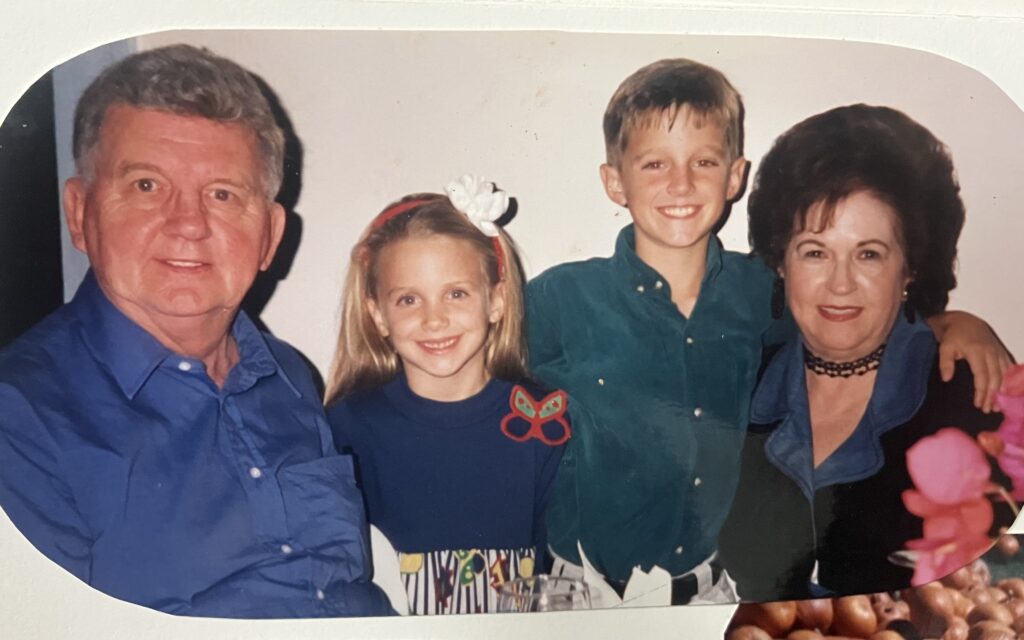
Early on July 17, 2020, Preston Harp’s cellphone rang. It was his sister, Natalie Harp. Come over immediately, she told him. There was an emergency with their dad.
Over several years, Preston had grown estranged from Natalie and their mother. But he had remained close to his father, Bob, a professor at a Christian university, and knew that the social isolation imposed by the coronavirus pandemic had left him despondent.
Days earlier, Preston had stopped by the family’s house in a gated community in Irvine, California, to repay a loan from his father. He found him distraught. Adhering to the household’s pandemic safeguards, Preston remained in his car, but the two shared a quick hug through an open window.
“Listen, I’m not doing okay,” the son recalled his father saying.
Now, after Natalie’s call, Preston Harp expected the worst. Seeing a swarm of police cars outside the home, he said, he smoked two cigarettes to steel himself, then walked inside. His fears were confirmed. Bob had taken his own life.
Preston, who provided an autopsy report and a detailed account to The Washington Post, said his mother and sister preferred to keep the cause of his father’s death private and tell people Bob had died in his sleep. Preston said he recoiled at the secrecy.
“I just said, ‘I’m going to say what the police said,’” Preston said. “He hung himself in the garage.”
That painful disagreement marked the moment Natalie Harp’s family, already strained by conflicting political views, finally broke apart, according to Preston. In the emotional dislocation that followed their father’s suicide, the siblings were pulled to ideological extremes in America’s divisive currents, Preston said. They have not spoken since.
Natalie moved deeper into the MAGA movement, trumpeting Trump’s baseless claims of electoral fraud after his 2020 loss to Joe Biden. A cancer survivor who credits Trump with fast-tracking an experimental drug that she says saved her life, she went from delivering a speech at the 2020 Republican National Convention, just over a month after her father’s death, to a job as an anchor on One America News and then to the White House, where she now serves as one of Trump’s top aides.
“You are all that matters to me,” she wrote to him in a 2023 letter first reported by the New York Times.
Neither Natalie Harp nor her mother, Jill Harp, responded to requests for comment. Extended family members also did not respond to inquiries.
The White House did not contest Preston’s account of the family’s disagreements and estrangement after Bob Hart’s suicide but did not make Natalie Harp available for comment or provide a statement from her.
Since his father’s death, Preston, 38, has been on his own political journey, venturing to the outer reaches of leftist political identity — “radicalized,” he said. He said he came to see the United States as a villain in world history and found himself identifying with socialist Latin American countries that have drawn America’s ire — first Cuba, then Venezuela and Nicaragua, where he moved with barely any belongings in 2023.
He said he is prepared to die violently for the cause of the Sandinistas, the Marxist-influenced revolutionary movement that has dominated Nicaraguan politics for decades under President Daniel Ortega.
“To be a martyr is the most honorable way to die in my opinion,” Preston, who lives a spartan existence under a tin roof in the inland town of Masaya, told The Post in an interview. “Glory to the martyrs!”
His political evolution accelerated after August 2020, Preston said, when he saw his sister delivering her speech at the Republican National Convention.
Bob Harp, Preston said, had endured the strictest of lockdown measures to protect Natalie from the coronavirus after she underwent chemotherapy in 2018 to treat bone cancer. Yet there she was, delivering a political speech on the other side of the country, in South Carolina, railing against socialism, not wearing a mask.
A family fissure over Donald Trump
Preston and Natalie grew up not just as siblings but as friends and classmates, home-schooled by their mother “in the hopes of indoctrinating us with conservative Christian and patriotic values,” he said.
Their relationship suffered its first rupture, Preston said, when he was 15 and Natalie 12. Their mother allowed Preston to join a debate club in San Diego, where he was drawn to a liberal-seeming lecturer who recommended several books, he said.
The most influential, Preston said, was Howard Zinn’s “A People’s History of the United States.” Preston said he read the book, which sought to highlight the darker elements of American history, by flashlight at night to avoid detection by his mother.
“From that day on,” he wrote in a personal essay he shared with The Post and put on Facebook, “I was never the same.”
Over time, Preston renounced traditional Christianity, spurned standard career paths in hopes of making it as a musician, moved out of the family house and spent stretches living out of his car, often crashing at friends’ homes. Natalie, by contrast, Preston said, never rebelled against what he describes as their cloistered upbringing. She lived at home, he said, and didn’t cultivate an outside network as he did.
“I had friends, and I could talk to them,” he said. “My sister didn’t have a peer group.”
Preston said he increasingly struggled to find common ground with her and his mother, but not with his father.
Preston was “taking a different faith path and lifestyle path than Bob,” said a family friend who spoke on the condition of anonymity to discuss intimate details, but “it was important to Bob to maintain a good and open relationship with Preston.”
During their weekly conversations, Preston said, his father often spoke of difficulties at home. His mother and sister were becoming increasingly supportive of Trump and his America First movement, he said. In 2019, Natalie wrote a LinkedIn post in which she credited Trump with saving her life and sharply criticized Biden’s health care policies.
That led to an interview on “Fox & Friends,” then a speech in Washington at the Faith & Freedom Coalition “Road to the Majority” 2019 Conference, where she took the stage beside Trump. An “incredible, unbelievable young woman,” was how Trump described her to the audience. “She lit up the television screen like very few people I’ve ever seen do it.”
Bob Harp, a business professor at Biola University, “was not a fan” of Trump, Preston said, and found his proclamations of Christianity to be a “joke.” According to Preston, his father’s feelings of isolation intensified during the pandemic.
“He was an extrovert, and the isolation of working on computer screens all day was difficult for him,” the family friend said. Natalie, he said, was “fragile and needing isolation from possible infections.”
In July 2020, Preston was still living nearby in Santa Ana when he drove to his family’s home to repay the loan from his father. He said he found him distressed. They shared a few words, and then Preston watched his father disappear back inside.
“He didn’t seem okay,” Preston said. “But I couldn’t do anything.”
“That was the last time I saw my dad.”
The path to ‘radicalization’ in Nicaragua
In the years since, Natalie, 35, has not publicly discussed her father’s suicide at age 61, nor what Preston says is their estrangement.
Preston said the unwillingness to reveal how his father died left him alienated. Bob’s obituary didn’t list a cause of death. The absence of information forced relatives and friends, he said, to choose between two irreconcilable accounts. Some, he said, have accused him of lying, and he has lost contact with most of his relatives.
Around this time, he began seeking counsel from academics he admired.
Among them was Danny Shaw, a critic of U.S. policy who teaches Latin American and Caribbean studies at the City University of New York. Shaw said that Preston told him he wanted to move to Cuba and live beside those he felt had been oppressed by the United States. Shaw recommended Nicaragua instead, and in the summer of 2022, Preston traveled there, relocating to the country the following year.
“I felt my heart open back up again after two years of sadness about my dad,” Preston wrote in his essay. He immersed himself in Sandinista culture. He felt at home among those who professed, as he did, that the U.S. was a villain.
In September 2025, Preston fractured his skull and broke his collarbone and two ribs in a motorcycle accident. He said Nicaragua’s socialized medical system saved his life and provided rehabilitative care — free.
“What would have happened in the U.S.?” said Preston, who was uninsured. “Drowned in debt for the rest of your life.”
The experience completed his conversion. Online, he flaunted his tattoo of a Sandinista revolutionary hoisting a rifle into the sky. He decorated his small concrete dwelling in Sandinista propaganda materials. He dismissed any criticism of Ortega’s actions — closing opposition news outlets, jailing opponents, eroding the separation of powers — as recycled U.S. rhetoric.
“He’s now a sincere sympathizer,” Sandinista broadcaster Mario Zuniga said of Preston.
Preston said he has continued to watch his sister from afar and is dismayed by her proximity to Trump and loyalty to him.
“I haven’t been myself, dwelling on the past, and the pain of losing my Dad,” Natalie wrote to Trump in a 2023 letter, obtained by author Michael Wolff and authenticated by The Post. “I don’t ever want to let you down. Thank you for being my Guardian and Protector in this Life.”
When Preston tells his Nicaraguan friends that his sister is a close aide to the man presiding over the remilitarization of U.S. foreign policy in Latin America, many are stunned, he said, unable to fathom how two siblings had fastened themselves to such different politics.
In Trump, Preston said, Natalie found a new father figure.
And in Nicaragua, Preston said, he found a new family.
Isaac Arnsdorf contributed to this report. If you or someone you know needs help, visit 988lifeline.org or call or text the Suicide & Crisis Lifeline at 988.
The post How Trump aide Natalie Harp’s family broke apart — and polarized appeared first on Washington Post.