Head lice (Pediculus humanus capitis) are parasites that primarily infest children in child care, preschool or elementary school. Having lice doesn’t indicate poor hygiene, despite a long-standing misconception driven by stigma, and lice don’t spread other diseases. But children with lice are often shamed and unnecessarily excluded from attending school.
As a primary care pediatrician with specialized training in infections and infestations of microbes, viruses and tiny pests such as lice, my goal is to keep children healthy so that they can stay in school. And as a mother of two, I personally have experienced the battle against lice with my own children.
Head lice have been humans’ unwanted companions since ancient times. Understanding how they spread, as well as how to detect and treat infestations, can help parents and schools handle head lice effectively without fear.
A head lice primer
Adult head lice are gray-tan insects with six legs, approximately 2 to 3 millimeters long — about the size of a sesame seed. They live exclusively on humans, feeding on blood by biting the scalp and using their saliva to prevent the blood from coagulating.
Female lice lay eggs on hair close to the scalp, attaching the eggs firmly to the hair shaft with a secreted glue-like substance. The eggs take eight to nine days to hatch.
Head lice cannot jump or fly, so they most often spread from person to person through direct head-to-head contact. In school, this might happen when children are sitting very close to each other or napping alongside classmates. Eggs or lice can also be spread when kids share objects such as hats or hair brushes, but this route is much less common because they don’t live long off of the head.
There is no medical evidence that certain types of hair are resistant. Lice can infest all hair types.
Your child might have lice if you see them frequently scratching their scalp. That itchiness is a sensitivity reaction most children develop to lice saliva. It can take four to six weeks for the sensitization to develop in children who have never had lice before — which means your child has probably likely had lice for a few weeks by the time you discover them.
What to do if you think your child has lice
First of all, don’t panic. A head lice infestation can be frustrating or embarrassing, but it’s not dangerous, and there are effective treatments.
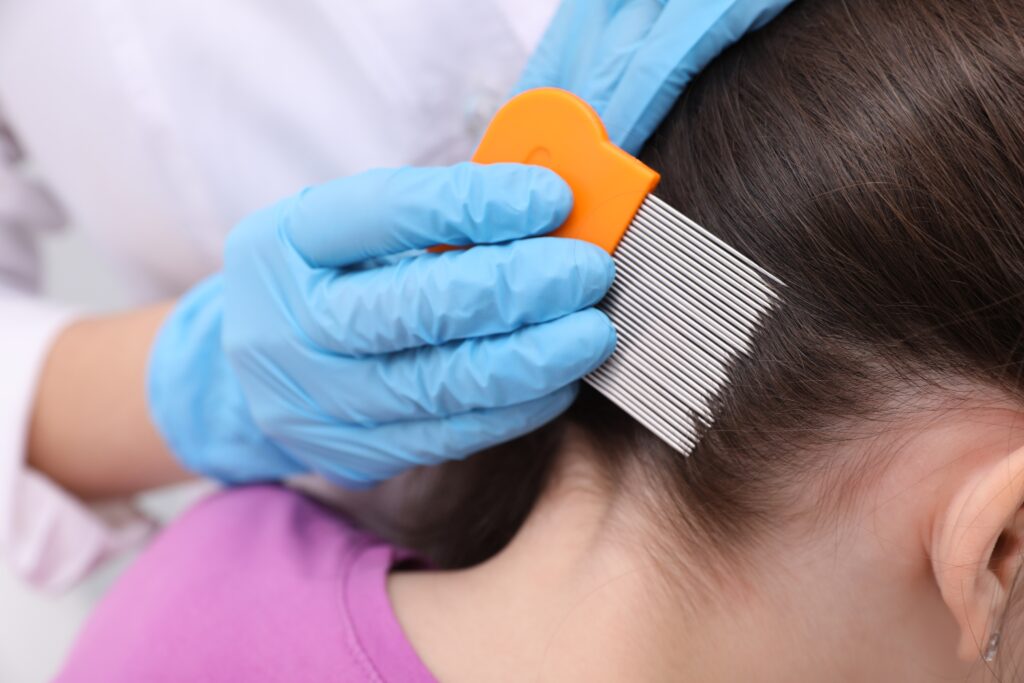
Look closely at your child’s scalp for live lice. They move fast and avoid light, so it might be difficult to find one. Be sure to check for eggs, which are often behind the ears or at the nape of the neck. Eggs are securely attached to hair and not flaky like dandruff.
Once you are sure your child has head lice, check other household members, too. The American Academy of Pediatrics recommends that you treat all household members who have lice, as well as anyone who shares a bed with the child, even if you don’t find lice or eggs on them.
Several treatment options exist that are approved by the Food and Drug Administration, safe for children, available over the counter and affordable:
- 1% permethrin is available as a lotion or a cream rinse and sold under the brand name Nix in the United States as well as in generic forms. It can be used for children 2 months and older. It kills live lice effectively but not eggs, so you’ll need to reapply it in nine to 10 days to kill any lice that may have hatched since the first treatment.
- Pyrethrins + piperonyl butoxide shampoo is sold under the brand name Rid and in generic form. This substance can be used for children 24 months and older. Like 1% permethrin, it generally needs to be reapplied nine to 10 days after first use.
- Ivermectin 0.5% lotion can be used for kids older than 6 months. In addition to killing adult lice, ivermectin continues to kill lice that hatch after treatment, so a single application should do the job.
After the topical treatment, comb the hair with a fine-tooth comb to ensure that no live lice remain. Using a creamy conditioner as you comb can make lice more visible. Since no treatment is 100 percent effective, combing also helps to remove eggs that would later hatch into live lice and would need to be killed with the second treatment. Getting rid of the empty nits isn’t necessary, but it can reduce a child’s embarrassment and parental worry.
What if treatment doesn’t work?
An itchy head after topical treatment may just be a reaction to the treatment itself. Check for live lice or new eggs, which would be sitting within 1 to 2 millimeters of the hair base, rather than empty nits that are whiter and farther along the hair shaft.
Sometimes over-the-counter treatments don’t work fully — either because of user error or reexposure, or because the lice have developed a resistance to them. If you have the resources, lice-removal salons or clinics — available in most urban and suburban areas — can offer professional help. Alternatively, you should be able to get one of these second-line therapies, available by prescription only, from your child’s health care provider.
- Malathion 0.5% lotion is sold as brand-name Ovide or as a generic form and approved for children 6 and older. Because malathion is highly flammable, you cannot expose the treated hair to any heat, even a hair dryer. If you see live lice in seven to nine days, repeat the treatment.
- Spinosad 0.9% suspension is available as the brand-name Natroba or as a generic liquid. You can apply it on children 6 months and older. Repeat the treatment if you see live lice in seven days.
- Ivermectin oral tablets are approved to treat lice in adults, but not in children. However, since oral ivermectin is approved for other parasitic infections in children who weigh at least 33 lbs, doctors can use it to treat lice off-label.
If you would prefer to avoid chemical treatment, you can try manually removing every single louse and using an emollient with dimethicone lotion. However, research on whether this technique is effective is limited. And none of the many alternative remedies for treating lice — such as smothering them with mayonnaise or oil, dehydrating them with saline or hot air, or zapping them with an electronic comb — have proved to be effective.
Lice do not survive more than 48 hours off the head. To kill lice or eggs that have jumped to surfaces, wash all clothing, bedding, head wear and toys that came in contact with the child’s head in the past two days in hot water and dry them on high heat. Vacuum furniture and carpets to remove hair, and place any objects that cannot be washed in plastic bags for two weeks.
What about school attendance?
Beginning in the 1980s, as an effort to contain outbreaks of head lice, many schools in the country adopted “No Nit” policies that excluded children from attendance if any eggs or empty nits were found on the child’s head.
However, many medical experts and public health organizations, including the American Academy of Pediatrics and the Centers for Disease Control and Prevention, reject these policies as unnecessary and ineffective. Keeping children out of school because of lice also contributes to social stigma.
According to current guidelines, if a child has a head lice infestation, they should not be sent home early from school. Instead, the school should notify the parents, and the child should keep attending school as they are being treated. They should avoid close head contact and sharing items such as hats, scarves and hairbrushes.
Some schools continue to check students’ hair for nits after treatment, but this practice is not effective because empty nits without live lice can persist in hair for weeks or even months.
Emily J.C. Wong, MD, is an associate professor of pediatrics at the University of Virginia.
This article was produced in collaboration with The Conversation, a nonprofit news organization.
The post I’m a primary care doctor and a parent. Here’s how I handle lice. appeared first on Washington Post.