Americans like to keep their deaths tucked away and medicalized so we can fool ourselves that the Grim Reaper is rather kind. As long as we do not confront certain brutal realities, we can keep imagining that death looks like the peaceful portrayals in television and movies, where patients apparently suffering from Extreme Paleness murmur loving final words and quietly close their eyes.
Anyone who has spent time in hospitals and nursing homes knows that this is a lie. Death is frequently painful, undignified and pitiful. But we are comfortable ignoring this truth, provided that it happens behind closed doors, in a sanitary fashion.
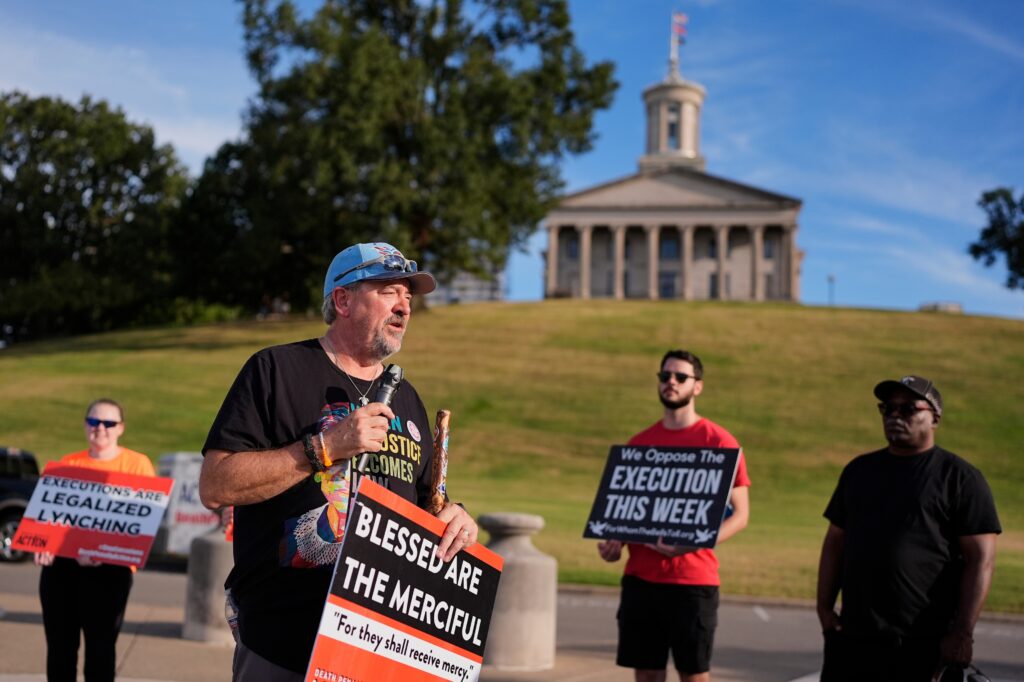
Consider the saga of Christa Pike. On Sept. 30, she was set to become the first woman executed by Tennessee in more than 200 years, but the state botched the execution and sent her to an intensive care unit instead. It is bizarre to think of doctors laboring to revive her, knowing that they might be simply giving the executioner another chance to finish her off. But this is the insane logic of the death penalty as it is practiced in 21st-century America: fine to kill her, but only in the officially appointed manner, with all the procedures followed and the correct forms filled out.
The reaction to the news that Fort Hood shooter Nidal Malik Hasan would be executed by firing squad — with the execution live-streamed — took on an equally surreal tone. The U.N. human rights office proclaimed that this would be “tantamount to a public execution and would breach the absolute prohibition of torture.” U.S. Sen. Chris Murphy (D-Connecticut) called it “disgusting.” It seems disgusting to me for the state to cold-bloodedly kill a person who poses no imminent threat. But once the authorities have decided to do this, I’m not clear on why it’s so much worse to let people watch.
Yes, one could argue that making death a spectator sport degrades both our society and the condemned. But one could also argue that our refusal to confront the reality of executions is what allows them to continue.
For decades, Gallup polling on the death penalty has shown that more Americans support capital punishment than oppose it. Yet we have always been uncomfortable with the actual process. We want to believe that the act itself can be something other than brutal. So we’ve spent over 100 years looking for a kinder method of execution, only for each of the new techniques to also prove gruesome. Lethal injection is no exception. A 2014 Gallup survey reported that 65 percent of Americans considered this the “most humane” method.
Whatever inmates suffer while waiting on death row for the appointed hour, we like to imagine them quietly drifting off to sleep at the last moment. Yet it’s hardly peaceful to be strapped to a gurney in front of witnesses who are there to watch you die. Nor can we always be sure that they don’t suffer physically. Autopsies frequently show fluid on the lungs and other signs that could indicate suffering before death occurs. And that’s when the executions go as planned. An analysis of executions from 1890 to 2010 found that slightly over 7 percent of lethal injections were botched, the highest rate of any method.
As Pike’s case shows, we’re still botching them. Her attorneys say the executioners struggled to get the needle seated in a vein, and the New York Times reported that as the drugs went in, “she described a burning spot in her arm that felt like it was going to burst.” According to her attorneys, when Pike arrived at the hospital, her arms were “swollen, burned and blistered” from the drug.
This is not obviously less barbaric than a firing squad, as Judge Alex Kozinski pointed out in a blistering 2014 dissent in a death penalty appeal. You could argue that the guillotine is the most humane method, with a firing squad a close second. Both are comparatively difficult to botch and mercifully fast, resulting in rapid unconsciousness. We have had those methods available for centuries. Why, then, did we stumble from the electric chair, through the gas chamber and into lethal injection?
Because those methods seemed more gentle. They left the bodies looking intact; they felt less like an act of war. But as Kozinski eloquently argues, judicial killings are inherently “brutal, savage events.” We destroy the body and extinguish the unique universe that exists inside a person’s head. What we are doing is a desecration, even if you think it is merited.
Torn between our desire for vengeance and the uncomfortable reality of what that entails, we have sought to ease our discomfort more than theirs. The prisoner will still, at a minimum, be forced to wait years for an official to declare the hour of their death. Then they have to choose their final meal, march to the execution chamber and face their last breath before an audience. But the illusion of a peaceful lethal injection minimizes our own mental distress about the end that we have collectively willed but are unwilling to face in its full, irreducible brutality.
The post Lethal injection is no kinder than a firing squad appeared first on Washington Post.