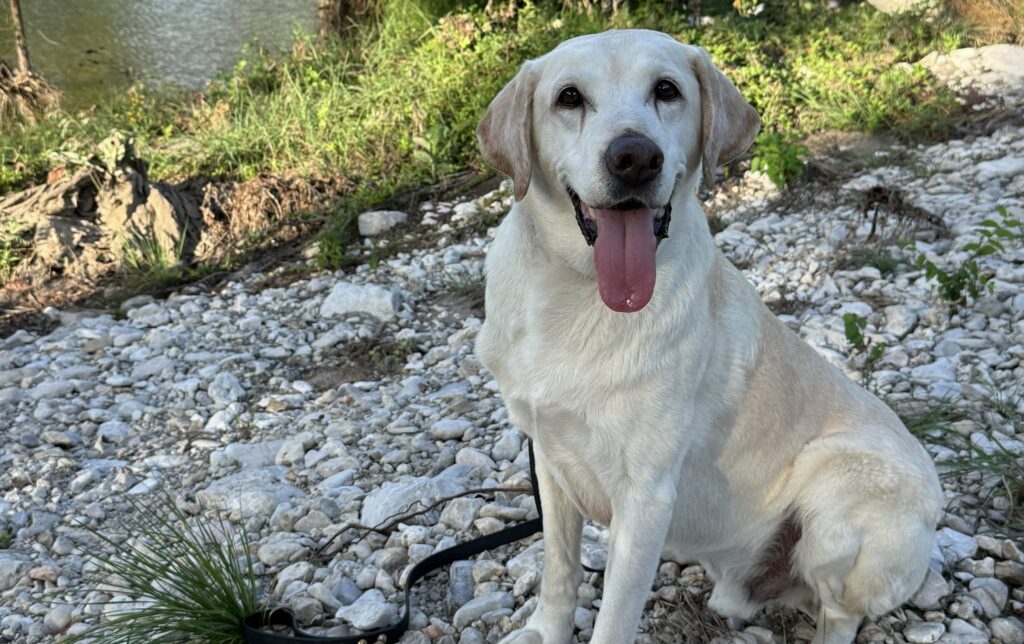
The Labrador retriever puppy at a Mississippi animal shelter had a funny habit: He grabbed anything he could — toys, sticks, rocks — and dropped them in front of employees in hopes they would play fetch with him.
Christy Bormann, a search-and-rescue dog handler in Texas, saw a photo of the frail puppy — who was taken into the shelter as a stray — and something clicked.
“I just knew that he was going to be the next partner for me,” said Bormann, who named the dog Canyon because he enjoyed digging holes.
Over the next two years, Bormann helped Canyon gain weight and turn his love for fetch into the skills necessary to become a working dog. She knew his energy and strong sense of smell would help her as she worked at natural-disaster sites and in missing people investigations.
In recent years, Canyon has assisted in dozens of search-and-rescue operations, including after the 2025 Texas floods, which killed more than 100 people, including children at Camp Mystic. Canyon also assisted after Hurricane Helene in 2024 and the Maui wildfires in 2023.
Bormann carries a stuffed squeaky bunny toy for Canyon, 7, to play fetch with as a reward after a mission.
“He could run through an entire room full of his favorite peanut butter cups, would not even look at them, and is only looking for that target scent,” Bormann, 48, told The Washington Post.
The work is grim — Canyon is trained to find people who have died — but Bormann said his job is critical, allowing authorities to provide answers to grieving families.
The American Society for the Prevention of Cruelty to Animals also recognized the impact of Canyon’s work by honoring him as dog of the year at a luncheon on Thursday, in part for his work after the 2025 Texas floods, when he spent about three months searching along the Guadalupe River near Camp Mystic.
Pauline Boss, professor emeritus of family social science at the University of Minnesota, said dogs like Canyon provide “immense benefit” because people often can’t truly begin the grieving process until they have evidence of their loved one’s death.
“While they don’t know, the stress is exceedingly high,” Boss said. “They can’t grieve because they feel guilty if they should still be alive … but they feel a loss.”
Boss said that if their loved one is found after a natural disaster, even if they are not alive, people are often both sad and relieved “because now they can go ahead with their religious rituals, with their mourning. They can cry without feeling guilty.”
Bormann wasn’t thinking about making that kind of impact when she adopted a German shepherd mix in 2002 who would become her first search-and-rescue dog. The dog, Lady, wanted to play nearly all of the time. Bormann’s roommate told her to find a way to control Lady or find another place to live.
Bormann, who was a research assistant at Texas A&M University, attended a dog obedience class in College Station, Texas, where an instructor told her that Lady’s extreme love for toys might make her a good search-and-rescue dog. Bormann and Lady began volunteering to search for people missing in the wilderness.
Search-and-rescue work eventually became Bormann’s focus, and she’s now the canine training coordinator for Texas A&M Task Force 1, a search-and-rescue team that works with the Federal Emergency Management Agency and the state of Texas.
After another one of her dogs, a Labrador retriever named Cody, died in 2020, Bormann stumbled upon a photo of Canyon, who looked almost identical to Cody. When Bormann adopted Canyon in the fall of 2021, he played fetch with anything Bormann could toss.
“I could pick up a glove and throw it,” Bormann said. “And he would fetch that all day.”
To train Canyon, Bormann walked him on a leash past an object with an odor. After Canyon smelled it, Bormann threw a ball to him. Eventually, Canyon learned to sniff the smell as quickly as possible so he could play fetch. Bormann then hid the object under dirt, sand, concrete slabs and desks for Canyon to search for.
“All he has to do is figure out where,” Bormann said. “And then he gets to play.”
In May 2023, Canyon became certified in searching for missing people and began going out into the field. He has searched for people amid wildfire ash, along steep muddy banks after floods and beneath homes destroyed by tornadoes.
When Canyon detects the scent of a person, he barks to alert Bormann. Bormann informs first responders, who use the information to continue their search.
While searching after a disaster might feel like a game to Canyon, he often reads Bormann’s emotions to know when to stay calm in the field, Bormann said. He does the same with others in disaster zones. Canyon often carries rocks or sticks to people who appear to be upset, Bormann said.
Matt Bershadker, chief executive of the ASPCA, said in a statement to The Post that “Canyon embodies the incredible potential in every animal.”
“His journey is a powerful reminder that animals should never be judged by their past but by their potential,” Bershadker said, “and that with the right care and opportunity, they can go on to do extraordinary things.”
When he’s not working, Canyon enjoys jumping over the back of the couch to cuddle with Bormann and wrestling with her other search-and-rescue dog, Connor, a 5-year-old Labrador retriever.
Bormann’s dogs typically retire around age 9, when their energy begins to taper off. While Bormann trains her dogs to be disciplined — walking alongside her, stopping on her command and sleeping away from her bedroom — they get more privileges after retiring.
“When he’s retired,” Bormann said about Canyon, “he will get to sleep in bed full-time.”
The post Once a frail shelter pup, this search-and-rescue dog now works disaster zones appeared first on Washington Post.