VOICE OF A CENTURY: The Life and Artistry of Marian Anderson, by Anthony Tommasini
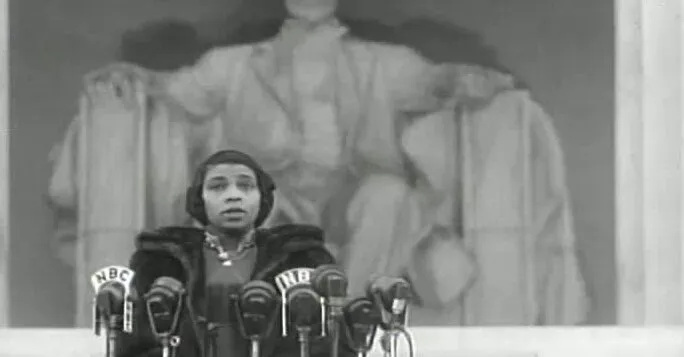
At her filmed 1939 Easter Sunday performance on the steps of the Lincoln Memorial, Marian Anderson earned the title of Anthony Tommasini’s new biography, “Voice of a Century.” Her cello-toned contralto, though not large, had an effortless majesty; it was plush, earthy and sweet. Yet Anderson was no diva; her singing of art songs and spirituals was internalized, not flung to the heavens. Eyes often closed, she lavished concentration upon the text, which she treated as sacred.
That concert became a watershed of the young civil rights movement. The Daughters of the American Revolution, a white civic group, had blocked Anderson’s scheduled appearance at Constitution Hall, then the largest concert hall in Washington, a legally segregated town. (They would later bar Paul Robeson.) President Franklin D. Roosevelt and the first lady, Eleanor Roosevelt, helped move Anderson’s recital to the Lincoln Memorial. The audience stretched out as far as the eye could see.
She went on to cross almost every racial divide in her chosen field. But like Ethel Waters, who had broken similar ground on Broadway, Anderson preferred to incite change through excellence, not banner-waving or the fiery outcries that many activists demanded. However angry Anderson may have felt about the hotels that had turned her away, the segregated concert-hall seating she fought and the sometimes condescending reviews, one of them titled “The Negro Singer With the White Soul,” she rose above every slight with supreme dignity. In her 1956 autobiography, “My Lord, What a Morning,” she said: “My mission is to leave behind me the kind of impression that will make it easier for those who follow.” Countless singers, notably Leontyne Price, walked through the door she had opened.
Tommasini, the former longtime chief classical music critic of The New York Times and the author of “Virgil Thomson: Composer on the Aisle” and “The Indispensable Composers: A Personal Guide,” gives this great American saga a sympathetic and astute telling. He explores the singer’s artistry with as much probing insight as she brought to her songs, while adding all the context her story needs to make the grandeur of her achievements clear.
Anderson had a dogged work ethic, instilled in her by her blue-collar parents. From her family she had learned not to dwell on racial indignities, but to focus on moving forward. The quality of her voice became obvious as she sang in church choirs, but it took the sight of a woman playing piano “ever so beautifully” behind her window to spur Anderson on. “Her skin was dark, like mine,” she wrote in her memoir. “I realized that if she could, I could.” The pain of being shunned by the Philadelphia Musical Academy — “We don’t take colored” — only made her more determined.
Anderson exhaustively studied classical singing; she even went to Europe to master languages and lieder. Whatever prejudice she faced in years ahead was counterbalanced by the support of a string of white champions, notably Sol Hurok, the eminent classical manager who began booking her in prominent halls.
She scored an enviable coup when RCA Victor, one of the biggest record labels in the world, signed her in 1924; her catalog would one day fill a 15-CD set. There and onstage, her way with spirituals was her crowning glory. She sang them with as much nuance as she brought to Schubert and Brahms, while filling them with unshakable strength. Anderson transformed “He’s Got the Whole World in His Hands” from a gospel singalong into a hymn; her hushed reading of its pivotal line, “He’s got everybody in his hands,” said as much about racial unity as any fire-and-brimstone sermon.
Career-wise, she had the same ironclad focus. Not until her mid-40s did she marry; children, she acknowledged ruefully, were out of the question. Anderson didn’t shy from tough choices. In 1934, as her star was rising, she dropped Billy King, the African American accompanist who had stuck by her through her lean years, in favor of a superior Finnish pianist, Kosti Vehanen. King was shattered.
Anderson herself harbored an aching disappointment. “I wanted to sing in opera,” she said. “Concertizing was second choice.” The dream was unrealistic; relatively few operas have contralto roles, and the fact that she had recorded almost none of the available arias did not help her cause. In 1955, Rudolf Bing, general manager of the Metropolitan Opera, broke a color line at the house by casting the 57-year-old Anderson as the fortuneteller Ulrica in Verdi’s “Un Ballo in Maschera.” For all the depth she found in that supporting role, the milestone had come too late: Her pitch had always been flawed, and now it fell painfully flat.
In the remaining decade of her career, vocal perfection mattered less than her huge symbolic importance. As the civil rights movement exploded, Anderson sang at many key events, notably the 1963 March on Washington. That year she received the Presidential Medal of Freedom. Until her death in 1993, Anderson remained a humble, soft-spoken royal. But as this inspiring book proves, nothing outshone the wonders of her art.
VOICE OF A CENTURY: The Life and Artistry of Marian Anderson | By Anthony Tommasini | Penguin Press | 338 pp. | $35
The post She Was No Diva: The Effortless Majesty of Marian Anderson appeared first on New York Times.