What boomer hasn’t heard, repeatedly, how mom and dad walked five miles to school, uphill in freezing rain while fighting off wolves — or some other hair-raising tale of toughness and deprivation?
Then our turn came. Having learned exactly nothing, we told the kids stories from our own legendary childhoods: how we left home after breakfast in patched jeans on a banana bike, armed with 55 cents, and didn’t return until dusk. That allowance goes a long way when you mooch a PB&J at a friend’s house and dine on chips and a Milky Way. There’s even enough left for bubble gum.
Competitive suffering may be one of the few things generations reliably pass down. And in that sense, today’s young adults are building a mammoth bequest. They have excellent material. Housing is outrageously expensive, inflation persistent and health care increasingly unaffordable. There are fewer traditional tickets to the middle class in corporate management or in manufacturing. A.I. is eyeing their future earnings. It’s a compelling tale of economic adversity.
But here’s where my inner boomer — despite my best efforts to keep it quietly occupied with Wordle — starts clearing its throat. Hasn’t every generation faced what seemed like an unprecedented crisis in its 20s and 30s? We boomers — I was born in 1956 — certainly thought so. We came of age with the Vietnam War and the draft dividing the country, gasoline lines and stagflation. The homicide rate in 1980 was more than twice today’s. Hanging over all of us was the reassuring possibility of nuclear annihilation.
Somehow, we still found time to shop for lava lamps. And attend rock concerts, and yes, our music was better — don’t even go there.
Is life so much worse now? Or is every generation just convinced that it drew the short straw while editing out the parts where fortune delivered?
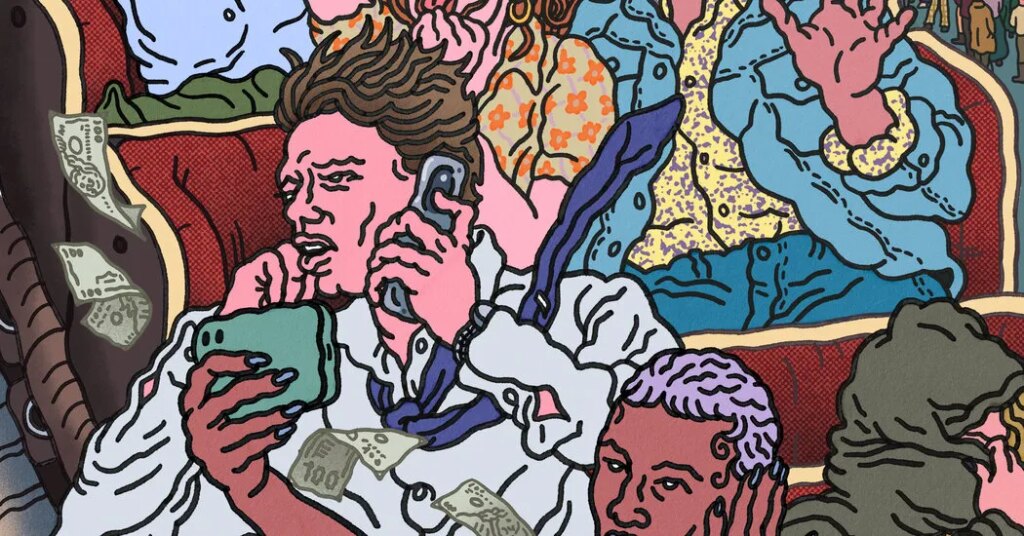
On a recent video call with my 30-something daughter-in-law, something about the scene felt oddly familiar. She was working from home on her laptop while my not-quite-a-toddler grandson sat contentedly nearby with his toys under her distracted supervision. Suddenly, I remembered a photo I snapped in 1995, with a film camera. There was my wife, Kim, about the same age, in her windowless home office, cutting deals using a cellphone with an antenna affixed, surrounded by a fax machine and file folders and a desktop computer the size of an Oldsmobile — all while balancing our youngest on her lap.
Different century, same chaos.
These like images tell me that maybe some of this is less a modern phenomenon than a life stage. The technology changes. The financial angst and vague sense that everyone else has figured out adulthood do not.
None of which means today’s young adults are imagining their predicament. Timing matters. Research has found that graduating into a severe recession such as 2007-9 can depress earnings for at least a decade compared with those of people who graduate during periods of prosperity.
Homeownership is traditionally the first rung on the wealth ladder, and it has been yanked up as higher prices, and now interest rates, have outrun young adult incomes. In 1985, the median new home cost 4.6 times the median annual earnings of a full-time worker aged 25 to 34. In 2025, it was seven times. Many young adults carry substantial student debt and face punishing costs for health care and child care, making the financial burden even greater. Career paths can feel less secure.
But — and I can practically hear myself aging as I type this — for most people, their 20s and 30s have never been the gravy years. They’re the years when expenses tend to arrive before income does, careers wobble, babies appear, and many of the older people you know seem to have had it made for decades.
The question isn’t whether young adults today have it hard. It’s whether they have it uniquely hard, or whether every generation, looking sideways at its parents instead of backward at what those parents endured at the same age, concludes that the game has been rigged against it.
Boomers made the same miscalculation. We compared ourselves with what our parents had achieved, not with what they had endured. For many of them, the included both the Great Depression and World War II. Stagflation seems less arduous a challenge in that company.
Nobody builds a hardship story around his or her advantages. Young people today have plenty. Boomers thought that color television and digital phones — freedom from rotary dialing — were technological leaps. Today my watch can take a call, measure my heart rate, give me directions and remind me I’m still 1,247 steps shy of my goal.
Cars are safer. Investing is easier. Education and training are available online. Remote work has opened the world to at-home job seekers. Try job hunting without Google, LinkedIn or Zoom. I had to scan newspaper want ads, print resumes on expensive paper, mail them into the void and wait for the phone to ring.
The phone was attached to the wall.
On the other hand, when we left the office, the office generally stayed there. Call that one a draw.
So, the message isn’t that young people should quit complaining. That would be both unfair and, coming from a boomer, almost self-parody. The message is simpler: Hardship and opportunity tend to arrive in the same package. We’re just better at noticing the hardship than, say, the largest intergenerational wealth transfer in American history tagged for millennials — if mom and dad don’t spend it all on home whole-body cryotherapy chambers and a personal longevity concierge.
The kids are all right. I have a few of my own. Some are pushing 40, so perhaps it’s time I stopped calling them kids. They’ll figure it out — not because the hurdles aren’t real, but because that’s what generations do. They complain, adapt, take some things for granted and eventually become the people with households full of stuff telling younger people how difficult everything used to be.
Will this familiar progression finally fail? I don’t think so. But the fixes won’t be easy. Defeating stagflation in the early 1980s was painful. The Federal Reserve under Paul Volcker drove short-term interest rates as high as 19 percent — my first mortgage was double-digit — helping set off two brutal recessions that claimed a lot of boomer jobs. It worked, though.
Today’s scourge is affordability, most visibly in housing. There will be no Volcker-like fix. We need at least a million more homes by some estimates, whatever the interest rate. That will require states, cities and towns — perhaps pushed by young voters — to make housing easier to build. The politics will be messy, the progress uneven. But eventually we will adapt, as generations do. Housing may reclaim its former role as an accessible wealth builder.
And then, as always, the hard years will start to glow. The cramped apartment becomes our first little place. The awful job becomes the place where I learned everything. The scramble to balance work, babies and bills becomes a season of being young, busy, useful and fully engaged — the very things older people miss most.
I can hear millennials in the future, right now. “You have no idea what life was like before A.I. We had to Google things ourselves. Cars had steering wheels. We had to stop texting and drive.”
Dan Kadlec writes Aging Without a License, a Substack newsletter about the lighter side of living, loving and loss.
The Times is committed to publishing a diversity of letters to the editor. We’d like to hear what you think about this or any of our articles. Here are some tips. And here’s our email: [email protected].
Follow the New York Times Opinion section on Facebook, Instagram, TikTok, Bluesky, WhatsApp and Threads.
The post Think You Have It Bad, Millennials? Join the Club. appeared first on New York Times.