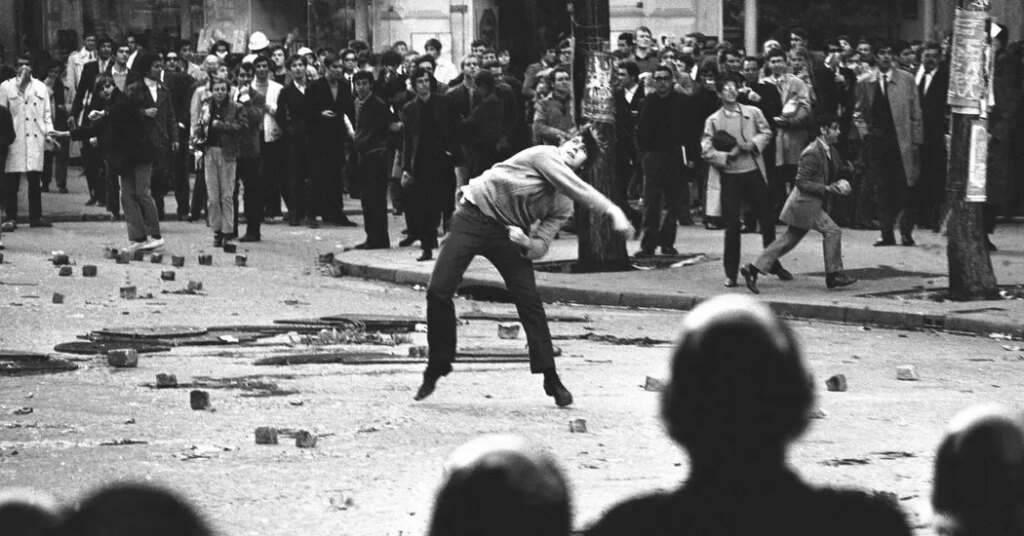
Do you hear the people sing?
On Thursday, thousands of protesters, many of them high schoolers, broke out into the national anthem at Place de la Bastille, where in 1789 a mob stormed a royal prison, touching off the French Revolution.
Protests are so embedded in French political life that “the streets” are considered a fourth branch of government, a last resort when the legislative, executive and judicial are unresponsive, according to David A. Bell, a history professor at Princeton University.
Modern France sprang out of a bloody revolt in 1789, whose symbolism has been invoked in movements ever since, as it was on Thursday. From street revolts throughout the 19th century — including a short-lived one in 1832 that inspired “Les Misérables” — to the Yellow Vest protests that began in 2018, that tradition has thrived.
France also possesses a distinct political culture, said Julian Bourg, a history professor at Boston College. “In contrast to the Anglo-American tradition, which sees the state as some foreign, invasive body threatening individual freedom, in France, there’s a long tradition that the state embodies the people,” he said, and that the state is thus “directly accountable to the people.”
Most importantly, Mr. Bell said, protests are common because of a sense that they work. Demonstrations in the 1930s led to worker protections that are still jealously guarded. And French leaders have offered some concessions in recent protests — though some advocates have dismissed those as a “smoke screen.”
Certain aspects set these protests apart. For the first time in decades, Mr. Bourg said, high school students were the first to act. And historians also note the role of social media in allowing movements to spread like wildfire, as opposed to uprisings from past generations that took longer to ripple out from Paris.
Nevertheless, the demonstrations of recent weeks contain undeniable and instructive echoes of the past. Here are some protests in modern French history that put today’s student movement in context.
The Students (1968)
Twenty-first century demonstrations cannot be understood outside of those that swept across France in 1968, which transformed the country.
“We’re the heirs of May ’68,” proclaimed a banner outside a school last week. That year, protests led by university students spurred millions of workers to strike and nearly toppled the government, inspiring similar student movements abroad.
Mr. Bourg cautioned that, so far, the demonstrations in recent weeks have been more tightly focused and not as ideologically potent as those that roiled France nearly 60 years ago, fueled at first by radical, anti-establishment politics.
“That said, each major French protest movement does raise the possibility that the demands of a specific cohort may lead to more generalized protest and a broader political crisis,” he said. “That is the echo of 1968.”
Teachers, parents, university students and union leaders have rallied their support behind student demonstrators demanding better conditions and more teachers in high schools.
The Suburbs (2005)
France faced a three-week convulsion across hundreds of suburbs and towns in 2005 after two teenagers, Zyed Benna and Bouna Traoré, were electrocuted while hiding from police in an electrical substation.
Fiery clashes between protesters and the police arose amid long-simmering tensions over youth unemployment and accusations of police brutality, especially against low-income people and people of color in high-rise banlieues, or suburbs, of Paris and other cities.
Many of those tensions remain unresolved. The police killing of a teenage boy in 2023 set off mass protests, after which thousands of minors were arrested.
Though current protests have focused on demands for education reform, much of the anger stems from an enduring sense among young people that political leaders are not sufficiently invested in their futures.
The Yellow Vests (2018-20)
In 2018, the “Yellow Vest” protests — spurred by an increase in the gasoline tax and named for the roadside safety vests worn by the demonstrators — emerged as a spontaneous outcry over declining living standards.
The demonstrations flared late in 2018 and continued with periodic surges into 2020. Protesters broke into government buildings, the police fired rubber bullets and tear gas, and several people died in traffic incidents related to the demonstrations.
Mr. Bourg said there was not a clear partisan valence for the yellow vests, though the decentralized populist movement directed its anger against the economic policies of President Emmanuel Macron, whose final term will end early next year. And like current protests, Mr. Bell said, the yellow vest movement began with a focus on a singular issue. But it evolved to express frustrations over broader austerity measures.
The Older Workers (2023)
Mr. Macron also sparked outrage in 2023 when he proposed raising the legal retirement age to 64 from 62.
The outcry that followed drove more than a million people into the streets in some cases. Workers in disparate industries and across the political spectrum demonstrated against the proposed changes, which the government insisted were necessary steps to help address a budget crisis.
Mr. Macron used a rare procedure to push the new retirement age into law without a vote of the Parliament, reinforcing his image as an imperious leader.
Last year, after prolonged political turbulence, Prime Minister Sébastien Lecornu stunned the country by offering to pause the change until after the next presidential election, in 2027.
The post France’s Long, Fervent History of Protest appeared first on New York Times.