Three years after the Oct. 7 attacks in southern Israel, one of the clearest shifts in the way news organizations cover Gaza has happened largely behind the scenes: Reporters and editors have had to become increasingly explicit about not only what they know, but how they know it.
The conflict created a striking contradiction for newsrooms. Images and video from Gaza could travel around the world within minutes, giving journalists an enormous amount of potential evidence to examine. At the same time, Israel’s restrictions on independent foreign press access meant many international reporters could not use one of the oldest tools for verifying a story: seeing it for themselves.
That tension has made verification, attribution and open-source reporting more central to daily newsgathering. Techniques including geolocation, satellite imagery and video analysis existed long before Oct. 7, 2023, but Gaza has stress-tested them on an unusual scale, forcing newsrooms to verify material from a place most foreign reporters still cannot independently enter.
The shift has changed more than what tools reporters use. It has also changed how stories are written and presented, with news organizations putting more emphasis on what they can independently confirm, where information came from and what remains uncertain. In an information environment where false or manipulated material can spread before reporters have time to verify it, those distinctions can shape how accurately audiences understand events unfolding on the ground.
That pressure has pushed newsrooms to lean more heavily on technology and verification techniques. For example, CNN’s process for authenticating third-party material includes geolocation, reverse-image searches and chrono-location, along with checks for AI manipulation and analysis of satellite and aerial imagery.
Caroline Paterson, CNN’s vice president of international newsgathering, illuminated the challenge.
“The lack of access to Gaza has certainly meant that those techniques took on a greater significance on that story,” Paterson told TheWrap.
She added that the broader shift reflects “the changing nature of modern conflict,” where access is often difficult and material that is unverified, recirculated or manipulated can spread quickly.
Paterson said those techniques were already being developed and used at CNN, drawing on lessons from Ukraine, Sudan and Yemen.
CNN also uses experts to analyze images and video, including identifying objects such as munition fragments when determining responsibility for a strike.
One of the earliest demonstrations of the challenge came just 10 days after the Hamas attack.
After an explosion at Gaza City’s Al-Ahli Arab Hospital on Oct. 17, 2023, Palestinian officials blamed an Israeli airstrike, while Israel denied responsibility and blamed a failed Palestinian rocket launch. The confused early coverage quickly became a case study in the risks of reporting claims that could not yet be independently established.
The New York Times later acknowledged that early versions of its coverage had relied too heavily on claims by Hamas and had not adequately conveyed that those claims could not immediately be verified, according to an editor’s note examining the early coverage.
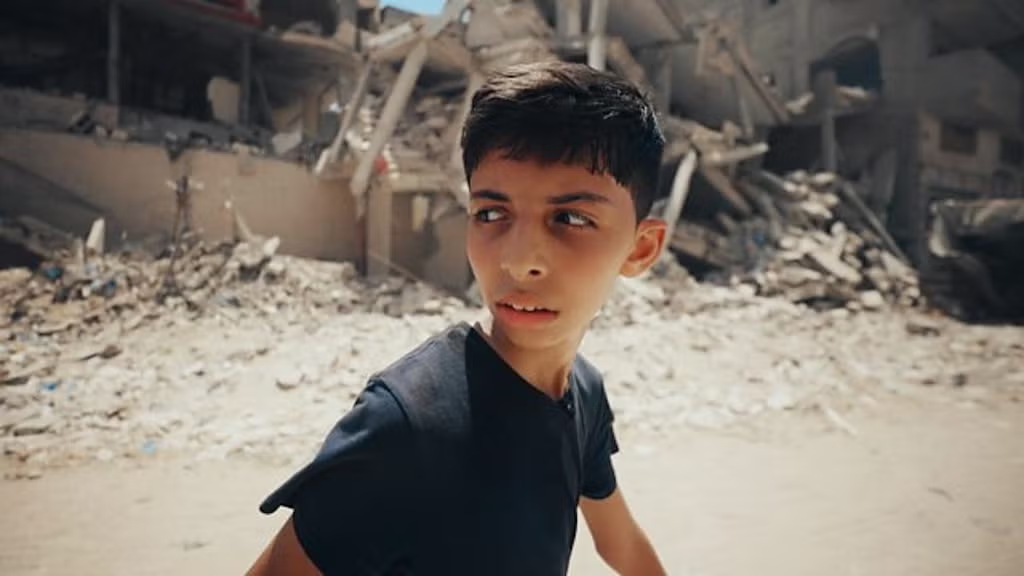
CNN reviewed social-media and broadcast footage, video from a freelance journalist inside Gaza and satellite imagery while consulting military and explosives experts. Its analysis found that the most likely explanation was a rocket launched from Gaza that broke apart in the air, though CNN said a definitive conclusion was impossible without physical evidence from the site.
The BBC had already been building similar capabilities. BBC Verify, launched months before Oct. 7, brought together journalists specializing in open-source intelligence, data analysis, fact-checking and visual verification.
Verification of user-generated content has been part of BBC journalism for more than two decades, according to background information provided to TheWrap. But the rise of AI-generated and manipulated content has added a new layer: BBC Verify journalists now routinely assess material for signs of AI before using it.
That assessment sits alongside more traditional verification methods, including comparing footage from different sources and angles, geolocating images and video and using satellite imagery and flight or ship tracking.
Those techniques become especially important when journalists cannot freely reach the places they are covering. In Gaza, newsrooms may have to scrutinize material emerging through social media while relying on journalists and other sources inside the territory.
The BBC said it is committed to reporting the Israel-Gaza conflict “impartially, and to the highest standards of journalism,” adding that part of its role is to counter misinformation and disinformation.
Restricted access
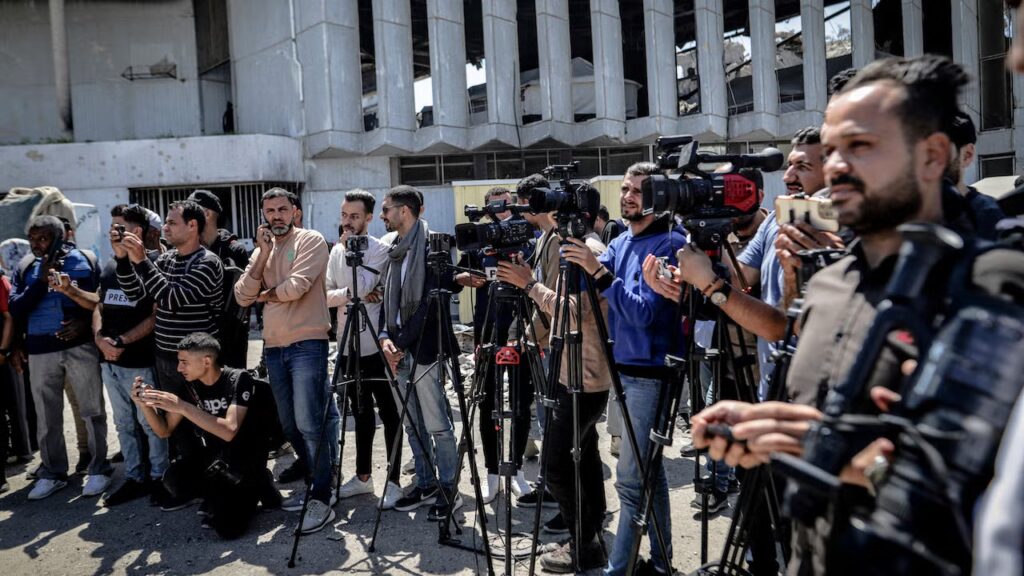
Israel has restricted independent access for foreign journalists since the start of the conflict, while allowing some reporters into Gaza on tightly controlled visits with the Israeli military. Israeli authorities have cited security concerns, including the risk that reporters could expose troop positions, while news organizations have argued that escorted visits cannot replace independent reporting.
In April, leaders from more than two dozen major news organizations — including CNN, BBC News, Reuters, the Associated Press, The New York Times and The Washington Post — called on Israel to allow foreign reporters independent access, arguing that journalists need to be able to question official accounts, speak directly with civilians and witness conditions firsthand.
The restrictions leave international news organizations unusually dependent on Palestinian journalists inside Gaza, footage from witnesses, aid organizations, government claims and material circulating online — making clear sourcing and attribution even more important. The BBC said it has relied on freelance journalists and firsthand testimony from people in the territory.
Reporters increasingly have to tell audiences not just what is being claimed, but what has actually been established: Who is making the claim? Can the location be confirmed? Is the footage current? Does another image or satellite view back it up? And when those questions cannot be answered, how prominently should that uncertainty be disclosed?
The same applies to responsibility for attacks, casualty figures and battlefield developments. News organizations have repeatedly had to distinguish between what Israeli or Palestinian officials say happened and what their own reporters have independently established.
In a fast-moving conflict, that distinction can be the difference between reporting a claim and inadvertently presenting one account as fact.
None of these techniques began with Gaza. Wars in Syria and Ukraine had already forced newsrooms to become more sophisticated about verifying material produced beyond the reach of their own reporters. But Gaza has brought those challenges together: a major international story, an enormous volume of imagery and claims circulating online, and severe restrictions on foreign journalists’ ability to independently see what was happening on the ground.
Three years later, that may be one of the conflict’s clearest legacies for newsrooms. In an era when audiences can see an event before reporters can verify it, the job increasingly isn’t only to tell them what happened. It’s to show them why they should believe it.
The post How Gaza and the Oct. 7 Attacks Changed the Rules of War Reporting | Analysis appeared first on TheWrap.