The human microbiome — the trillions of microbes that live in our guts — was a stable ecosystem for tens of thousands of years before rapidly changing in industrialized countries, raising possible health concerns for modern people, scientists reported on Wednesday.
In a study of Africans and South Americans, researchers identified more than 600 species of bacteria that may once have been common in the gut but are now rare or missing entirely from people in most societies today.
Many of these microbes may have benefited people’s health, said Justin Sonnenburg, a microbiome scientist at Stanford University and an author of the new study, published in Nature.
The changing microbiome, he speculated, may have helped increase some disorders that are common in the industrialized world, from allergies to dementia.
“How bad could this be, the fact that we changed our microbiomes so much?” Dr. Sonnenburg said. “This study, I think, points to the fact that it could be pretty bad.”
Our early apelike ancestors had a microbiome adapted to a diet of raw plants and meat. Its composition shifted hundreds of thousands of years ago when early humans started cooking with fires, scientists suspect.
As humans expanded from Africa about 50,000 years ago, they were still living on the animals they hunted and the wild plants they gathered. It was only about 10,000 years ago that farmers began domesticating crops, precipitating another likely shift in the microbiome.
In recent decades, an even more substantive change took place, as billions of people began eating food rich in sugar and refined grains. And modern medicine also may have had a profound effect: Antibiotics have saved countless lives, but the drugs can also destroy beneficial microbes in the gut.
To chart the history of the human microbiome, Dr. Sonnenburg and his colleagues have studied societies around the world at different levels of industrialization. Some of the most striking results have emerged from the Hadza, a small group of hunter-gatherers in Tanzania.
Studying stool samples from Hadza volunteers, Dr. Sonnenburg and his colleagues found a wide range of bacteria. “There are around 270 species in the average Californian, and around 730 in the average Hadza,” Dr. Sonnenburg said.
Even more striking is the diversity of those species. Many are rare or missing entirely from the United States and other industrialized countries.
Dr. Sonnenburg and his colleagues wondered how similar today’s Hadza microbiome is to the microbes that early hunter-gatherers carried.
They decided to compare the Hadza with other people who continue a similar lifestyle. The scientists began collaborating with anthropologists who study a Bolivian group called the Tsimane.
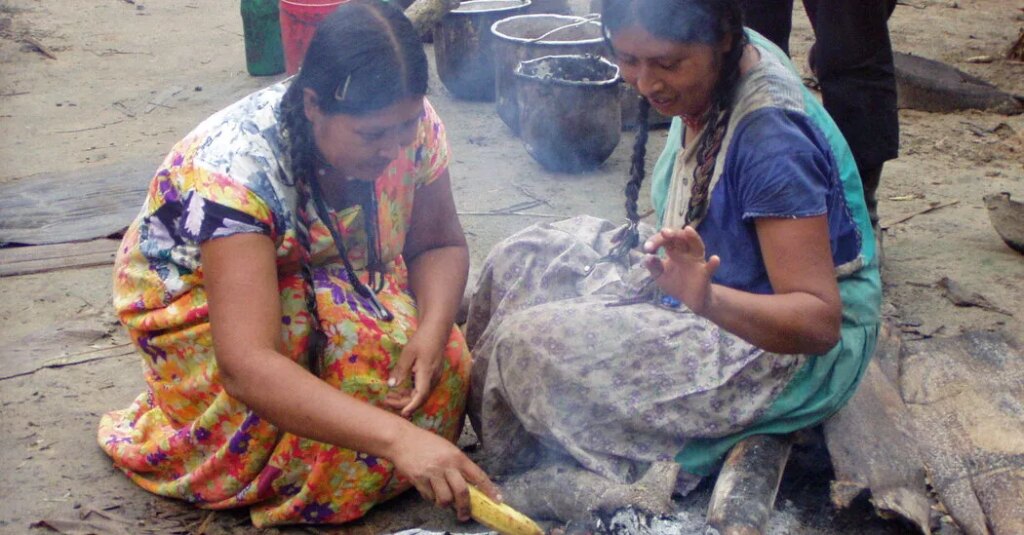
The Tsimane live in remote Amazon villages, where they maintain small farms while continuing to hunt and forage. While the Hadza and Tsimane have somewhat similar cultures, they have very different histories.
The Tsimane descend from people who left Africa 50,000 years ago and crossed to the Americas about 15,000 years ago. The Hadza’s ancestry, on the other hand, is restricted entirely to Africa.
Dr. Sonnenburg and his colleagues used powerful new methods to detect bacterial DNA in stool samples from the Tsimane and compared the findings with those from the Hadza.
The researchers found 848 species that were shared by the two groups but were rare or absent from industrialized countries. They then analyzed 636 species that were especially abundant in the samples.
The scientists found that each species tended to carry distinct mutations, depending on whether they were found in the Hadza or the Tsimane. That pattern suggested to the team that these microbial species inhabited the guts of hunter-gatherers tens of thousands of years ago.
The Hadza continue to carry them today, thanks to their lives as hunter-gatherers. But the ancestors of the Tsimane migrated over the Bering land bridge to the Americas 15,000 years ago, perhaps earlier.
That geographic separation made it impossible for microbes to spread from people in the Old World to the Americas. The hunter-gatherer ancestors of the Tsimane continued to carry some of the same species as their ancestors, but their bacteria gained distinctive mutations over thousands of years.
In all, the findings hint that hunter-gatherers shared a distinctive ecosystem of gut microbes for tens of thousands of years. “Our biology has probably been shaped by these microbes to a large degree,” Dr. Sonnenburg said.
The ancestral bacteria might have been important for training our immune systems, for example, or synthesizing compounds our bodies need. And as some microbes vanished in modern societies, new ones took their place.
That shift may be impacting our health. “You end up with a microbiome that’s very different than what your human genome has come to expect,” perhaps triggering inflammation and other unhealthy changes, Dr. Sonnenburg said.
Michael Gurven, an anthropologist at the University of California, Santa Barbara, and an author of the new study, said that the ancestral microbiome might help explain why the Tsimane appear to be protected from heart disease and other chronic diseases.
But Marie-Claire Arrieta, a microbiome scientist at the University of Alberta who was not involved in the research, cautioned that people in industrialized countries should not try to culture a hunter-gatherer microbiome.
Scientists don’t know much about the 636 gut microbes on Dr. Sonnenburg’s list and the possible harms they might cause. “There’s a lot of infectious potential,” she said.
Instead, Dr. Arrieta favored learning about the helpful things that the ancestral microbes can do in the human body, and finding ways to restore those particular functions.
“The message that we should go back to ancient microbiomes doesn’t make a lot of sense,” Dr. Arrieta said. “But, for sure, they’re important to study to understand some of these microbial functions that have been lost.”
The post Was the Human Gut Healthier in Ancient Times? appeared first on New York Times.