Benjamin Akio Kimitch needed a word that would give him permission to make a dance.
The word he landed on? Fantasy.
This dance references many worlds: Gagaku, the music and arts of Japan’s Imperial Court, and Bugaku, its ancient dance form. And there is also George Balanchine’s take, “Bugaku” (1963).
Allegra Kent, the ballerina who starred in the Balanchine work at New York City Ballet, pops up as well. Kimitch named his dance after her. And then there is his own family’s more ghostly presence, including his grandparents and aunt who were forced to live in a Japanese American internment camp, and — always a lingering muse — his mother who died when he was a teenager.
“I dream about my mom all the time,” Kimitch said. “These people that are no longer in my life can be in my dream, and these histories can be in my dream — and these things that I love, these things make me angry, they can all be together in that space.”
In “Allegra,” performed this week at New York Live Arts, Kimitch, 40, a major talent in contemporary dance, has created his fantasy of a Japanese American court dance fueled by memory and imagination.
Kimitch’s bewitching dances are transcendent experiences in which there is a sense of time being manipulated, of swelling or stretching as details of moving bodies become more delicately pronounced.
His exacting control infuses his dances with a cool clarity as he experiments not just with the art of taking time but in considering how time is experienced in life. It can be mind-bending, dreamlike. “Time moves really fast or it slows down,” he said. “It’s joyful, it’s sad and so when I’m making performance, try as I might, I can’t make something that’s not super personal and kind of tragic. So, yeah, time has to be a character.”
He knew he wanted to make a work around Bugaku, but he knew little about the slow, elegant form. He read all of the books he could find in English and traveled to Japan to study under Fumiya Otonashi, an experimental musician and Gagaku practitioner. He also researched what led Balanchine to make “Bugaku,” a now divisive work, seen by some as cultural appropriation.
In 1958, City Ballet went on tour in Japan. The next year, musicians from the Imperial Palace went on their first tour outside of Japan. It became clear to Kimitch that “Bugaku” was born of a series of intertwined events. It’s not just “this evil Orientalist ballet that should never be performed,” Kimitch said, “and this super ancient art form that not a lot of people know about.”
“No, actually the dancers in the company met the actual practitioners of this art form,” he continued, referring to shared bills in New York in 1959. “There was a real something going on backstage.”
He added his family history to “Allegra,” giving it more — and more labyrinthine — layers. Kimitch performs a solo that he learned from Yasuko Yokoshi in the precise, graceful Nihon-Buyo style of classical Japanese dance. Yokoshi, an experimental choreographer who built a career in New York before moving back to Japan, has been working with Kimitch for several years.
She introduced him to Otonashi, whose teaching he passed on to his four cast members. The dancers learned the same repertoire that he did “as a way to ground us in the form,” Kimitch said. “And then we started sort of deconstructing it” while incorporating “the DNA of Bugaku.”
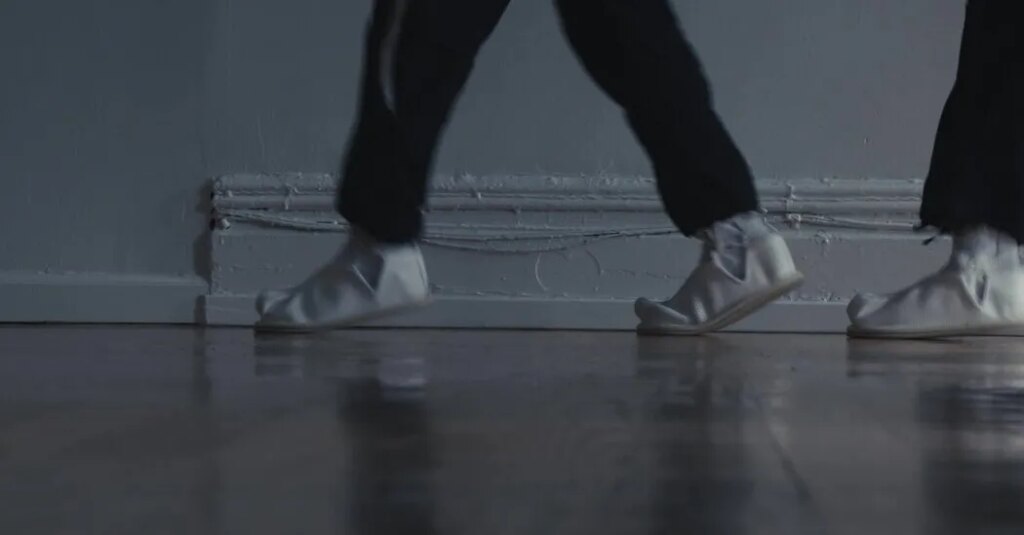
With architectural costumes by Carlos J. Soto, “Allegra” takes place on a 20-by-20 platform, which mirrors the raised stages of Bugaku. The cast wears traditional shoes. “It’s almost like you’re on ice,” Kimitch said. “You start all your weight on one leg, then you shift. And then you stand and then you bring your leg in. Even when we create choreography that is not traditional Bugaku, just by the parameters of the floor and the shoes, it’s forcing us to distill the vocabulary.”
Otonashi taught him that the most important thing about Gagaku “is that you’re creating an enjoyable performance for the gods,” he said. “You don’t want it to be solemn and serious. There’s supposed to be a drive to it. And if it’s too boring and serious, the gods will leave.”
And that relates, perhaps indirectly, to Allegra Kent, his dance’s namesake. Kimitch has been obsessed with her since he watched the film “Dancing for Mr. B: Six Balanchine Ballerinas.” Her vulnerability, he said, “just stuck with me.”
Kimitch interviewed her as part of his process for “Allegra” and told her that he wanted to name his piece after her. “She just so easefully was like, ‘Oh yeah, you know, it’s not even my real name,’” Kimitch said. “‘You can have it.’” (Kent was born Iris Margo Cohen.)
Her personality has informed many of Kimitch’s decisions. “I’m like, Would she like that?” he said. “Would she think that’s funny? Her delight is actually tied to the joy and delight that’s intended of how you perform for the gods. Her spirit is of that ethos.”
The post Dancing for the Gods Requires Delight appeared first on New York Times.