The Dodgers were spiraling.
Their general manager had been fired for racist comments. Their famous manager had loudly lost his touch.
They had not won a full-season championship in more than two decades. They were just a blip on a Los Angeles sports landscape dominated by Showtime.
The Dodgers were plunging into a purgatory of irrelevance from which seemingly nobody could save them.
A sportswriter saved them.
Fred Claire saved them.
The most forgotten hero in Dodger history stepped out of the shadows in 1987 as their instant general manager and created the miraculous monster that came to be in 1988.
Kirk Gibson’s home run? He contrived it. Tommy Lasorda’s Hall of Fame career? He enabled it. The infamous championship Stunt Men? He formed it.
The resuscitation of a Dodger brand during what was quite possibly its darkest moment? It all started with Fred Claire, the longtime Dodger executive who died Monday in his Pasadena home on his 91st birthday.
His quiet presence will forever be missed. His audacious impact should never be forgotten.
Claire was an endlessly kind, disarmingly honest and eternally humble sort whose love for the Dodgers was perhaps best illustrated by the story of his most prized souvenir.
After the Dodgers clinched the 1988 World Series championship in a stunning victory over the heavily favored Oakland A’s, catcher Rick Dempsey approached Claire in the champagne-soaked clubhouse. In Dempsey’s back pocket was the game ball used by Orel Hershiser to strike out Tony Phillips for the game’s final out.
Dempsey handed the ball to Claire in gratitude for the belief shown by the general manager in signing Dempsey and several other journeymen who helped lead the team to the title.
Claire quietly accepted the ball, took it home, put it on a shelf, but several years later realized it was needed elsewhere. At the time, the National Baseball Hall of Fame only had two final-out balls. Once again believing that the Dodgers were more important than himself, he donated his jewel to Cooperstown. The shelf remained empty.
“I just played one role in all this,” Claire told me several years ago. “In getting through our difficult times, I always believed in ‘We.’”
Referring to the Dodgers’ 1987 season as a difficult time was an understatement.
In April, longtime general manager Al Campanis was fired for making racist remarks about Black Americans on the TV show, “Nightline.”
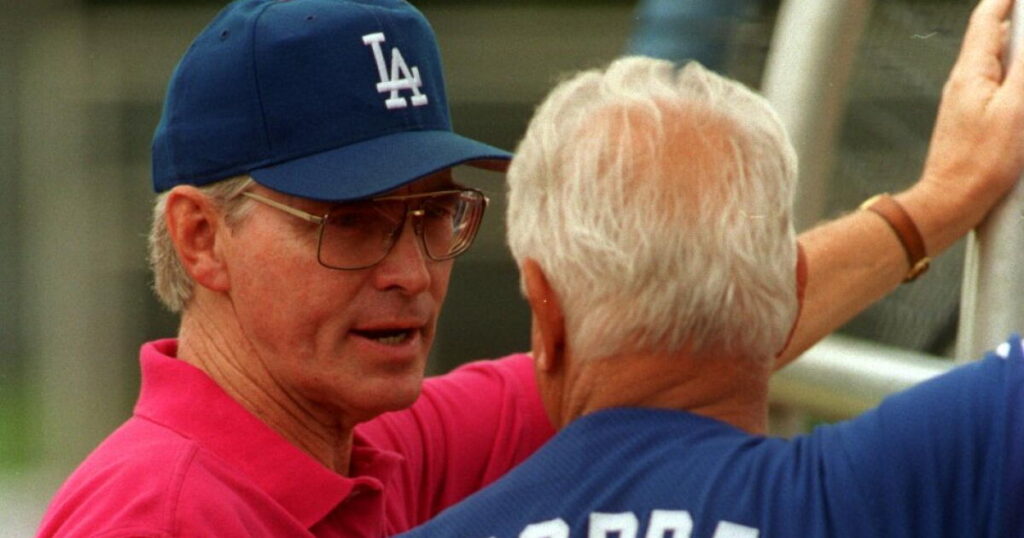
Peter O’Malley, the Dodgers’ president at the time, made the sudden and strange choice to replace Campanis with Claire, the team’s public relations boss who had spent the first 11 years of his career as a sportswriter.
There was much criticism. There was overwhelming disbelief. But instead of apologizing for the promotion, Claire ran with it. One day after taking the job he cut popular pitcher Jerry Reuss and signed unemployed Mickey Hatcher and set the stunt man tone.
”I wanted some fire, and Mickey was the guy who could give us that,” Claire told me. “I don’t know if there were people who doubted me, but I never doubted myself. I knew I had the job for today, and I was going to make the most out of that day.”
He slowly turned a stuffy and entitled team into a lean and scrappy one, and by the time he made the brilliant move of signing free agent Kirk Gibson in January of 1988, the stage had been set.
Nine months later, it was only fitting that Gibson’s famous walk-off homer against Dennis Eckersley of the A’s in the World Series opener scored Mike Davis, who was also signed by Claire.
And the most valuable position player in that series? None other than the guy Claire signed first.
“Fred Claire was amazing,” Hatcher told me. “For a guy who was suddenly put into the limelight, he asked all the right questions, listened to everyone, and believed in all of us.’’
It was this great belief in collaboration that burned Claire in 1993 when he traded seemingly frail pitcher Pedro Martínez for second baseman Delino DeShields on the advice of his medical staff.
Martínez, of course, became a Hall of Famer while Claire became saddled with the stain of one of the worst trades in Dodger history. The perception surely irked a man who was just following organizational advice, but Claire never backed down from his role in the deal.
“The facts have to be the facts, and those facts are, I traded Pedro,” Claire told me.
Another trade ended his Dodger career, as he was fired by the new Fox ownership in 1998 when he publicly announced he had nothing to do with the horrible trade of Mike Piazza to the Florida Marlins.
That was Fred Claire personified, honest to the end, refusing to sacrifice his integrity, never surrendering his dignity.
Because he was too modest for acclaim and too quiet for headlines, Claire essentially disappeared from the Dodgers orbit for nearly two decades after his firing, instead focusing on teaching, consulting, and co-writing an autobiography entitled, “Fred Claire: My 30 Years in Dodger Blue.”
During this time he also became a touchstone for all Dodger alumni, as many former players contacted him daily for advice or help or just to remember the good old days. He never failed to answer a call, never turned down a request, seemingly every former Dodger knew his number and leaned on his goodness.
He was finally honored at Dodger Stadium in the summer of 2017 in an emotional ceremony that was long overdue. By then, he was heavily involved in the last great fight of his life, a battle against cancer that led him to become an important advocate and fund raiser for City of Hope.
In one of his final visits there last month, Claire didn’t focus on his illness, but rather his room number. He was quite proud that it was 4217, because Jackie Robinson was 42. Claire was with Robinson shortly before his death and constantly stressed the connection between the icon and his franchise.
In our final correspondence, on the day before he died, Claire texted me and several others with seven photos.
There were images of him with wife Sheryl, with Lasorda, with Dave Roberts, with several champagne-stained Dodgers in a celebratory clubhouse.
There was also a picture that did not contain him but spoke volumes about his character. It was a simple photo of a plaque bearing the number 42 and accompanied by a quote.
“A life is not important except in the impact it has on other lives.”
Jackie Robinson said it.
Fred Claire lived it.
The post Fred Claire’s quiet impact on the Dodgers should never be forgotten appeared first on Los Angeles Times.