Right-wing candidates in Latin America have won the last seven presidential elections since the start of 2025. Number eight — Brazil — might be weeks away.
The right’s winning streak is a major boost for President Trump’s desire to have ideologically-minded allies to partner with as he seeks to impose greater U.S. control over Latin America.
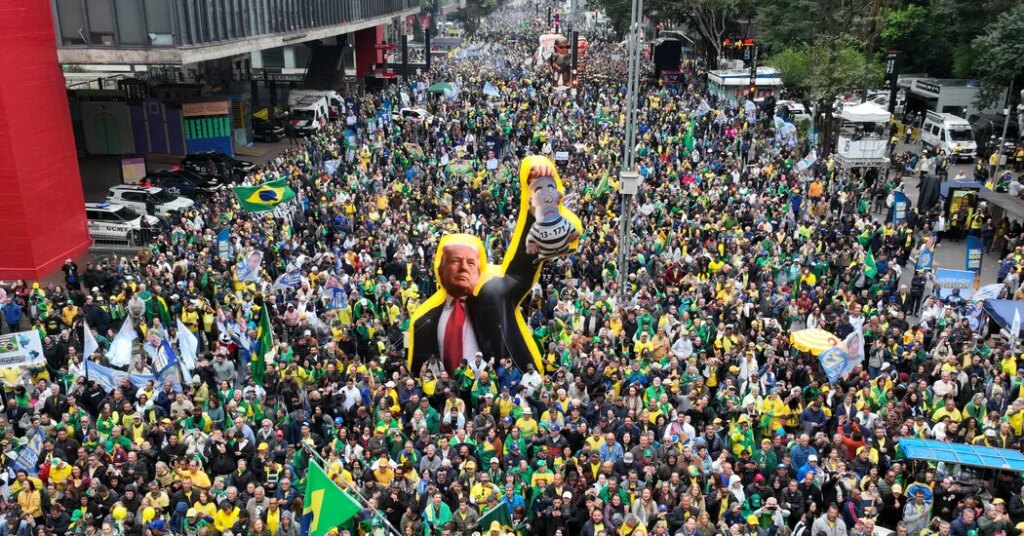
On Sunday, Flávio Bolsonaro, the son of Brazil’s former hard-right president Jair Bolsonaro, received the most votes in the election’s first round, making him a strong favorite for the presidency when he faces off against President Luiz Inácio Lula da Silva later this month.
For the right, Brazil, Latin America’s largest nation and economy, would be the biggest prize.
Brazilians also gave right-wing politicians control of Congress and governorships across the nation, including four new federal lawmakers with the last name Bolsonaro. (They are the former president’s wife, two other sons and brother.)
In a larger context, the results are not that surprising.
Politics in Latin America have long swung back and forth.
Just a few years ago, left-wing candidates were on a winning streak, claiming countries like Brazil and Colombia and giving them control over most of the region.
And a pendulum always swings back. But this lurch to the right in Latin America — in Colombia, Chile, Honduras, Bolivia, Peru, Ecuador and Costa Rica — is coming at a particularly consequential moment.
The Trump administration is bent on exerting new levels of control over the region with tariffs, sanctions, airstrikes, visa revocations, election interventions, an oil blockade on Cuba and the capture of Venezuela’s leader.
It’s President Trump’s more aggressive version of the Monroe Doctrine, the 1823 claim of U.S. primacy in Latin America. And the pairing of Mr. Trump’s policy with the right’s ascendance is creating a fundamental shift in the region, particularly when it comes to security.
The Trump administration has made its top priority in Latin America a new war on drugs. The administration has compared fighting the region’s powerful cartels to the war on terror in the Middle East, and has acted accordingly.
The State Department has labeled 21 criminal groups in Latin America as terrorist organizations. The Pentagon has carried out 71 strikes on boats in the waters around Latin America, killing nearly 240 people it claimed were drug traffickers. (Many legal experts consider the strikes illegal.) And last month, American soldiers joined a police operation in Ecuador against a cartel.
That is the sort of cooperation the Trump administration wants to expand. Eighteen Latin American nations have joined a new U.S.-led coalition against cartels, and at least four of them — Colombia, Guatemala, Honduras and Ecuador — have already agreed to joint military operations with the Pentagon.
Brazil — with its 200 million citizens spread across a country that accounts for roughly half of South America’s size — has been the biggest missing piece. But that will change if Mr. Bolsonaro wins the runoff on Oct. 25.
Mr. Bolsonaro has been an eager Trump supporter for years, as his father was one of Mr. Trump’s top allies during his first administration. Mr. Bolsonaro has already said he would add Brazil to the anti-cartel coalition, called the Shield of the Americas, and work with the United States to fight Brazilian gangs.
He had suggested in social media posts last year that he would welcome U.S. military intervention in Brazil, though he denied that in recent interviews, saying the cooperation would be limited to intelligence. But it was Mr. Bolsonaro who successfully lobbied Mr. Trump to designate two Brazilian gangs as terrorist groups.
It’s not the first time the U.S. and Latin America have tried to fight drug gangs together. But the degree of ideological alignment across the region, as well as the Trump administration’s willingness to intervene militarily, has made this an exceptional moment.
Security experts say the coordination could aid intelligence, especially in tracking criminal financial networks — which have long been a problem for Latin America.
In August, the Pentagon announced a new task force for the Western Hemisphere designed to act as a hub for intelligence and operations among allied countries. And last month, 14 nations followed Washington’s lead and designated various cartels as terrorist organizations.
The largest cartels are effectively multinational corporations, trafficking drugs and laundering money across borders, and so the designations could enable governments to better attack their finances with sanctions.
“You were on your own,” Mr. Trump told his Latin American allies at the United Nations last month. “You’re not on your own anymore.”
At the same time, the Trump administration has signaled that it’s less eager to help leftist governments. That was the case in Colombia before voters there elected Abelardo De La Espriella, a lawyer who has vowed to take an especially hard-line approach to cartels. And as part of a larger diplomatic tiff with Mr. Lula’s leftist government in Brazil, the White House has withheld visas for federal police agents from the country.
Mexico, the other big Latin American democracy still run by a leftist government, has actually expanded its security cooperation with the administration, but the U.S.-Mexico relationship is unique in the region. (Uruguay, whose population is 3.5 million, is the third leftist democracy left in the region.)
There are still questions about whether the counter-cartel coalition can make a difference. Experts say the Pentagon’s boat strikes have hardly slowed the flow of cocaine. And there are few specifics on how countries will actually work together, and what becomes of the effort once Trump is out of power.
There are also questions on what it means for Latin America’s citizens and sovereignty. The imbalance in political, economic and military power between the United States and any one Latin American nation is significant, even with Brazil.
Mr. Trump, for instance, tried to intervene in the criminal case against Mr. Bolsonaro’s father, who faced charges for attempting a coup, by imposing 50 percent tariffs on Brazilian products. That effort failed and Jair Bolsonaro was convicted, but Mr. Lula has warned since that Latin America must retain its ability to govern itself in the face of pressure from Washington.
Mr. Bolsonaro, however, has argued that the threat to sovereignty comes not from Mr. Trump but from the cartels. To fight them in Brazil, Mr. Bolsonaro has promised to learn from Nayib Bukele, the president of El Salvador whose authoritarian tactics has drastically lowered crime rates while also drawing complaints of human rights abuses.
In his nation of six million, Mr. Bukele has locked up tens of thousands of young men with little due process, placing many in what he calls “mega-prisons.” Mr. Bolsonaro, who said he has studied Mr. Bukele’s approach, has proposed building five similar prisons, and has also called for lowering the age of criminal responsibility to 16 and chemically castrating rapists and child abusers.
Latin American leaders have increasingly spoken highly of Mr. Bukele’s approach and the results it has yielded, making El Salvador one of the region’s safest nations. Mr. Bukele, who has called himself the world’s coolest dictator, is also, according to polls, one of the world’s most popular presidents.
The post A Bolsonaro Win Would Nearly Complete Trump’s Latin America Map appeared first on New York Times.