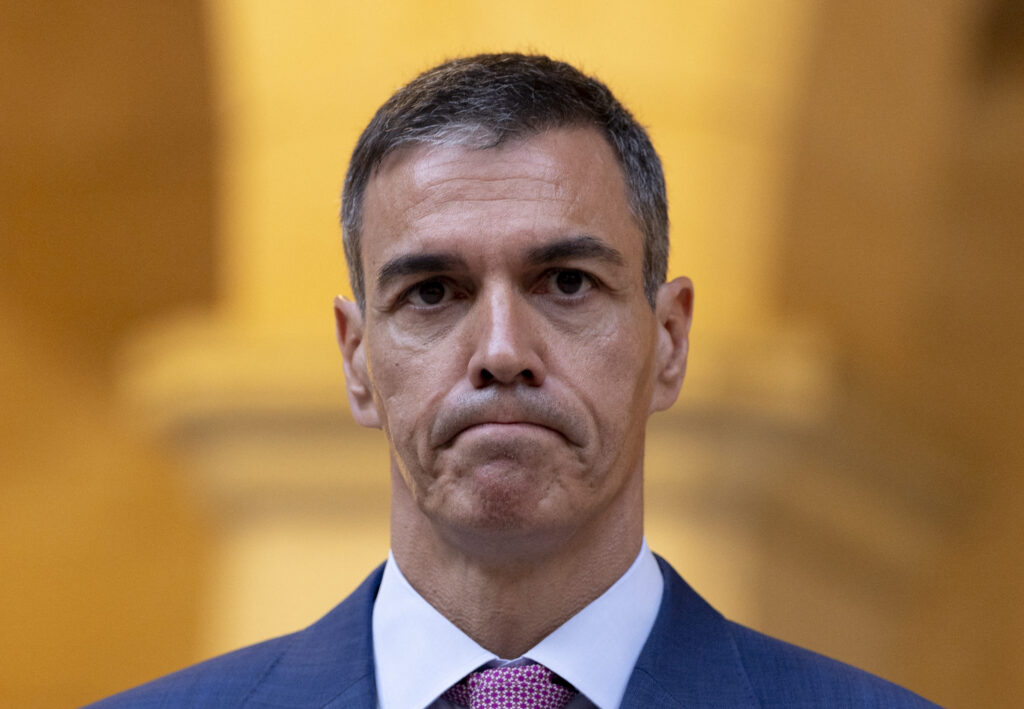
Spanish Prime Minister Pedro Sánchez, perhaps Europe’s foremost critic of President Donald Trump and the continent’s most prominent left-wing leader, called for snap elections on Monday amid growing protests over high housing costs and tenants’ rights.
Pressure has mounted on Sánchez, who leads a left-leaning minority government, after the eviction of an 87-year-old pensioner, Maricarmen Abascal, sparked nationwide protests, with demonstrators camping in Sol square in the center of Madrid.
“To do more, we need the support of the people; we must ensure that parliament grants us a much broader progressive majority,” Sánchez said in an address to the nation, conceding that his government had made mistakes.
Sánchez’s government proposed legislation aimed at providing stronger tenant protections, including safeguards against eviction and rising rents, but the measure failed.
That prompted Sánchez to call for early elections Nov. 29 — a risky proposition given that he has never led his Spanish Socialist Workers’ Party (PSOE) to an outright parliamentary majority.
In his gamble, Sánchez is hoping to reshuffle a deadlocked parliament and gain a stronger hand. Yet polls largely suggest the conservative People’s Party coming in first, though without a governing majority. That would open the door to a coalition with the far-right Vox party.
A defeat for Sánchez could bring down one of Europe’s longest-serving leaders, whose star power has risen among the global left for standing up to Trump.
And it would end of the few left-leaning governments remaining in Europe. Spain, under Sánchez, has stood apart for opposing Trump’s demand that European allies increase military spending, for criticizing the U.S.-led war on Iran, and chastising Israel for its military operation in Gaza and its treatment, more generally, of Palestinians.
At a time of rising global antipathy toward immigrants, Sánchez has led an effort to grant legal status to many migrants in Spain, which has provided an economic boost to Spain.
In the coming months, voters in Spain, France, Italy and Poland will all go to the polls, with far-right parties appearing to make gains.
Sánchez drew Trump’s ire last year when Spain was the only NATO nation to reject Trump’s call to surge defense spending to 5 percent of GDP.
Sánchez then opposed the U.S. decision to attack Iran, banking on Trump’s unpopularity in Europe to become a torchbearer of European pushback against the war. His government refused to grant U.S. military access to Spanish bases for strikes in the Middle East, prompting on-and-off threats from Trump to halt trade with Spain.
Sánchez’s government came under scrutiny after a migrant rush this summer on Ceuta, a Spanish exclave in North Africa, and has repeatedly contended with corruption scandals involving politicians close to him.
On Monday, the People’s Party celebrated the snap election decision with a banner declaring “At last!” on social media.
The prime minister’s opponents have demanded elections for months over the corruption cases that have embroiled his party, including a former transport minister and a party secretary.
Sánchez’s wife, Begoña Gómez, is also under investigation for alleged influence peddling. The prime minister has denied any wrongdoing in his wife’s case and any knowledge of the facts investigated in the other.
Sánchez’s policies on migration have led to clashes not only with Trump, but also at times with some of his E.U. peers.
While many European leaders call for blocking new arrivals, Sanchez approved a decision to grant legal status to nearly 500,000 undocumented migrants, largely from Latin America.
Spain was the only one of 27 nations to oppose an E.U. decision allowing the establishment of deportation hubs in third countries to expel rejected asylum seekers.
Sánchez’s government, one of the few in Europe openly accusing Israel of genocide in Gaza, has also pushed the E.U. to suspend ties with Israeli Prime Minister Benjamin Netanyahu’s government over its devastation of the Palestinian territory.
The Spanish prime minister, in power since 2018, has built a reputation for political resurrection. Defying expectations in 2023, Sánchez managed to remain in power by calling a snap election after his party’s big losses in regional and local elections.
At the time, he made a deal to form a minority government, with support from Catalan parties that support the region’s independence, in exchange for a controversial law that would grant amnesty for an illegal 2017 referendum to break from Spain.
Ellen Francis contributed to this report.
The post Spain’s Pedro Sánchez, main critic of Trump in Europe, calls snap elections appeared first on Washington Post.