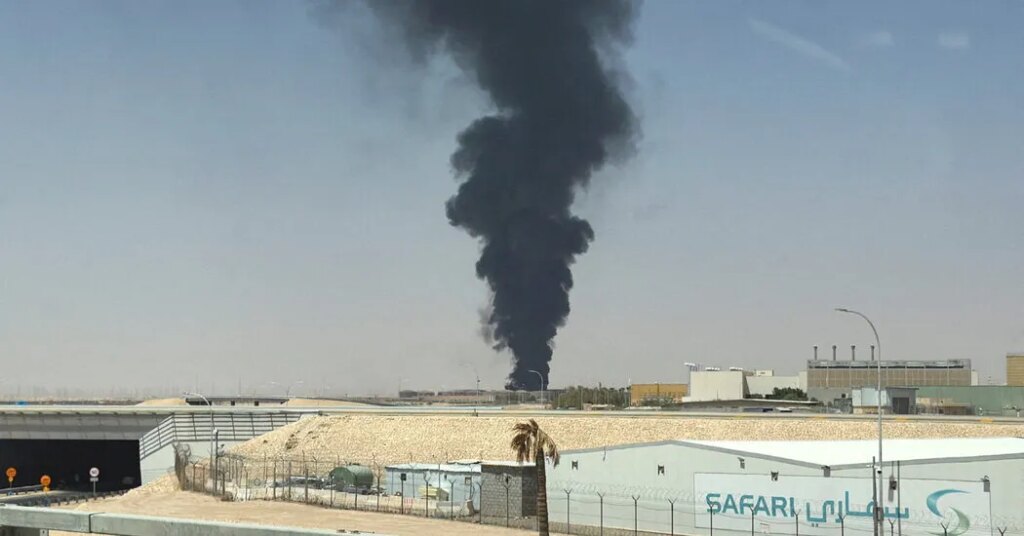
The government of Yemen, backed by Saudi warplanes, launched an offensive on Monday to try to retake the Bab al-Mandab Strait, a day after announcing a major military campaign against the Iranian-backed Houthi militia.
The new campaign has evoked memories of the last time Saudi Arabia intervened against the Houthis in Yemen.
In March 2015, the Saudis launched an air campaign in the country and led a coalition of mostly Sunni Arab states, most notably the United Arab Emirates.
The stated goal was to restore the Yemeni government that the Houthis drove out of the capital, Sanaa, in 2014. But despite years of fighting, that did not happen, and a brutal war helped cause one of the world’s worst humanitarian crises.
In 2022, a fragile truce was agreed and most of the fighting abated. But the agreement began to unravel in July this year, after the Houthis accused Saudi Arabia of bombing the airport in Sanaa. The truce collapsed last month when a sweeping Houthi military offensive took over Yemen’s Red Sea coast.
Here is what happened in 2015 and how it’s connected to the new round of the conflict.
Why Saudi Arabia and the U.A.E. intervened
In March 2015, Saudi Arabia announced the formation of a 10-country military coalition and the launch of a bombing campaign against the Houthis to try to restore the government. But the campaign was effectively a two-country effort, with Saudis and Emiratis doing most of the fighting and committing the most resources.
For Saudi officials, the threat felt existential. Saudi leaders said they feared that a hostile force on their southern border would function as a proxy for Iran, the kingdom’s main regional adversary. Tehran provided the Houthis with weapons and training, but many analysts say its initial role was modest and that the Houthis are a distinct, homegrown movement driven primarily by domestic and regional ambitions.
The war also carried a political dimension: Crown Prince Mohammed bin Salman, Saudi Arabia’s de facto ruler, was 29 at the time and had recently been named defense minister. The intervention in Yemen was his first major act.
The Emirates had its own agenda. Its leaders viewed Islah, the Islamist-leaning party at the heart of the anti-Houthi coalition, with profound distrust. By cultivating proxy forces in Yemen, the Emirates sought control over key maritime commercial hubs along the country’s southern coast, analysts said. These connections included the Southern Transitional Council, an armed political group with ambitions to create an independent state that directly undermined the authority of the Yemeni government it publicly supported.
How the operation went awry
When the Saudi-led coalition recaptured Aden in 2015, that appeared to presage a broader Houthi defeat. But the effort to extend the offensive stalled and the militia fortified its positions near Sanaa, locking front lines in place for years as the Saudi-led air campaign dragged on. Coalition aircraft repeatedly struck civilian infrastructure but were unable to neutralize the Houthis or destroy their weapons stockpiles.
The anti-Houthi alliance also fractured: Rival Yemeni groups opposed each other and growing friction between Saudi Arabia and the Emirates caused problems, too.
An Emirati-led offensive to seize the Red Sea port of Hudaydah in 2018 descended into stalemate. The coalition was eventually forced to pull back under international pressure as Yemen teetered on the brink of famine.
In August 2019, the Southern Transitional Council turned its weapons on its Saudi-backed allies and seized control of Aden, the interim capital of the government that the coalition had sought to restore. The Emirates began drawing down its forces in Yemen, and a power-sharing deal was agreed in November to integrate the separatists into the Saudi-backed government. But instead of unifying the coalition’s factions, this resulted in even deeper splits as each group sought to protect its own interests.
How the war caused a humanitarian crisis
The United Nations has said that the war helped caused one of the world’s worst humanitarian crises, contributing to the deaths of hundreds of thousands of people from violence, hunger and disease.
The coalition was accused of war crimes after airstrikes hit crowded markets, wedding halls, hospitals and funeral gatherings. Houthi forces were accused of indiscriminate artillery shelling, of deploying land mines in populated areas, and of systematically recruiting child soldiers.
The coalition enforced air and maritime blockades around Yemen, maintaining that such measures were vital to intercept Iranian weapons shipments. Hudaydah, which handled about 70 percent of Yemen’s food and medical imports, suffered years of bombings. But humanitarian agencies said the restrictions harmed the civilian population, pushing many toward starvation and helping to cause one of the worst cholera epidemics in modern times.
The high cost for Saudi Arabia
Beyond the billions spent on the war, the military campaign eroded Saudi Arabia’s international reputation and exposed the kingdom to Houthi drone and ballistic missile strikes.
The war also became a political liability for Prince Mohammed, and severely strained relations with Washington. The U.S. Congress repeatedly voted to limit American military aid because of the human toll of the war.
The Houthis have not been defeated. The group still controls Sanaa and much of Yemen’s populous northern highlands and it has become a more formidable military force, equipped with long-range missiles and attack drones.
The post Why Saudi Arabia’s Last War in Yemen Turned Into a Quagmire appeared first on New York Times.