All American children will be automatically enrolled in Trump accounts for investing in the stock market, the Treasury Department announced this week. For parents looking to invest money on behalf of their children, it raises the question: What is the best way to do so?
In addition to Trump accounts (also known as 530As), families have two main options: 529s, which are for college savings, and custodial brokerage accounts, which are standard brokerage accounts in a child’s name (known as UTMA or UGMA accounts).
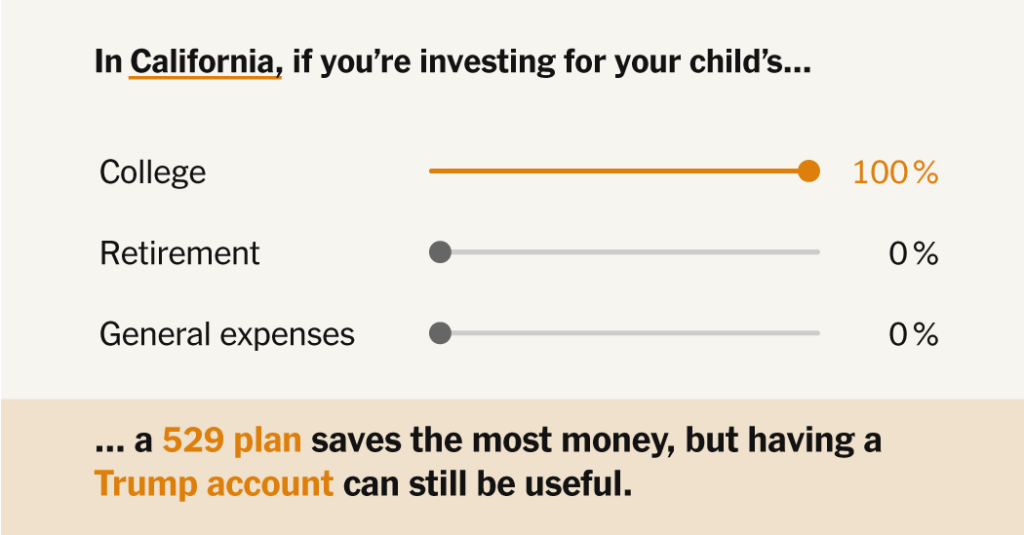
Our calculator can help parents estimate which account would be worth the most when a child turns 18, if they started investing now. You can compare different scenarios here, and learn more about each account below.
In most cases, the differences in total savings aren’t huge, but there are important distinctions, like flexibility in how the money can be used and how it’s taxed. The 529 almost always wins because of the tax benefits for education savings. And a custodial account is more flexible than a Trump account for other savings goals.
But parents should think of a Trump account as a collection cup for any free money available to them, even if they don’t plan to invest their own money in it, advisers said.
Some state governments, nonprofits and philanthropists have already pledged to donate to Trump accounts, and more of these contributions are expected to come now that all children will have accounts. These contributions will be automatically deposited in eligible children’s accounts.
Other contributions, like from parents, family or employers, require an extra step from parents — activating the account online or in the Trump accounts app. At that point, parents of babies born since 2025 will also have the chance to elect the $1,000 seed deposit from the federal government.
Separate from free money in Trump accounts, a family’s choice of primary investment vehicle depends not just on which one is worth the most when a child is 18, but also on the plans for the money, said Joel Dickson, global head of advised strategies at Vanguard.
“The introduction of Trump accounts has in many ways jump-started a broader discussion of how you can save for your children’s future,” he said. “It’s important to understand what the goal is.”
When a 529 wins: college savings
If the money is for education, a 529 is the best choice, advisers said. Families that invest the same amount in a Trump account or a 529 will end up with more in the latter.
That’s because of the tax advantages. Withdrawals for qualified expenses are made tax-free, and investment growth is also untaxed. Most states also offer annual tax deductions or credits for contributions to 529 accounts.
“The 529, because of the tax-free growth, it’s really hard to beat that over the course of time,” said Leighann Miko, founder of Equalis Financial, an advisory firm on the West Coast.
These accounts also have the smallest impact of the three options on students’ financial aid eligibility, advisers said.
There are limits on how the money can be spent, though. Qualified expenses include college tuition, trade schools, associated costs like room and board, up to $10,000 in student loans, and K-12 private school in many states.
Using money for other reasons triggers a 10 percent federal penalty, and income taxes on any growth. Parents are also required to repay state tax savings they received on those investments.
If a child doesn’t use the money for education, though, parents have a few options. Leftover funds can be transferred to another family member, and up to $35,000 can be rolled into a Roth I.R.A. if the 529 account has been open for at least 15 years, provided the child starts earning income and meets other qualifications.
When a Trump account wins: retirement
The money invested in Trump accounts cannot be accessed until Jan. 1 of the year a child turns 18, at which point the account becomes a traditional I.R.A. for retirement. Money in an I.R.A. can be withdrawn without penalty after age 59½.
Though the Trump administration has promoted Trump accounts for use for other reasons once children become adults, those can come with limits. Money can be withdrawn without penalty for higher education, and limited amounts for reasons including the birth of a child, a first home (a maximum of $10,000) or medical expenses. Otherwise, account holders must pay a 10 percent early withdrawal tax.
“To me, Trump accounts are really better framed as a retirement account for these kids,” said Cristina Guglielmetti, a Brooklyn-based financial planner. “As college savings, it’s not the best vehicle.”
No tax is paid on the account as the investments grow. But unlike with 529s, when account holders withdraw the money, they pay ordinary income tax on investment growth and any pretax contributions (from employers, the government or philanthropists). Also in contrast with 529s, contributions from individuals and employers are capped at $5,000 a year (that limit will increase with inflation beginning in 2028).
It’s unclear exactly how Trump accounts will affect financial aid eligibility, financial advisers said, and they are awaiting more guidance from the Trump administration. But for now, once the accounts become I.R.A.s, withdrawals are expected to significantly affect aid eligibility.
When a custodial brokerage account wins: flexibility
If the goal is flexibility, to invest in whichever stocks you want and to spend the money anytime without penalty, a custodial brokerage account is the best fit.
There aren’t annual contribution limits, and once children are adults, there are no restrictions on how they use the money. Parents can also withdraw money earlier as long as it’s for the direct benefit of the child.
Account holders may owe taxes annually, on money they earn in the account from interest or dividends, and anytime they sell stock. Also, at certain ages, they’re subject to the “kiddie tax,” which requires them to pay taxes on interest, dividends and capital gains above $2,700 at their parents’ higher marginal tax rate.
Because they’re owned by the student, these accounts also have significant impact on students’ eligibility for financial aid.
Financial advisers cautioned that because children get control of the money between age 18 and 25, depending on the state, parents lose control over how it’s spent. They might consider investing in their own name, advisers said, and giving it to their children later.
“As a parent, in many ways the best way to grow wealth and provide financial security for your child is to do that for yourself,” Mr. Dickson said.
Methodology
This calculator is meant to compare Trump accounts, 529 education savings plans and custodial brokerage accounts, not to offer financial advice.
Monthly contributions are assumed to be fixed, starting from today until the child turns 18, with all three accounts earning the same annual return. Contributions to a Trump account are limited to $5,000 a year, rising 3 percent annually starting in 2028.
Trump accounts and 529 funds grow tax-deferred. Custodial earnings are taxed as the account grows. The calculator treats 1.7 percent of the balance as dividends each year. Amounts above a $2,700 exemption are taxed at 15 percent, a stand-in for the kiddie tax. The rest of the growth is taxed only when the investments are sold, assumed over four years.
The calculator assumes any non-qualified expenses incur a 10 percent income tax and a 10 percent penalty for the Trump account and 529 plan, regardless of income. A custodial account never incurs a penalty.
State tax benefits are calculated using the entered income, joint filing and the state’s tax brackets. Repayment owed on non-qualified expenses is factored in.
When a child is eligible for free seed money, the calculator always recommends opening a Trump account, even if no additional contributions are added, in addition to whichever account results in the most funds.
This calculator makes several simplifying assumptions. The model doesn’t calculate federal income taxes, state tax on investment income outside the 529 tax break, account fees or finer differences among state 529 rules.
The post Is a Trump Account the Best Way to Invest for Your Child? Try Our Calculator. appeared first on New York Times.