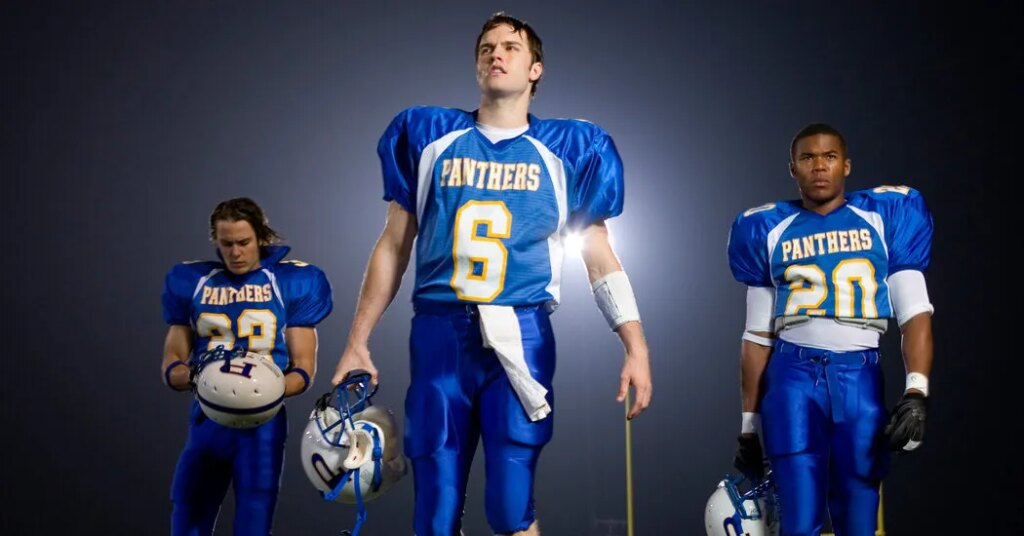
“Friday Night Lights,” the slow-burning masterpiece that premiered on NBC on Oct. 3, 2006, is a show about football. During its five-season run, there were plenty of crunching tackles, perfect spirals and last-second touchdowns by the Dillon Panthers.
But beginning with the first episode, in which Dillon’s star quarterback, Jason Street (Scott Porter), is paralyzed in a freak on-field accident, it is also a carefully observed portrait of a town — and by extension a country — oscillating between glory and despair, communion and chaos. Two decades after its premiere, that vision feels even more relevant.
In interviews, the show’s creator, Peter Berg, and the stars Kyle Chandler, Connie Britton, Taylor Kitsch, Gaius Charles and others looked back on their time in Dillon and the legacy of “Friday Night Lights.” These are edited excerpts from the conversations.
Peter Berg first adapted his cousin Buzz Bissinger’s acclaimed nonfiction book about Texas high school football into a 2004 film. A tragic accident he witnessed while researching the movie inspired him to return to the story a few years later.
PETER BERG (creator) I was filming real football games during the course of making the film. I happened to be at Westlake High School [in Austin] when David Edwards collided with this young Westlake receiver, Coy Aune, and became a quadriplegic. I got to know David quite well, and his mother, Faye, and the Aune family. It brought a diverse group of people together who never would have known each other, and that touched my heart.
I went to Kevin Reilly, who was the head of NBC. I said, “I want to introduce the audience to the all-American superstar, and at the end of the pilot, I’m going to break his neck.” Reilly said, “Are you sure?” I said, “Yes.” If it wasn’t for David Edwards, there would have been no “Friday Night Lights” TV show. [Edwards, who became a motivational speaker, died in 2008.]
COY AUNE The David Edwards thing was something we bonded over. When he decided to write the Jason Street character, I thought it was great.
BUZZ BISSINGER (author, “Friday Night Lights”) I think subconsciously he said, “There’s more to be mined here.”
LINDA LOWY (casting director) Pete wanted to find raw actors. Actors that hadn’t done much, that were game for anything.
TAYLOR KITSCH (Tim Riggins) They wanted me to read for Street. I gravitated toward Riggins.
GAIUS CHARLES (Smash Williams) I started ad-libbing in my audition. I was like, “Hey, Pete, you looking for me, baby!”
KITSCH I brought in a cooler, and I had a few Lone Star beers.
CHARLES If I acted like Smash every day, I would probably get in a lot of trouble.
LOWY The way Pete was directing people also gave me ideas about what I should be looking for, because he made everybody improv. He did things that I had never seen a director do in the room.
BERG I’d make them sing songs and play the characters drunk, play them confused, play them with French accents. I made them all sing the national anthem.
ADRIANNE PALICKI (Tyra Collette) Peter Berg gave me the best acting class of my entire life. He’s like, “Do it like you’re on meth.” I don’t know what that feels like, but OK.
LOUANNE STEPHENS (Grandma Saracen) He threw a pillow like it was a football and told me to catch it and say some stuff.
KITSCH It was “Talk about your father, or lack thereof.” I remember shutting down when my old man was brought up.
LOWY We tested Emma Stone for Aimee Teegarden’s part. [Teegarden played the Taylors’ daughter, Julie.] We all knew she was brilliant. Pete thought she was a little too old at that point to play this 14- or 15-year-old.
Berg wanted more established actors to play the Dillon coach and his wife, Eric and Tami Taylor. He eventually cast Kyle Chandler and Connie Britton, who had played the coach’s wife in the film.
CONNIE BRITTON (Tami Taylor) I was like, No way in hell I’m going to go play the wife on a show about football. That sounds like a terrible idea. Pete kept calling me. He said: “Listen, you have to come do this. This is our chance to give these women from this town a voice.”
KYLE CHANDLER (Eric Taylor) I was doing an episode of “Grey’s Anatomy.” Shonda Rhimes called me to her office one day. She said: “I want you to go next door. There’s someone who wants to meet up with you.”
LOWY Pete said to me: “Linda, cancel Kyle Chandler, I don’t want to see him.”
PALICKI Pete wanted Dwight Yoakam to play Kyle Chandler’s role.
LOWY I said: “Pete, I am not canceling Kyle Chandler. As an actor, you’ve got to understand that you don’t do that. He wasn’t coming in to read; he’s coming in to meet. You’ll meet him for five minutes.” Pete was like, “I love it when you get mad.”
BERG I thought he was too clean-cut. And then I met him after he had been on a bachelor party drinking binge. I’m like, That looks good.
CHANDLER I’d been up late smoking cigars with the guys.
BRITTON I very reluctantly agreed to do the show, and I cried that day. I said, “Why can’t I want more for myself than just playing the wife character on a show about football?”
CHANDLER When we first met, I knew immediately that she was good people.
BRITTON We talked for hours about how we wanted that marriage to be, and what we wanted it to look like.
CHANDLER I’ve got a pretty fantastic marriage, and I was able to bring all of that into the show. I’d bring up old arguments and win them on TV.
The creative team decided early on to use unconventional camerawork and improvisation to give the show a naturalistic feel.
DAVID BOYD (cinematographer) I said we should get three cameras. Don’t put marks down — let these kids be kids, let them be real.
BERG I told the actors they could feel free to try absolutely anything. And they all looked at me like, We don’t believe you.
PALICKI I’ve been in “Smallville,” where the first day on set, I’m walking through the woods naked. It was like, Oh, maybe I get to be taken seriously as an actor.
BOYD I said, “Pete, I think we’re not going to get the third camera.” So he went down the hallway to talk with the line producer. He said, “First day, I think I could use a third camera.” It was there for five years. Pete’s a pirate.
NAN BERNSTEIN FREED (production manager) These operators would find the most wonderful shot — lying on the floor, getting in a closet, being in a bathtub.
BRITTON These cameras are telling the whole story. It gave us so much freedom.
STEPHENS I could say something different in every take. Nothing had to match.
KITSCH I took that ball and ran with it. No pun intended.
DEREK PHILLIPS (Billy Riggins) My first scene in the pilot was supposed to be I walk in on my brother and Tyra in bed together, and I dump a bowl of cereal on his head. Berg said, “I want to improv some stuff.” I remember this trickle of sweat started to come down from my armpits, because I was like, “You want to improv something?”
BERG When I was on “Chicago Hope,” I was never allowed to improvise. You had to say everything exactly as written, and hit your mark, and be a good little actor. I never liked that.
PHILLIPS We shoot a take. Pete never cuts, and he goes, “Tell him ‘This ain’t Maxim magazine.’” The camera’s still rolling, and I say, “Hey, this ain’t Maxim magazine.” He goes: “No, no, no! Yell it at him.”
SCOTT PORTER (Jason Street) Pete would push you until you would finally break. I’m in the huddle and I’m amping the team up, and we’re starting to come back. Pete’s yelling things from the sideline, and eventually he goes, “Now tell them in Spanish.” Pete, I don’t speak Spanish.
BRITTON There’s a very small at-home scene in the pilot. I walk back into the kitchen for some reason. Pete yells from behind the camera, “Do your stripper dance!” What, Pete? I was so mad. That was part of the opening credits for the entire run of the show.
The pilot episode was shot in early 2006 in and around Austin. The scene of Jason Street’s paralysis was shaped by what Berg had observed on that terrible night in the city a few years earlier.
BERG There were 9,000 people in the stadium when David Edwards got hurt. The only sound was the screaming of David’s mother, Faye. The rest of the stadium was dead silent. Then you heard the siren approaching from afar. And as the siren got closer, it sounded like another scream.
PORTER We had real paramedics who asked me questions that paramedics would ask somebody who suffered an injury like this. And just in the moment, I say, “Thank you,” to the paramedics. That wasn’t scripted, but it completely encapsulated who Jason Street was.
BERG I remember watching them playing the game after David was taken away. I was wondering what was happening to him in an emergency room somewhere.
BISSINGER The fact that they continued to play said eons about the importance of high school football in Texas.
PORTER My mom knows I wasn’t injured. But when we watch the pilot, she cries every single time. Because it’s her baby out there on the field.
BRITTON It’s the best pilot I’ve ever seen.
PHILLIPS I remember watching and bawling my eyes out for two reasons: because it was that good, and because I was part of it.
PALICKI That is the best pilot. Last weekend, an 18-year-old girl was coming up to me crying because she went to college because of Tyra. That’s happening over and over again.
“Friday Night Lights” went on to middling ratings and much critical acclaim for its first season, which became the norm throughout the show’s run. It remains beloved, landing at No. 14 on The New York Times’s recent survey of the best shows of the 21st century.
BISSINGER It was called “Friday Night Lights,” and it was on Tuesday. That didn’t really compute.
FREED It had a lot of growing pains on the commercial side of the business. Did I say that delicately?
BRAD LELAND (Buddy Garrity) The show will never go off. It translates in every language. Because it’s a universal story, which is not about Texas high school football.
KITSCH A lot of guys want to have a shot and a beer with Riggins. I don’t really drink, but sometimes you’ll go to a restaurant or a bar, and a waiter will drop off a beer. And they’ll just say, “For 33.”
BERG I’m buddies with [the San Francisco 49ers running back] Christian McCaffrey. He tells me the whole team’s going to watch the pilot on the plane to Australia to play the Rams.
PALICKI It’s a story about community, love, family. It’s giving people hope.
CHANDLER I met with one of the coaches out at Del Valle [a town outside Austin]. I went over to his house. He goes, “There’s one more thing you need to know to be a great coach: You’ve got to love the kids.” That, for me, was the key to that whole show.
PORTER We took our time, and we told our stories. They don’t make them like that anymore.
LOWY Five perfect seasons, and that was enough. Sometimes, that’s enough.
The post ‘Friday Night Lights’ Oral History: ‘I Remember Watching and Bawling’ appeared first on New York Times.