TAIPEI, Taiwan —Meet Zhang Mingrui. The Beijing entrepreneur spent the summer as chief financial officer of a start-up selling digital scales. While building the business, he and his teammates relied on AI tools to perform a range of tasks: designing product, creating a website, managing financial risk.
“I feel really accomplished,” he said.
Zhang is 10 years old.
The United States and China are in an intensifying race to dominate artificial intelligence. But while American tech executives and President Donald Trump debate the risks of the technology advancing too rapidly, Chinese parents are sending their children to classes and camps to immerse themselves in its uses.
Bookings for AI-themed study tours this summer surged 370 percent, according to the state news agency Xinhua. The analytics firm Changjiang Securities projects China’s AI education market will reach $22 billion by next year. To Nishant Sharma, director of technology and innovation at Changchun American International School, the growth “reflects both genuine educational demand and the psychology of a technology boom.”
The Chinese government is aiming to provide AI education in all schools by 2030. “We will build a general AI literacy system for all stages of education and for the whole of society,” Zhou Dawang, director of science, technology and informatization for the Education Ministry, said in April.
AI-related jobs posted in the country’s new-economy sector grew more than eightfold in the first four months of 2026. More than 80 percent of Chinese felt excited about AI applications, KPMG reported last year; only half that percentage of Americans felt the same.
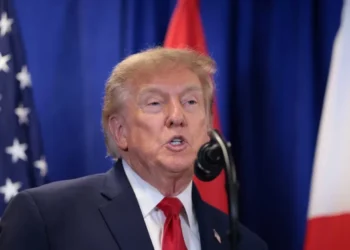
AI education also is growing in the United States — as are fears about its potential for harm. President Donald Trump has dismissed such concerns. “I will never stifle the growth of a technology that will be bigger than the industrial revolution,” he said Tuesday at the White House.
Chinese President Xi Jinping raised the issue during his own White House visit last week. “Both China and the United States are leading nations in artificial intelligence,” he said as Trump looked on. “We have both the capability and responsibility to develop and manage AI for good, and ensure that the development of AI is always under human control and serves the well-being of the people.”
Trump, seeking to reassure the public, announced Tuesday that top tech executives had pledged to police themselves in ensuring the safety of their rapidly developing models. The agreement is voluntary; Trump described it as “morally binding.”
The White House event followed warnings from the industry. “Do not underestimate the power of this technology,” Anthropic researcher Jacob Coxon wrote in a resignation letter last month on X. “These will soon be superhuman systems that can hack anything, revolutionize any field overnight, and acquire real power and resources. … The people building AI earnestly believe that it could kill us all by the end of the decade.”
Anthropic, in a forthcoming prospectus, plans to caution would-be investors that advanced AI could pose “catastrophic or existential risks to humanity,” Reuters reported this week. “We must slow the pace at which we improve the capabilities of AI models,” Anthropic CEO Dario Amodei wrote last month.
Amodei and the leaders of Google, Meta, OpenAI, X and Nvidia signed the agreement. Also at the White House on Tuesday was Amazon founder Jeff Bezos, who owns The Washington Post.
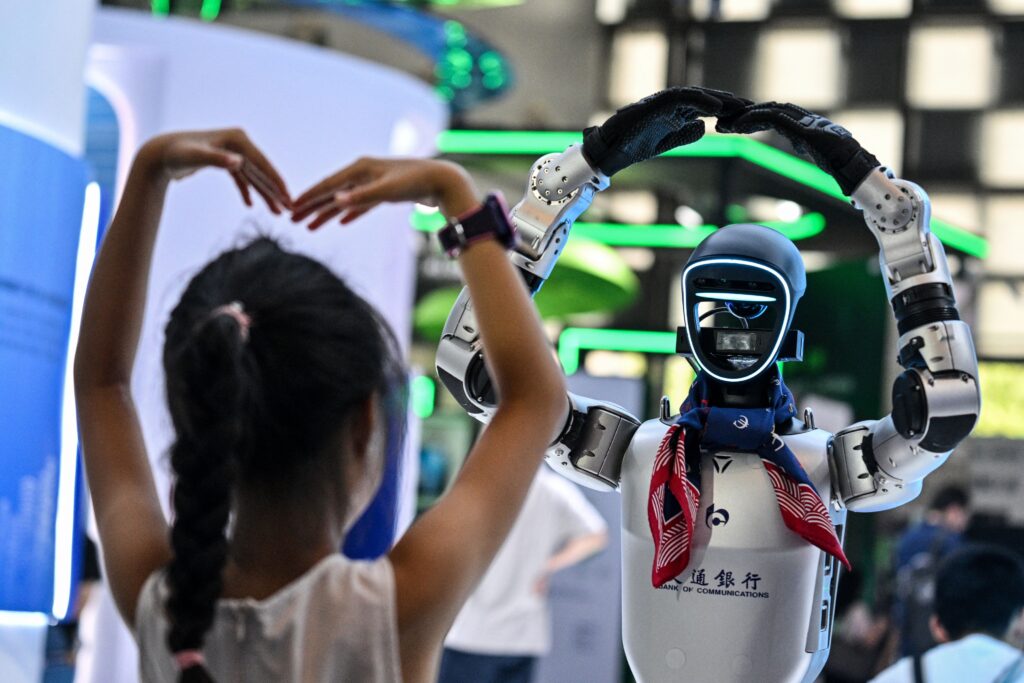
Zhang was one of more than 50 students from China, Singapore, Britain and Australia attending a camp in Beijing organized by the year-old AI learning platform Xinya AI. “AI could be a tool for teenagers to explore the world,” said Chi Boyang, a Xinya AI co-founder.
The six-day program included visits to robotic hubs and university campuses, sessions on AI ethics and literacy, and training in using AI tools, including U.S.-developed platforms, to design and present products. Student creations included an AI-powered crutch for the elderly, a safety-alert AI helmet and a location-tracking AI bottle that filters water.
“All of the work came from discussions among students,” Chi said. “The only role of teachers was to guide them when they got stuck.”
Muriel Gao, a parent, said the camp exceeded her expectations.
Her son, 8-year-old Zhu Zhentao, used AI tools to create a video showing his late parrot reuniting with its mother in heaven. “He even reminded me that the video might raise copyright issues,” Gao said.
AI education is also taking off in the United States, where some programs also guide students in launching start-ups. A difference, researcher Claire Perkins said, is that while U.S. growth has been driven by market demand with federal encouragement, China is mandating universal access.
Beijing envisions a comprehensive AI education system that spans all levels of schooling and extends to the broader public.
“Close coordination among government policy, education and industry is a distinct advantage for China,” said Xiao Qian, vice dean of the Institute for AI International Governance at Tsinghua University.
The U.S. system is decentralized, noted Yingyi Ma, a nonresident senior fellow with the Brookings Institution who studies U.S. and Chinese AI education. But its open-ended environment, she said, tends to yield breakthroughs that can define entirely new directions.
Still, she said, equal access remains crucial: “Without that, decentralization just produces unevenness without ever cashing in the creative upside.”
Chinese authorities are closely monitoring the surge in commercial AI camps. State media outlets have criticized some programs for allegedly exploiting parents’ anxiety with high-priced, low-quality courses.
“The industry needs clearer standards and more qualified professionals,” said Maggie Yang, Mainland China CEO of Empact, which has trained more than 100 teens to use AI tools to solve social challenges.
Nicole Feng, Zhang’s mother, said her son has become more adept at using AI tools to explore his own interests, such as aviation.
But for Zhang, it goes beyond that.
“AI is not a tool for me,” he said, “but a virtual friend I can talk to, solve problems with and turn to for emotional support.” An award winner this summer, he hopes to return to AI camp and compete in more competitions.
The post While the U.S. debates AI risks, China mandates universal training for students appeared first on Washington Post.