The warning from police was so terrifying, it was easy to overlook it also was implausible.
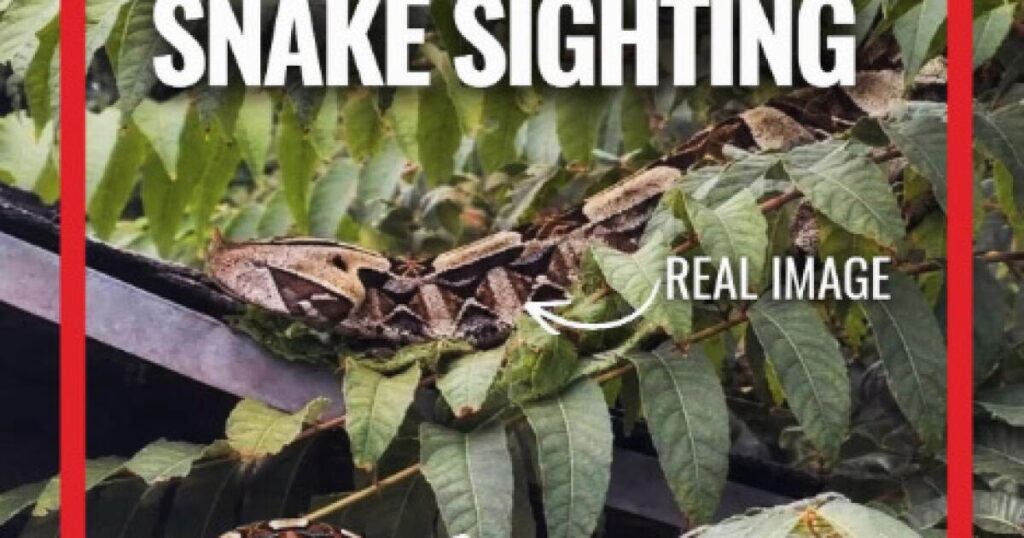
A Gaboon viper — a highly venomous snake native to the rainforests and savannas of sub-Saharan Africa — was on the loose in a Santa Ana neighborhood.
Officials issued the alert Monday after a man shared with police an image appearing to show the dangerous reptile slithering from the thin branch of a tree onto the roof of a backyard shed.
The public got the message, with some parents keeping their children indoors while police and herpetologists scoured the backyard for the snake. The snake hunt was featured on TV newscasts and in newspaper articles. A woman living nearby called police in a panic after she found a snake, which turned out not to be a viper, in her backyard.
But almost from the beginning, some people questioned whether a Gaboon viper could really be slithering through the Orange County city.
After roughly two days of investigation, police informed the public the entire panic was driven by a hoax. The photo was a fabrication, generated by AI.
The sham thrust to the forefront a growing problem: law enforcement agencies across the country are increasingly receiving photos and other evidence that’s been manipulated or wholly generated with artificial intelligence, experts say.
“These types of threats are not going away, so we need to find a way to mitigate it,” said Joseph Lestrange, a former division chief at Homeland Security Investigations. “At least we can try and save our cops from going on wild goose chases.”
Law enforcement has largely been “behind the curve” in adapting to the world of AI, which has implications for spoofing issues like the snake in Santa Ana, proof of life in kidnapping cases like the Nancy Guthrie investigation and even evidence collection in criminal probes, Lestrange said.
It can also waste police resources and damage reputations.
A Florida man was arrested in April after he showed a deputy inside a retail store an AI-generated video of people breaking into his patrol vehicle in the parking lot. The deputy reviewed surveillance video from the store and determined no one entered his vehicle, according to the Seminole County Sheriff’s Office.
The man arrested in that case had allegedly used AI videos to dupe people before. He admitted to police in West Palm Beach that he had created an image using a Home Depot customer’s likeness that falsely depicted the man kissing another woman — then showed it to the man’s wife, WPTV in West Palm Beach, Fla., reported.
Officers told the station the man was recording reactions on his Meta glasses and posting them on social media to create viral content.
Last October, police in Salem, Mass., were forced to warn residents about a viral TikTok prank that used AI to create fake images of intruders breaking into homes after they received an influx of calls reporting break-ins that never happened.
People who received the fabricated pictures believed there was an intruder in their home and called 911 in a panic, wasting police resources, according to the department.
“Besides being in bad taste, there are many reasons why this prank is, to put it bluntly, stupid and potentially dangerous,” the department said in a statement at the time. “Police officers who are called upon to respond do not know this is a prank and treat the call as an actual burglary in progress, thus creating a potentially dangerous situation.”
Internet sleuths have also started using AI to “unmask” suspects in high-profile cases, flooding tip lines with bad information. Following a mass shooting at Brown University last year, officials urged the public to stop sharing such images out of concern that it would slow down the investigation and search for the suspect.
In the past, large amounts of evidence in a criminal investigation could be taken mostly at face value, especially images and videos. Now, agencies have to take advanced steps to ensure what they’re receiving is authentic and verifiable, Lestrange said.
“It makes policing a lot more challenging because it adds a whole bunch of additional dimensions. You can’t trust your evidence as your evidence. Now you have to say, ‘This looks like it’s evidence, but we have to authenticate it first and take action second,’” Lestrange said.
Experts say law enforcement agencies are going to have to adapt and partner with companies that can create tools for them to quickly detect AI-manipulated evidence.
“It’s not if it happens to your agency, it’s when,” Lestrange said. “It’s going to eventually happen to everybody and it’s a wake-up call.”
In Santa Ana, some in the department were immediately suspicious of the photo of the viper. They ran it through publicly accessible AI detectors but got different outcomes. One program said the photo was the work of AI, while another determined it was legitimate.
Herpetologists were also skeptical. Gaboon vipers live on the ground and can weigh more than 45 pounds — too heavy to be adequately supported by a thin tree branch. The reptiles are also illegal to own as pets in California.
Possessing the snake requires a specialized permit from the California Department of Fish and Wildlife. Investigators searched through public records for anyone who had such a permit in the area, but none showed up, said Officer Natalie Garcia, a Santa Ana Police Department spokesperson.
But, of course, it’s always possible that someone purchased, and was keeping, the snake illegally. And as officials combed through the shed on Monday for signs of the snake, they found droppings that could have been consistent with the reptile, so they played it safe and continued the search.
“Public safety is obviously number one for us, and we took this like any report that we come across,” Garcia said. “We wanted to just investigate to the extent of whatever it took us to finally figure out the truth.”
The next day, detectives visited the man who reported the snake and spoke to him for several hours at work. Eventually, he told them he’d made it up and the image was a fake, Garcia said.
Authorities are putting together a case to submit to the Orange County district attorney’s office recommending that he be charged with making a false report of an emergency, Garcia said. The man had not been charged or taken into custody as of Thursday morning.
“I can only hope that it sends a message to our entire community that we take this very seriously, and there’s consequences to these actions if you decide to break the law in this manner,” Garcia said.
The post AI image of deadly snake sent Santa Ana into panic. It’s a new hoax headache for police appeared first on Los Angeles Times.