The Trump administration, acting in defiance of top Democrats on the House and Senate foreign affairs committees, has stripped tens of millions of dollars in U.S. military assistance from European and Middle Eastern countries and will give those funds instead to conservative-leaning governments in Latin America, three U.S. officials told The Washington Post.
The State Department notified Congress of its intentions in September, prompting Sen. Jeanne Shaheen (D-New Hampshire) and Rep. Gregory Meeks (D-New York) to place a hold on the diversion of funds.
Late Wednesday, the administration quietly notified Congress it was defying the hold and moving ahead, diverting to Panama, Peru, Ecuador and Colombia $52 million that had been approved for Slovakia, North Macedonia, Tunisia and Iraq, the officials said. They spoke on the condition of anonymity to discuss security matters.
It is the latest move by the Trump administration to reduce U.S. spending or troop deployments in Europe and coincides with a Pentagon review that could result in a reduction and realignment of U.S. basing on the continent.
It is also a continuation of President Donald Trump’s undercutting of the legislative branch’s spending powers, a core constitutional authority that Trump has challenged in ways big and small.
In a letter to Secretary of State Marco Rubio on Wednesday, Shaheen and Meeks called the move a breach of the hold they had put in place and a violation of statutory requirements about where the money could go. The diversion of funding for Slovakia and North Macedonia drew particularly strong opposition because that money was included in a Ukraine supplemental bill specifically for countries impacted by the war in Ukraine.
“Both chambers of Congress provided these funds for a very specific purpose: supporting Ukraine and our European allies in the wake of Russia’s full-scale invasion,” they wrote in the letter, a copy of which was obtained by The Post. “The Executive Branch does not have unlimited discretion to redirect these funds toward unrelated Administration policy priorities or countries.”
The funding for Iraq and Tunisia came from different legislation and was not subject to the same restrictions, though it has also come at a sensitive time for Baghdad amid the Iran war and U.S. withdrawal from Iraq.
When asked about the lawmakers’ objections, the State Department told The Post that the money would be better used in Latin America in keeping with Trump’s foreign policy doctrine of re-prioritizing the Western Hemisphere.
“Reprogramming money away from Middle East and Europe to the Western Hemisphere is consistent with the National Security Strategy,” the department said in a statement. “The funds used in our region will combat narco-terrorism in our hemisphere and help continue to secure the Panama Canal.”
“The funds used in the Western Hemisphere will strengthen U.S. security partnerships and counter adversary military influence in our shared region,” the department added.
The State Department did not address questions about Shaheen’s and Meeks’s contention that the administration’s diversion of congressionally approved funds violates statutory requirements.
Congress approved the funds in 2022 at the outset of the Ukraine war, as the Biden administration was pressuring European countries to provide weapons to Ukraine so Kyiv could defend itself. Washington at that time also was leaning on non-European countries to end their arms sales relationships with Russia in a bid to isolate the Kremlin.
The goal of the bill, in addition to assisting Ukraine and its closest European neighbors, was to help foreign countries start buying U.S. military equipment instead of Russia’s, particularly those countries that provided their old weapons to Ukraine.
Last month, Democratic staffers met with State Department officials to question how providing the funding to the Latin American countries could be interpreted as responding to the “situation in Ukraine” or going to countries “impacted by the situation in Ukraine,” as the language in the original bill states.
The Trump administration “failed” to explain this during briefings for lawmakers or in subsequent written responses to their demand for clarity, Meeks and Shaheen said in their letter to Rubio.
Administration officials “also confirmed that Colombia, Ecuador, Panama, and Peru have not provided meaningful security assistance to Ukraine or other European allies and partners impacted by Russia’s war in Ukraine,” they wrote.
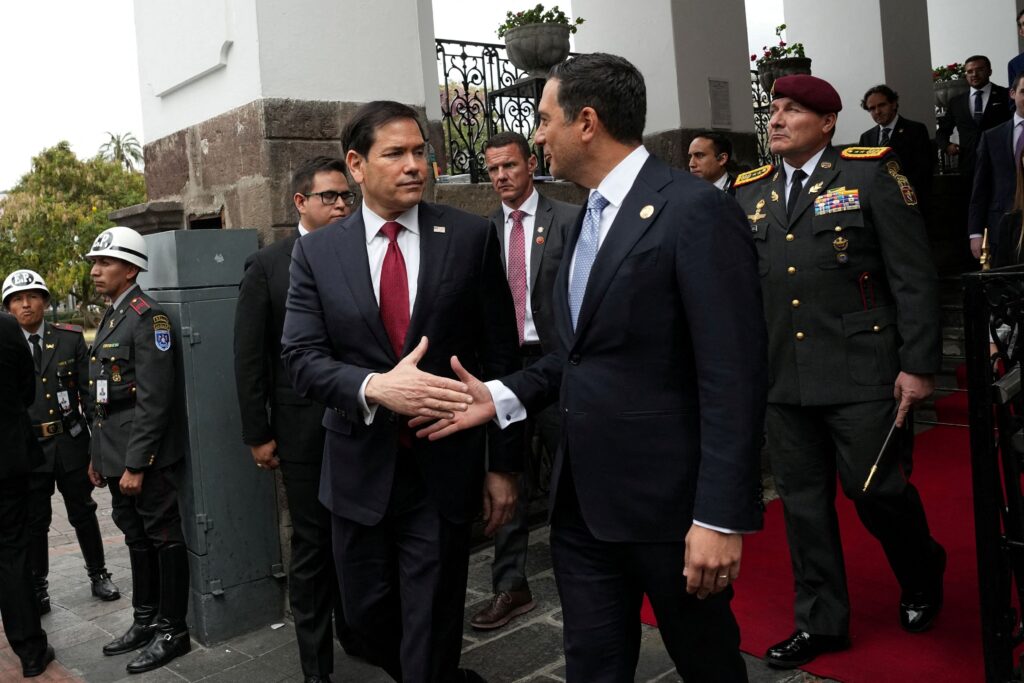
In September, Rubio visited Colombia, Ecuador and Peru to advance the Trump administration’s signature policies of fighting drug trafficking and illegal immigration. The right-leaning governments of Ecuador and Peru are particularly close with the Trump administration, having complied with its requests for deeper and more aggressive counternarcotics cooperation.
Trump often touts his renewal of the Monroe Doctrine, which sought U.S. domination in the Western Hemisphere to the exclusion of other imperial powers and claimed a God-given right to American territorial growth. Rubio has said the policy will concentrate on “missed opportunities and neglected partners.”
Jeremy Shapiro, research director at the European Council on Foreign Relations, said European countries will assume this is a “harbinger” of how the Trump administration will prioritize world affairs.
“It will heighten the sense that the Europeans could be abandoned if they don’t pass a loyalty test or do what the administration wants on Iran,” he said.
The post Trump defies Democrats, diverts aid for Europe to Latin America instead appeared first on Washington Post.