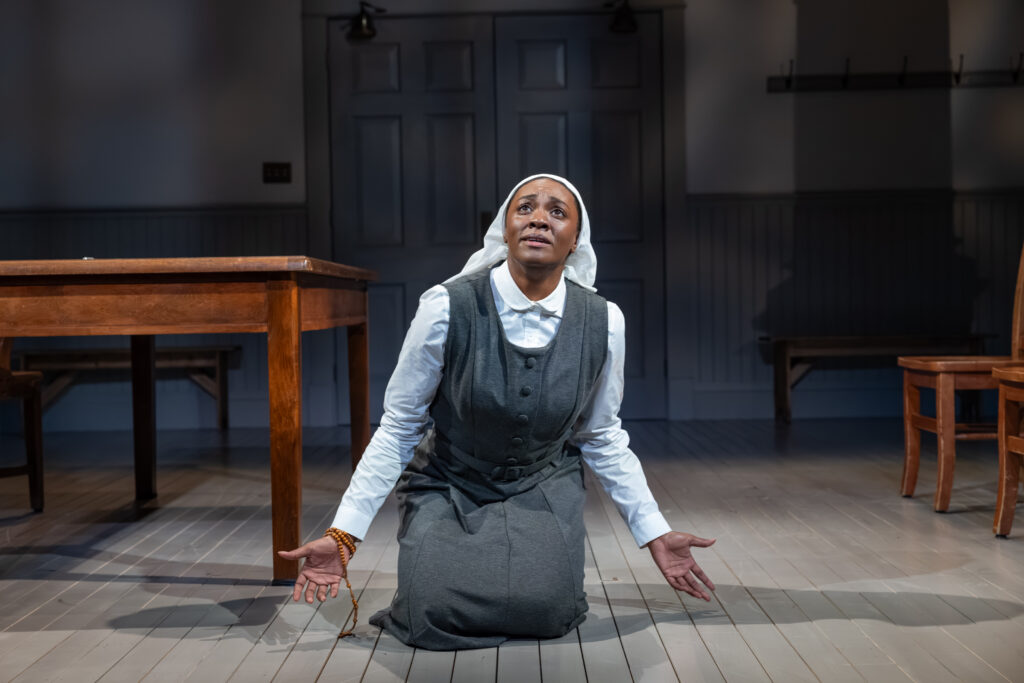
The Vienna of Folger Theatre’s “Measure for Measure” is relocated from Austria to the 1950s American South — so you can make that “Vie-enna,” as it’s laconically pronounced.
William Shakespeare’s bloodthirsty comedy opens with a man facing execution under a long-unenforced law against “fornication.” When public spaces bear signs dividing public amenities by race, that’s an offense easily read as “miscegenation.” Interestingly, the Folger’s production will undercut that easy black-and-white analysis with a provokingly simple casting choice.
Ruled by a Duke (puckish, canny Nathan Darrow) whose laissez-faire regime has let his city settle into a chaotic loucheness reminiscent of Savannah, New Orleans and other hothouses, this Vienna practices segregation of a reasonably “civilized” sort. Well-bred Black men like Claudio (JaBen Early, graceful and imposing) hold substantial social status. Genteel women like his sister Isabella (live wire Renea S. Brown) speak truth to power with reasonable security. And a widow of color (a rowdy Chinai Routté) might even operate a bawdy house catering to all sorts and shades without undue fuss.
Attract the constable’s attention too coarsely or too often, though, and the baseline may shift. Find yourself sincerely at odds with a White man in a real position of power (Lee Osorio’s tight-wound Angelo is the initially upright, eventually passion-felled magistrate in question), and the system won’t operate quite so evenhandedly.
There are seven actual Viennas in the culturally Southern states, but director Psalmayene 24 declines to specify one. General vibes — hat tips to scenic designer Debra Booth and costumer Mika Eubanks — do hint at the Deep South. Whatever the case, the drawls and dialects and the modes of dressing do speak volumes about caste and class. It’s just one way the creative team’s choices chime revealingly with Shakespeare’s ruminations on fairness, morality, justice and other notoriously squishy concepts.
The explicit racism of the United States’ history of slavery and Jim Crow segregation may be singularly ugly, this production suggests. But through a certain lens, it’s just another of the endlessly wearying ways humans have invented to accrue and protect power for one group at the expense of others.
Psalmayene’s concept pays subtle dividends for most of the proceedings, provoking more murmurs (and yes, guffaws) than outbursts suggesting indignation among Sunday’s opening-night audience. But in Shakespeare’s scorching final confrontation between right and righteousness, it assumes a crushing and sudden weight.
One low-status woman of color has been confined. One White woman of breeding has been freed. And one upper-class Black woman — Mariana (Renee Elizabeth Wilson) — turns to the heroine and asks her to join in pleading salvation for the man who has, as far as either of them knows, taken the innocent Claudio’s life.
Against all baser instinct, Isabella assents — not just urging the Duke to spare her enemy, but arguing that her own beauty was partly to blame for his weakness. It’s a humane and moving moment in any decent staging; refracted through the lens of racialized and institutionalized violence in America, it’s a gutting reminder of how much grief we’ve forced Black women to bear. And how much grace — and healing work — we’ve demanded of them at the same time.
Through Nov. 1 at Folger Theatre, 201 East Capitol St. SE. About 2 hours 30 minutes. folger.edu.
Here are reviews of two more productions now on D.C.-area stages:
‘Wish You Were Here’
No men, wicked or otherwise, intrude upon the domestic spaces of Sanaz Toossi’s “Wish You Were Here,” now at Studio Theatre. In those spaces, a half-dozen Persian women gather and gossip and get themselves together for a handful of weddings — and, yes, a funeral, too. After a compressed couple of years amid the Iranian Revolution, the play eventually spans more than a decade. But the choices men force upon these suburban women — choices about careers and childbearing and more, looming even before the tightening of religious laws that comes after the Shah’s overthrow — are never far from center.
Toossi’s 2022 play “English” tackled assimilation and cultural identity among another set of women in the same bedroom community not far from Tehran. This boisterous script is an even more explicit love letter to Iranian women, especially of her mother’s generation — especially those who stayed as the Shah’s deliberately Westernized Iran became the restrictive Islamic republic.
Sivan Battat’s sleek, handsome staging is invigorated by free and gorgeous work from an ensemble cast, led with fierce commitment by Ellen Nikbakht. Toossi’s story acknowledges political and religious shifts without centering them, holding focus on the inner lives of its characters, who grow more intriguing with every passing scene. It’s not endearing, necessarily; spikiness and volatility are key elements of this group portrait. But together, Toossi and this production make these women unforgettable.
Through Nov. 1 at Studio Theatre, 1501 14th St. NW. About 1 hour 45 minutes. studiotheatre.org.
‘Some Like It Hot’
Broadway’s 2022 overhaul of the film classic “Some Like It Hot” — now getting its regional premiere at Olney Theatre Center — hardly pretends to be serious social criticism. But between the Prohibition-era setting; the mob violence that drives the male leads (Jacob Tischler and Tavis Kordell) to disguise themselves as musicians in an all-female band; and the emergent queerness newly written into Kordell’s character, a certain amount shakes out from its briskly whirring machinery anyway.
The updates — courtesy of librettists Matthew López and Amber Ruffin — do no violence to the source material. If “Some Like It Hot” is far from Marc Shaiman and Scott Wittman’s tightest, brightest score, it does offer showy turns for most of its major players. And Jason Loewith’s judiciously scaled, carefully calibrated staging celebrates the newly renovated 1938 barn of a structure, where the Olney’s theatrical roots grow deepest.
Wisely, the art deco carnival of a production crowds the theater with all of the bright costumes, gorgeous panoramic projections and elaborate choreography an audience could ask for to kick off the season.
Through Nov. 8 at Olney Theatre Center, 2001 Olney Sandy Spring Rd., Olney. About 2 hours 30 minutes. olneytheatre.org.
The post A ‘Measure for Measure’ set in the American South illuminates Shakespeare anew appeared first on Washington Post.