I.
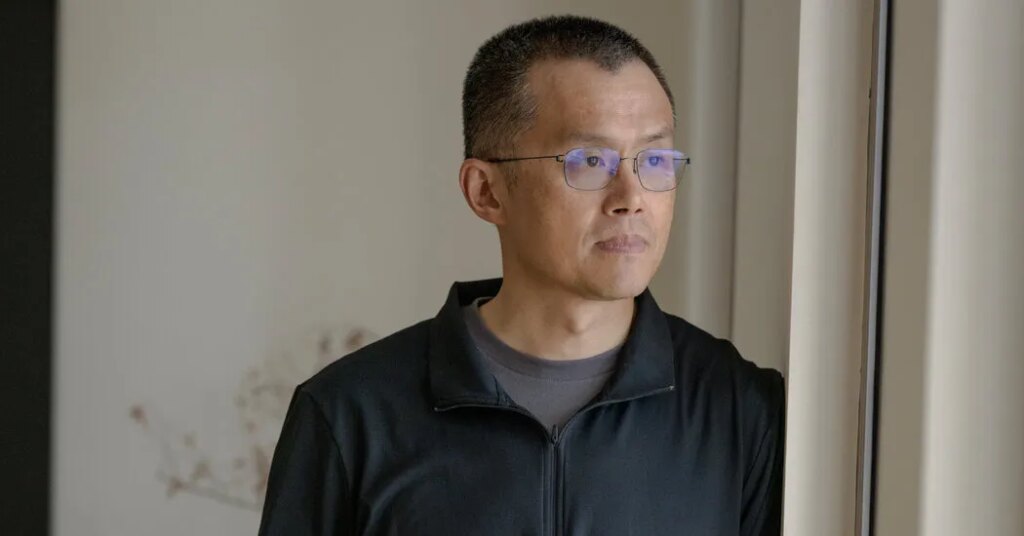
One morning in June, the cryptocurrency mogul Changpeng Zhao pulled up to the St. Regis resort in Abu Dhabi in a white Nissan S.U.V. Mr. Zhao is the richest man in crypto, worth an estimated $114 billion, and he lives in a villa nearby, with nine bedrooms, four bodyguards, a chef and a yacht named Da Moon. But he also likes to play the part of a “normal dude,” as he often describes himself, and that day he had offered to give me a personal tour of the city. Outside the St. Regis, Mr. Zhao sat at the wheel of the Nissan, with his iPhone mounted on the windshield, like the world’s wealthiest Uber driver. “My Lamborghini,” he joked as I climbed in.
Mr. Zhao, to be clear, isn’t a normal dude. Not long ago, the U.S. authorities brought a criminal case against him for his management of Binance, a crypto exchange depicted in court papers as a haven for Russian money launderers, Iranian sanctions evaders and Islamic State terrorists. Mr. Zhao pleaded guilty and escaped with his fortune intact. After serving a four-month prison sentence, he returned to Abu Dhabi, still Binance’s majority shareholder and still the most powerful figure in the industry.
These days, Mr. Zhao, who is 49, moves through the world like a head of state, flying around Asia on his private jet to advise governments on crypto regulation; a stop in Islamabad or Manila is often followed by the announcement of a new regulatory breakthrough for Binance. At home, one of his two dogs is a Taigan, an elegant Central Asian breed, likened to the gazelle. It was a gift from the crypto-curious president of Kyrgyzstan, with whom he went skiing in February. “He actually wanted to give me a tent, like a full-sized tent,” Mr. Zhao said. “I said no to the tent, and then he insisted on the dog.”
Mr. Zhao’s most influential allies are a pair of powerful ruling families. One is the clan that runs the United Arab Emirates, which wants his help creating a technology powerhouse in the desert. The other is the Trumps. Last year, Binance forged a business relationship with World Liberty Financial, the crypto start-up founded by President Trump and his three sons. World Liberty generated $799 million for Mr. Trump last year — his single most lucrative asset, more remunerative than his real estate portfolio or his social media business. Mr. Trump pardoned Mr. Zhao last October, a move widely criticized as a quid pro quo.
Known in the industry as “CZ,” Mr. Zhao often avoids reporters, but he met with me several times this year, eager to put a friendlier gloss on his career at Binance, which still hasn’t stanched the flow of dirty money. He is tall and thin, with short dark hair and a Binance tattoo on his forearm, and lacks the frat-bro swagger of many of his crypto peers. He comes across as polite and attentive, though his interests are almost comically narrow. This year, he self-published a memoir, “Freedom of Money,” in which he describes receiving an after-hours tour of the Louvre. The experience left him cold. The guide might as well have been “playing piano to a cow,” he wrote.
For years, his true calling has been what academics term “jurisdictional arbitrage” — moving from country to country in search of a legal framework pliable enough to accommodate his appetite for risk and growth. In Abu Dhabi, he may have found an ideal base of operations. As we drove into the city, Mr. Zhao chatted amiably, pausing to ask his bodyguard for help with directions. (“Yes, boss, stay right.”) We passed a string of impressive compounds and drove toward the presidential palace, Qasr Al Watan, whose striking white dome resembles the Taj Mahal.
Mr. Zhao was growing animated. “Democracy has been hailed as, like, the holy grail for the last couple hundred years, but democracies are inefficient,” he said as we approached the palace. “If you get a benevolent dictator, it’s actually extremely efficient. There’s very little debate going on. You don’t waste time on a lot of frivolous stuff.”
Lately, this top-down model of business and politics, simultaneously medieval and ultramodern, has gained traction in the United States. On a trip to Abu Dhabi last year, Mr. Trump called the nation’s ruler, Sheikh Mohammed bin Zayed Al Nahyan, “a very strong man” and “a man of vision like few others.” Zach Witkoff, the son of one of Mr. Trump’s top advisers and himself a kind of MAGA princeling, put it more bluntly at a crypto conference in Dubai in May last year. “We really need to take a page out of His Highness’s and the Emirates’ book,” Mr. Witkoff said. “They are just an amazing example of how you can lead with innovation while also maintaining your family values.”
Mr. Zhao is already living in the future these men crave, nestled in an elite enclave where monarchs and billionaires operate in harmony. As he drove away from Qasr Al Watan, he told me about a private conference he had attended nearby, at the Emirates Palace Mandarin Oriental hotel, a gathering of executives like the hedge fund founder Ray Dalio and the Japanese billionaire Masayoshi Son. While he sat in the audience, Mr. Zhao noticed someone stooping down to speak with him. It was Sheikh Mohammed. He wanted to know how Mr. Zhao was getting along and whether he could do anything to help.
“This is the king,” Mr. Zhao told me, “kneeling down beside you.”
II.
One day early this year, Mr. Zhao was working from bed — he often does business lying on his back after a long struggle with chronic pain — when the windows began to shake. He got up, he told me, and walked onto his balcony, where he saw a trail of smoke in the sky. Mr. Zhao lives on Saadiyat Island, an enclave of Abu Dhabi across the Persian Gulf from Iran, which had just fired a missile at the Emirates.
It was the start of a geopolitical crisis that has destabilized the region, but Mr. Zhao was not overly concerned. He went back to bed and kept working. “More people die from traffic accidents than from the missiles,” he said later. “Very protected here.”
Until he settled in the Emirates, Mr. Zhao was a man without a country. He was born in China, then moved to Canada with his family at the age of 12. After attending McGill, he worked a series of technology jobs, bouncing among New York, China and Japan. In July 2013, over a poker game in Shanghai, a colleague suggested he check out “this new thing called Bitcoin.”
It was the perfect borderless technology for his borderless lifestyle. After a few months of study, Mr. Zhao made a radical bet. He sold the family home — a three-bedroom apartment in Shanghai where he and his wife were raising two children — and plowed the $900,000 proceeds into Bitcoin. It was a risky move, but Mr. Zhao wasn’t worried. Even if Bitcoin plunged, he figured, he could easily land another high-paying job in traditional finance.
Mr. Zhao went on to work at a succession of crypto start-ups in Asia. The industry grew rapidly in the 2010s, with hundreds of new tokens, but the platforms for trading these coins were poorly run and vulnerable to hacks. In July 2017, Mr. Zhao founded Binance. Within a few months it was the largest exchange in the world, a title it has never relinquished.
Binance’s success rested on two pivotal insights. The first was that crypto investors, as a species, were drunk on risk and would never be satisfied swapping dollars or yen merely for an equivalent amount of crypto. For years, Binance has operated as a margin exchange: Traders can borrow money to place high-risk, high-reward bets on the prices of Bitcoin and other popular tokens.
The second insight was simpler yet more consequential. Many crypto investors didn’t want to identify themselves, and Binance didn’t ask them to. For its first four years, the company allowed customers to open accounts without providing even the most basic K.Y.C. — the “know your customer” information that traditional companies require to prevent financial crime.
Binance was not the only exchange to offer these types of risky services, but Mr. Zhao executed better than any of his competitors. “There was a lot of MySpace in the exchange world, and he built Facebook,” said Austin Campbell, the founder of a crypto consulting firm. The result was an extremely lucrative free-for-all: a platform where unvetted investment products were available to unvetted traders. As the market boomed, Binance took a cut of each transaction; the company quickly reached $1 billion in profits, according to “Freedom of Money.”
Mr. Zhao was suddenly a crypto celebrity. But he has never been widely understood outside the industry, even as he has joined a small cohort of ultrawealthy executives who wield astonishing political influence. When he recounts his most contentious moments, Mr. Zhao portrays himself as a kind of passenger — a crypto nerd overwhelmed by success, a naïve outsider who somehow stumbled into Bond villain status.
It is not always a convincing performance. Sitting in his kitchen in late June, Mr. Zhao told me that he had “never really wanted” to break the law in Binance’s explosive early years, when the company’s lax controls allowed a procession of bad actors to launder money. “It’s just my lack of experience in that area,” he said. “I’m a tech guy. I lived in China.”
That image isn’t compatible with the evidence U.S. prosecutors collected in their investigation into Binance. In court, they quoted an admonition that Mr. Zhao had given his underlings: “Better to ask for forgiveness than permission.” Privately, Mr. Zhao had discussed ways to obfuscate that Binance served American users even though it wasn’t licensed in the United States, according to legal filings. “Don’t leave anything in writing,” he told a subordinate.
In Abu Dhabi, Mr. Zhao described himself as a “rule follower.” It seems obvious, however, that he made a strategic choice to push the legal limits at a crucial time, when the habits of a new generation of investors were forming and the rules themselves were rather elastic.
I was reminded of this when he showed me into the entrance of his house, which was stocked with boxes of Binance swag. He urged me to pick out a gift, perhaps a Binance backpack or a yellow-and-black Binance sweater, styled to look like a varsity jacket.
I told him that reporters have protocols about these sorts of things, and that I had to decline any gift over $20. He laughed, and said the price was “probably 19 bucks.”
III.
Mr. Zhao paid a visit to the Emirates in 2021, after years of roaming around Asia. In 2017, he and his Binance colleagues had been forced to flee China in the middle of the night, as the government prepared to announce a ban on crypto exchanges. A stint in Japan hadn’t worked out, either; nor had Singapore, where it was difficult to get a work visa. Then Mr. Zhao’s friend Gabriel Abed, a businessman who served as the ambassador to the Emirates for Barbados, made a suggestion. He told Mr. Zhao to check out Dubai.
Immediately, Mr. Zhao saw how the Emiratis treated the rich and powerful. He arrived in Dubai on a Saturday morning in October, and within hours, a government minister, Omar Sultan Al Olama, came to visit. He offered Mr. Zhao a so-called golden visa, which grants 10 years of hassle-free residency. A doctor was summoned to conduct the blood test required of all visa holders. Applications often take weeks to process. Mr. Zhao was approved in less than 12 hours.
The friendly reception impressed Mr. Zhao. “On my fourth day in Dubai, I saw two properties,” he told me. “I bought the second one.” By the end of the year, Binance had signed a memorandum of understanding with the local authorities to develop rules for crypto operations; the company dispatched three staff members to help put together a framework. A draft was completed in January 2022 and signed into law a few weeks later. “When you’re the captain of a ship that’s sailing true north, the U.A.E. wants you on their team,” Mr. Abed said. “They did that with CZ. They rallied around him from Day 1.”
Not everyone in the Emirates is treated so generously. Over the years, the nation’s leaders have conducted mass surveillance, outlawed even the mildest forms of dissent and overseen a labor market where foreign workers are frequently exploited and abused.
But for Mr. Zhao, it was the beginning of a comfortable new life. Before founding Binance, he had separated from his wife, who moved to Tokyo with their children. He started a relationship with one of his colleagues, He Yi, a marketing executive known in China as the former host of a travel program called “Beautiful Destinations.” While his older children attended college in the United States, Mr. Zhao and Ms. He raised a young family in the Emirates.
Mr. Zhao was ushered into a rarefied world of billionaire networking. He got to know a group of Emirati leaders who were curious about technology — the “crypto sheikhs,” as he calls them. Eventually he worked his way up to the brother of Sheikh Mohammed, Sheikh Tahnoon bin Zayed Al Nahyan, a jujitsu enthusiast who would host high-powered businessmen at his palace. On the royal dinner circuit, Mr. Zhao was treated as a valued guest. “We’re like, what’s the seating arrangement?’” he said. “Just sit anywhere, it’s fine.”
During these early encounters, the sheikhs would pitch Mr. Zhao on the Emirates, asking what they could do to help him. Soon Mr. Zhao was preaching the nation’s virtues to the broader billionaire community. He encouraged the artificial intelligence mogul Sam Altman to set up a corporate presence in the Emirates, warning that other countries would treat him with hostility. “You’re going to face a lot of regulatory issues,” Mr. Zhao told him over coffee.
Mr. Zhao had more than a passing familiarity with the perils of emerging industries. As he arrived in the Emirates, Mr. Zhao was locked in a vicious competition with a young entrepreneur named Sam Bankman-Fried, the founder of a rival exchange, FTX. The son of Stanford Law School professors, Mr. Bankman-Fried was in many ways the polar opposite of Mr. Zhao: a consummate insider whose personal connections and proximity to the U.S. political elite greased his path to the top of the industry. “He had tricks I didn’t have,” Mr. Zhao wrote in his memoir. Mr. Bankman-Fried would poach Binance employees, offering salaries three to five times as high. Mr. Zhao also heard rumors that Mr. Bankman-Fried was bad-mouthing him in Washington.
In November 2022, a report in the crypto publication CoinDesk raised doubts about the stability of FTX’s finances. Mr. Zhao was in Dubai, on his way to have drinks with Mr. Abed, when he decided to weigh in on Twitter, posting a short but ruthless announcement. He was selling a stash of $500 million in FTT, a digital coin that was a proxy for FTX stock. The post set off a panic, as anxious investors rushed to pull money out of FTX.
The money wasn’t there — Mr. Bankman-Fried had stolen $8 billion from his customers. He had no choice but to seek a bailout, and only one man in crypto had the resources to save him. Two days after his tweet, Mr. Zhao announced that he was buying FTX; a day later, he pulled out of the deal, sending FTX deeper into crisis. It all had the feel of a masterful bit of corporate warfare — an act of “blood sport,” as one observer put it. Within six weeks, Mr. Bankman-Fried was arrested at his apartment in the Bahamas and extradited to the United States. He was eventually sentenced to 25 years in prison for fraud.
Mr. Zhao told me that he had never meant to destroy FTX. Slipping into his usual mode of shrugging naïveté, he explained that he had hoped to gradually sell his FTT over a few months. “I had no intention to crash them,” he said. “We lost $500 million.”
His vanquished rival sees it differently. “He played me,” Mr. Bankman-Fried said at the time. “He played it well.”
IV.
Billionaires gravitate to the Emirates for billionaire reasons. The country doesn’t levy an income tax, and it’s considered extremely safe, at a time when crypto investors have been targeted by kidnappers in Europe and the United States. But for Mr. Zhao, who had just seen his nemesis dragged across borders, the Emirates held another important advantage: It had no extradition treaty with the United States.
In either late 2022 or early 2023, he recalled, an Emirati royal asked him over dinner whether he wanted citizenship. Mr. Zhao sent in some documents and waited. Months later, a government emissary arrived at his house, holding a box with passports for Mr. Zhao and his family. The Emiratis “would never extradite citizens,” Mr. Zhao told me. “That was a very strong thing.”
He had reason to be wary: The noose around Binance was tightening. U.S. prosecutors were collecting evidence that the exchange’s lax protocols had allowed scammers, hackers and sanctions evaders to move money. In private messages obtained by the government, Binance employees spoke with astonishing candor about the exchange’s shady clientele. “Is washing drug money too hard these days,” one employee wrote. “Come to Binance we got cake for you.”
Mr. Zhao hired a team of lawyers to broker a deal with the Justice Department. His new passport gave him considerable leverage. After a couple of years in Dubai, he moved an hour and a half south to Abu Dhabi, closer to the nation’s center of political power. While the negotiations unfolded, Mr. Zhao gave serious thought to life as a fugitive; he would have to limit his traveling, but he would be safe in the Emirates, at least in theory.
Eventually, his legal team struck a bargain with the U.S. government. Mr. Zhao would plead guilty to violating the Bank Secrecy Act, an anti-money-laundering statute, and step down as chief executive. (The company would pay a $4.3 billion penalty.) Despite the generous terms, he was frustrated with his lawyers and didn’t think he deserved any prison time at all. “I got put in jail because we had a platform that didn’t have proper K.Y.C.,” he told me. “You can vote for the president of the United States government without having an ID. I don’t know how that system came about. I would imagine someone should be put in jail for that, given what I went through.”
Still, it was an excellent outcome for Binance. At the sentencing hearing in the spring of 2024, Mr. Zhao delivered a contrite statement: “I deeply regret my failure, and I’m sorry.” The judge gave Mr. Zhao a four-month sentence, calling him “a dedicated family man and a giving person.” When the sentence was read aloud in the courtroom, Mr. Zhao’s college-age son quietly pumped his fist.
As the rare felon with virtually unlimited resources, Mr. Zhao was ideally positioned to suffer as little as possible. He was assigned to Lompoc II, a low-security facility in California, the same complex where Mr. Bankman-Fried was later housed. Before he reported to prison, Mr. Zhao assembled a team of advisers, who schooled him in the subtleties of cellblock politics. One of them, Michael Santos, exchanged letters with other inmates, who agreed to help Mr. Zhao get his bearings inside. “CZ, you’re a guy who’s understood people and had thousands of employees,” Mr. Santos told him. “You’re not going to lose those skills when you walk in here.”
Mr. Zhao arrived at Lompoc on the morning of May 30, 2024. He quickly settled into what’s known as a “car” — an informal social group, often established along ethnic lines. The other Asian inmates sat with Mr. Zhao during meals and worked out with him in the yard at recess. They were thrilled to be in the presence of a multibillionaire. “Everybody gave way for him,” said Jaton Aguon, a fellow inmate at Lompoc. “It was like a king walking down the aisle.”
Mr. Zhao grew close with a Vietnamese bank robber who had once worked as an engineer. They talked in detail about the robberies, which didn’t involve any of the “Ocean’s Eleven”-style preparation one might expect. He was “very mellow” and “a super-chill dude,” Mr. Zhao told me. “He just walks in, asks for the money and leaves. And he got away with it 11 times.”
The bank robber was one of a handful of inmates who were interested in the business world. He read Bloomberg and The Wall Street Journal and asked Mr. Zhao about Elon Musk’s astronomical compensation package at Tesla. Other inmates also had questions about business, including one who wanted to understand the mysteries of the crypto market. “He’s like, well, Bitcoin — why did it go up?” Mr. Zhao recalled. “I’m like, wow, I don’t know for sure, either.” Mr. Zhao started a study group that tracked stock prices; one of the prison TVs was tuned to CNBC.
Not every one of his messages landed. At Lompoc, Mr. Zhao had a hard time conveying his deeply held belief that the Binance case was essentially victimless, with “no fraud, no nothing.” When he explained the details, the response was dismissive. “They’re like, yeah, that’s what everybody says,” Mr. Zhao recalled.
In August 2024, Mr. Zhao left Lompoc for a halfway house. But a complication with his immigration status meant he had to spend his last two weeks at a local jail, passing the time doing push-ups and crunches in his cell. On the day of his release, an officer escorted him outside, where his mother, sister and assistant were waiting. They drove to a nearby airport and deposited him onto a private plane bound for Abu Dhabi.
Between the moment Mr. Zhao left custody and the moment his jet took off, only 26 minutes elapsed.
V.
Mr. Zhao returned to a world that was shifting in his favor. A crypto-friendly administration was poised to take power in Washington. Shortly before the election, Mr. Trump had founded World Liberty as a joint enterprise with the family of Steve Witkoff, a real estate mogul who was preparing to serve as White House envoy to the Middle East. Soon America’s newly empowered dealmaker-diplomats were spending lots of time in the Emirates.
As he drove me around the city, Mr. Zhao paused to point out the ADNEC Center, a conference hall that hosted a giant gathering of crypto enthusiasts in December 2024. “This is where I met Eric Trump,” he said. At the venue, he recalled, a Trump booster named David Bailey had introduced him to the president’s middle son, a leader of World Liberty. It was a casual conversation, with no official agenda. “He was just saying that he was looking at some real estate deal here,” Mr. Zhao told me.
Their interests were about to align. The Emirates had been working to transform from a petrostate into a powerhouse in emerging technologies, a project spearheaded by Sheikh Tahnoon, who oversees $1.5 trillion in Emirati sovereign wealth. Before he went to prison, Mr. Zhao had held talks with Peng Xiao, one of the sheikh’s top lieutenants, about selling the Emiratis a stake in Binance, the ultimate union between his company and his political guardians.
Rarely seen without dark glasses, Sheikh Tahnoon is chairman of a venture capital fund called MGX, which specializes in A.I. Early last year, MGX agreed to invest $2 billion in Binance, a deal that valued the company at $75 billion, according to a person familiar with the matter. MGX viewed Binance as the perfect bridge between crypto and A.I. — a high-tech money-transmission service that could someday enable automated A.I. “agents” to make payments on behalf of real people.
Mr. Zhao told me that he wanted to settle the deal in Bitcoin. The Emiratis worried that it was prone to drastic price swings that would complicate the transaction. They preferred to pay Mr. Zhao in stablecoins, a type of cryptocurrency designed to maintain a price of $1.
What happened next is widely disputed — and likely to become the subject of a congressional investigation if the Democrats win control of Congress in November. According to MGX, the fund evaluated several stablecoins before selecting USD1, a coin created by World Liberty, citing “business suitability.” It was a stunning choice, given that USD1 was completely untested, with no track record. Last year, The Wall Street Journal reported that Binance had specifically asked MGX to pay in USD1; Mr. Zhao said MGX had made the decision. “I didn’t care too much as long as the stablecoin is reputable and is not going to disappear overnight,” he told me. “There wasn’t any other consideration.”
But all the parties had an incentive to cut World Liberty into the transaction. An Emirati-backed investment firm had taken a 49 percent stake in the start-up in January 2025, days before Mr. Trump’s inauguration; Sheikh Tahnoon got a seat on World Liberty’s board. Around the same time, the Emiratis were negotiating with the White House to secure the export of the valuable computer chips that power A.I. Binance also had business in front of the Trump administration. With its legal troubles receding, the company wanted to escape some of the restrictions imposed in the 2023 settlement.
Mr. Witkoff’s son Zach announced the deal in May 2025, thanking Binance and MGX “for their trust in us.” Democrats in Congress condemned it as “stablecoin corruption.” An issuer like World Liberty makes money by accepting cash deposits from crypto traders, giving them stablecoins in return and then investing the deposits to generate a yield. With the $2 billion from MGX and Binance, World Liberty instantly became one of the world’s largest stablecoin companies, a boon to the Trump and Witkoff families. “It’s just such a craven effort to curry favor,” said Senator Richard Blumenthal, Democrat of Connecticut, who has investigated Mr. Zhao and Binance. “Unprecedented in its scope and scale of corruption.”
Mr. Zhao is adamant that nothing untoward occurred. He said he no longer held the USD1, which he used to invest in Bitcoin and other assets. “I assume that President Trump has very good lawyers, and the setup where the sons run businesses and the father is the president is completely kosher,” he told me. He suggested that some of the outrage might reflect cultural differences. “In Kazakhstan, we can eat horse meat,” he explained. “In some other countries, we’ll be like, ‘Well, that’s crazy.’” The ruling families of two governments had struck a business deal — couldn’t that be a good thing? Mr. Zhao reached for a medieval comparison. “If you marry the daughter of one country to the prince of another country,” he said, “they maintain peace for 50 years.”
Two weeks after the $2 billion transaction, the White House agreed to share access to the chips, overcoming concerns from some U.S. national security officials. Steve Witkoff joined Mr. Trump last spring on a trip to Abu Dhabi, where they celebrated the deal with the Emiratis at Qasr Al Watan.
Privately, Mr. Witkoff also told an acquaintance that Mr. Zhao deserved a pardon, according to a person familiar with the conversation. Mr. Zhao had filed the relevant paperwork and was waiting for the president’s verdict. The outcome would have enormous implications for Binance. After Mr. Zhao pleaded guilty, the exchange’s dormant U.S. operation lost state-level licenses. A pardon could help the company pitch itself to regulators. (A White House spokeswoman said Mr. Witkoff does not play a role in the pardon process.)
When he described the process to me, Mr. Zhao spoke carefully, calling it a “black box” overseen by a couple of lawyers who gave periodic updates from Washington. Once in a while, he said, he would be approached at social events by shady middlemen who said they could arrange a meeting with Mr. Trump — for the right price. “It’s a mini industry of people who want to make a buck,” Mr. Zhao said.
Mr. Zhao ignored them. He told me that he started thinking seriously about a pardon in March 2025, after other crypto executives received clemency and The Journal reported that he, too, was seeking it. “I was like, if the newspapers think I should be asking for a pardon, maybe I should,” he said.
In reality, as early as December 2024, Mr. Zhao’s legal team had been working with Brett Tolman, a prominent pardon attorney, to explore the possibility of clemency, according to two people familiar with the matter and documents reviewed by The New York Times. Ultimately, Binance paid $2.1 million to a lobbying firm run by Ches McDowell, who is close to the president’s elder sons, for services including “executive relief,” according to public filings. (A World Liberty spokesman told me the company had “zero involvement in any decisions on pardons.”)
When the pardon was announced last October, Mr. Zhao had just landed in Kyrgyzstan for a meeting with President Sadyr Japarov, who was interested in creating a digital coin pegged to the Kyrgyz national currency. Mr. Zhao posted a brief thank-you message on social media as his hosts greeted him in the capital city, Bishkek. He spent the evening at a restaurant with the president, talking about stablecoins.
VI.
On a blistering morning this summer, Mr. Zhao pulled into the driveway of his $5 million villa, where he and Ms. He host a rotating cast of grandparents and siblings. He was greeted at the door by his two dogs. In addition to the Taigan, Mr. Zhao has a Belgian Malinois that he named Broccoli, which he thought sounded a little like “blockchain.”
With a photographer trailing behind him, Mr. Zhao bounded from room to room, pointing out pictures of his young family. A stately cream-colored piano sits in the center of his children’s playroom, surrounded by toys — a scene of neglect that dismayed the tuner who came to service it. It was a Steinway, “one of the expensive ones,” Mr. Zhao told me, “but I don’t know how to use it.” In his home gym, he paused to do some bench presses.
Mr. Zhao wanted to make clear that he doesn’t live like a normal billionaire. While Forbes estimates his wealth at over $100 billion, Mr. Zhao insists that the actual figure is much lower, somewhere between $10 billion and $30 billion. He could live comfortably on a tiny fraction of that, he said — a mere $10 million.
On the crypto podcast circuit, Mr. Zhao is occasionally asked about his house, and he often mentions an upstairs leak that he has never managed to fix. Sure enough, in the living room, he pointed to a patch of water damage on the floor, then gestured to the ceiling. “That’s the spot,” he said. “I don’t know if you see the difference in color.”
It’s true that Mr. Zhao’s villa is modest by billionaire standards; a house nearby is on sale for $150 million, he told me. But it’s hard to square his affectations of humility with the world of power and privilege that he has settled into. Once, at a group dinner, Mr. Zhao listened as Mr. Altman described an emerging field of biotech research. “They can take from one single person a sperm and an egg,” Mr. Zhao recalled. “Basically, you can have a kid yourself.” Mr. Zhao has his own ambitions to defy biology; he has invested in a start-up that works with artificial wombs.
Since prison, Mr. Zhao has split his time among a range of ventures, including his tech investments and his travels as a kind of crypto diplomat, helping promote the industry in countries where he’s often treated like royalty. “They always send a guy with two cars to drive right up to the plane,” he told me. “There’s a girl holding the local delicacy, like you’re supposed to try one of them.”
Mr. Zhao downplayed his involvement in Binance; the company’s plea deal prohibited him from “operating or managing” the business. He made a point to express frustration with Binance’s recent decision to sue The Journal, after the paper reported on turnover in the compliance division, calling the case “a gigantic waste of time.” Even if Binance wins, “they won’t get very much,” he told me. (The company dropped the lawsuit last month.)
It’s obvious that Binance remains a major part of his life. One of the two co-chief executives appointed to replace him was Ms. He — the mother of his three young children. Two years ago, in a gesture toward traditional governance, Binance established a board of directors with three supposedly independent trustees. One of them is also the board’s chairman — Gabe Abed, the friend who first recruited Mr. Zhao to the Emirates. They have gone jet-skiing together, and Mr. Abed gave Mr. Zhao a pair of orange high-top sneakers, emblazoned with the words “TRUMP CRYPTO PRESIDENT.”
Lately, Binance has faced new accusations of impropriety. The company fired or suspended four compliance officials last year, after they reported that nearly $2 billion had flowed from customer accounts to a cluster of entities with ties to Iran — a possible repeat of the sanctions evasion that led to the U.S. criminal case in 2023. The company disputed the employees’ findings and denied that anyone was disciplined for raising concerns. The Justice Department said later that two Chinese firms had used Binance to launder the proceeds of Iranian oil sales, though it didn’t file any changes against the exchange.
Some cracks have also emerged in Binance’s relationship with the Emiratis. In December, the company received a license to operate out of Abu Dhabi, which would soon face a barrage of Iranian missiles; the exchange’s new overseer hailed the company as a beacon of “regulatory progress.” Over the summer, however, two Binance employees were briefly detained in the Emirates, an unusually aggressive step by the local police, who were looking into possible financial crimes on the platform.
The detentions alarmed Binance’s local work force. Mr. Zhao told me that he had sent a message to a contact in the Emirati police and reached out to lieutenants of Sheikh Tahnoon. “I just said, ‘Look, let’s find a way not to have this happen,’” Mr. Zhao recalled. “It looks bad for the country, it looks bad for us.” He insisted that the Emirates remained a friendly home for Binance. “No one’s in danger,” he said.
Mr. Zhao has the confidence of someone who has glided away from trouble over and over, a consummate winner in an era that often rewards brazen rule-breaking. In his memoir, he writes for a page and a half about his belief in “simulation theory,” the notion that we might all be living in someone else’s imagined reality. He encountered the idea early in his crypto career, and now believes it’s a mathematical certainty. “In 20 years, we should be able to plug a rod into our heads like in ‘The Matrix’ for complete simulations,” he writes. “Billions of people will. There will be billions of simulations.”
That belief has given Mr. Zhao some detachment from the stresses of everyday life. It’s possible we’re versions of Super Mario, he writes, running around an artificial landscape. He tries to live by a simple mantra: “It’s just a game.”
Reporting was contributed by Michael Forsythe, Nicole Hong, Vivian Nereim, Ben Protess, Cade Metz, Anjana Sankar and Kenneth P. Vogel. Kitty Bennett contributed research.
The post Inside a Billionaire’s Paradise With Crypto’s Most Powerful Ex-Convict appeared first on New York Times.