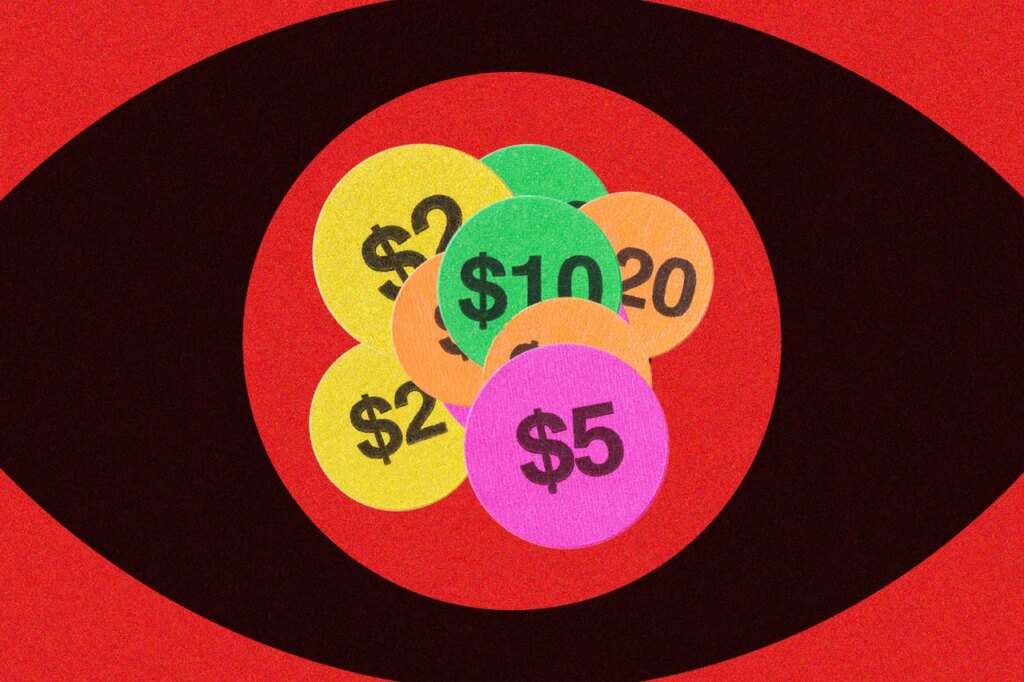
I always feel like I’m overpaying whenever I buy something these days. I never seem to have access to the best coupons, and apps with algorithmically adjusted prices don’t exactly lower the cost of what’s in my cart. It feels like prices are constantly creeping up and my budget is being stretched thin.
These core frustrations were what drew me to Gouged: The End of a Fair Price and What That Means for Your Wallet. Author Lindsay Owens knows what it’s like to advocate for consumers’ economic interests. She’s the CEO of Groundwork Collaborative, a DC think tank and corporate watchdog, and previously worked as an economic policy adviser in Senator Elizabeth Warren’s office.
Before the launch of her book, available now, we spoke about how software has been instrumental in changing how goods are priced, and how generative AI could make existing issues worse. Owens also shared a couple of tips for readers who want to claw back a fair price.
The following conversation has been edited for length and clarity.
WIRED: The era of fixed prices for goods and services already feels like it’s in the rearview mirror. How did we get to this current cultural moment where costs are so variable?
Lindsay Owens: It turns out we all got a little too comfortable with the fixed price. We’d had it for 150 years, since John Wanamaker stuck a price tag on the items in his department store in Philadelphia in the late 1800s. Maybe we just assumed it was a law, but it was actually a norm.
Buy this book at:
If you buy something using links in our stories, we may earn a commission. This helps support our journalism. Learn more.
It is under attack, if not gone. I think the biggest contributor to the end of a fair price is new technology. There was, of course, always an impetus to overcharge, but new technologies have supercharged that impulse. Big tech reinvented the rip-off. They supercharged these age-old impulses, and they made it possible to squeeze more out of Americans in almost every transaction. New technologies are the cornerstone of this shift.
An eye-opening moment for me earlier this year was when I requested all the data McDonald’s keeps based on my app interactions. I got a 515-page dossier that estimated a zero percent chance I’d ever stop being a customer. How can loyalty apps negatively impact what people pay?
Loyalty programs are sophisticated data harvesting. Most of us kind of know that. We enter knowing it’s a bit of a devil’s bargain. We are giving up a lot of data, but we do it in exchange for the promise of deals and discounts tied to our loyalty. It turns out they’re not holding up their end of the bargain.
In 2004, a Duke economist named Curtis Taylor put out a piece asking what would happen once companies could buy and sell records of what shoppers purchased. He said that once loyalty programs go high-tech, firms will use those records to identify their most eager customers and charge them more. The effect was that consumers would pay a price for their loyalty. I think his warning rings true today.
Could you explain what you mean by surveillance pricing?
Surveillance pricing is a technique that’s at the intersection of two things Americans hate: getting preyed on and being ripped off. It’s a colloquialism for something you might have learned about in economics class called personalized pricing. This is the idea of changing prices not based on market conditions, not based on demographic groups. In first-degree price discrimination, the company uses information about me personally to decide and estimate my willingness to pay.
Importantly, willingness to pay isn’t the same thing as ability to pay. Maybe you need something urgently—you’re a mom in the middle of the night with a sick kid, and you need Tylenol on your doorstep in the morning. There are all sorts of reasons why you might be desperate.
You mentioned earlier that software innovations are a major driver of these changes. Do you see generative AI as exacerbating existing issues?
Absolutely. Agentic commerce is not ubiquitous quite yet. We’re in the early stages, but the early warning signs are flashing. Walmart says Sparky cart totals are 35 percent higher than non-Sparky cart totals. These new technologies are supercharging age-old impulses to upsell you, to get you to purchase an add-on, to make sure you leave with the item instead of coming back tomorrow.
AI agents are often marketed as tools that can help automate your online shopping decisions. How else could this kind of outsourcing of decisionmaking backfire for consumers?
We’re at an inflection point. We can quickly move to regulate this and require agents to work in consumers’ interests, as other agents in our economy work in consumers’ interests.
Your realtor has to work on your behalf. Your lawyer has a best-interest standard or a fiduciary standard even in some cases.
The cost of living and affordability crisis is making life hard for Americans. These new technologies are making consuming and shopping exhausting. Once you imagine layering in fighting off a snake oil salesman, then you realize consuming is about to be completely different.
In the US, do you see laws banning surveillance pricing happening primarily on the state level, or will federal decisionmakers get more involved?
It’s a little of both, right now. I worked for Senator Warren as a staffer, and I just testified on behalf of [Senator] Josh Hawley on this issue. So, I think this issue is a nonpartisan one.
Obviously, federal momentum takes a long time; there’s been more movement at the state level. We’ve seen dozens of pieces of legislation to crack down on surveillance and algorithmic pricing this year. Some of it has passed and been signed into law in states like Connecticut, New Jersey, and Maryland.
How can I beat surveillance pricing? What strategies can I try, even if it’s a Sisyphean effort?
From the bottom of my heart, I do not believe it is every consumer’s job to duck and dodge and bob and weave and beat the machine. There are some ways to fight back, like calling members of Congress. Look, I think raising your voice is important.
In addition, there are a handful of ways to try to get a better deal. The first is to change the way you comparison shop. You can’t just comparison shop across brands; you have to compare within brands: logged in versus logged out, in the app versus on the website versus in the brick-and-mortar store. Maybe you also change geographies using a VPN? These are all ways to comparison shop the same item from the same company but in different modalities.
The second thing is they figure out how much they can overcharge us by experimenting on us. My organization exposed Instacart’s massive experiment treating millions of Americans as guinea pigs without their knowledge in A/B tests. You can turn the experiment back on them. Call your friend. Ask them to fire up their app. See who gets a better deal. You can even have them purchase it, and Venmo each other. Sit next to your spouse, and both look at plane tickets.
These are useful tools, but when you use these suggestions, you lose something that is also valuable: your time. These are time-intensive efforts, and our time is valuable. The fact that corporate America is also sucking that dry is pretty frustrating.
The post How to Beat Surveillance Pricing Before It Bleeds You Dry appeared first on Wired.