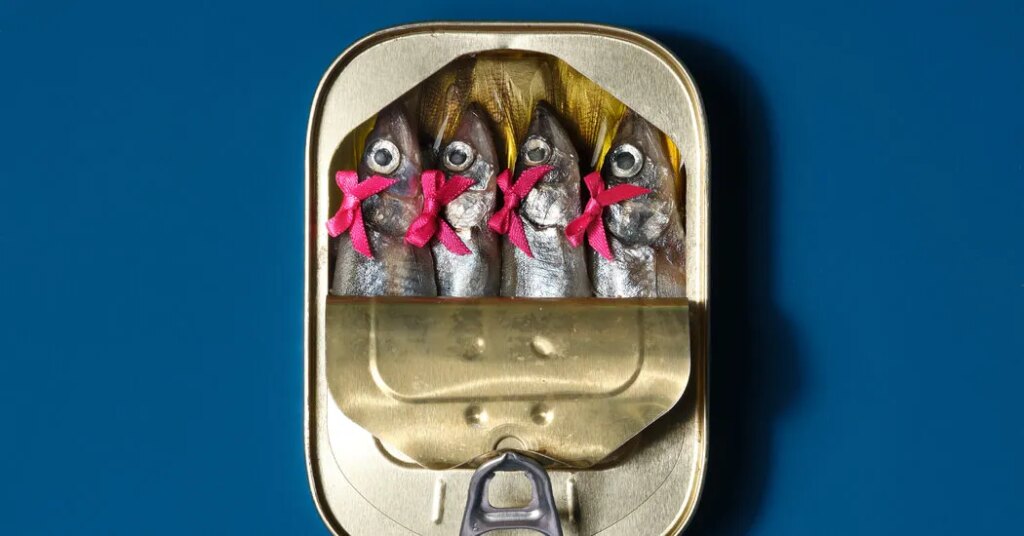
To eat tinned fish for innumerable days and nights in a row, as I have, is to undergo sensory overload. There’s the jiggly tofu silhouette encasing the tender crack-crunch of vertebrae, the briny aroma about as subtle as a house on fire. Salt-slick density melting on the tongue to umami mush.
Like many of our cleverest inventions — duct tape, computers, hair spray — this came out of a war. In the late 1700s, France was troubled by costly military skirmishes and offered a cash prize to citizens who could figure out how to cheaply prevent food from spoiling. An enterprising man named Nicolas Appert sealed cooked fish into glass jars and boiled them, eventually winning 12,000 francs and the kudos of Napoleon Bonaparte. Later, in Britain, the merchant Peter Durand swapped Appert’s jars for tin-plated cans. Fast-forward 200 years and now we’re all swimming happily in a $15 billion global market of shelf-stable seafoods that can last for years and years.
But what drove the ichthyic pioneers of the 19th century were matters of practicality; I do not think Appert and Durand would easily understand how, today, tinned fish is as much a sensible grocery item as it is a status symbol, a viral “hot girl food,” a borderline luxury good. I think it would probably take a long time to explain to the two of them why you can buy limited-edition tinned fish at concerts and why there is coveted merch for saleabout tinned fish and why a store exists in New York City called the Fantastic World of the Portuguese Sardine where a single-serving tin of said fantastic sardine can cost $44.
I think if you tried to tell them about “sardinemaxxing,” they would be confused.
I’m confused, myself.
Because $44 feels like a small price to pay for a sociological education, I spent some weeks recently sampling as much of this genre as I could. I ate not just sardines but also smoked salmon marinated in chili oil, small-batch mussels in sweet pepper and garlic, various types of trout, anchovies and an enormous amount of t*** — so much t*** that I refuse to look at the word anymore and you cannot make me spell it out — and what I learned is that most of it tastes kind of just … OK?
The genesis of the modern tinned-fish fervor was the Covid-19 lockdown. During that time, otherwise rational human beings suddenly dropped unspeakable amounts of cash on rare plants, industrial kitchen gadgets, “loungewear” and, yes, $10-to-$80-a-pop artisanal preserved fish meats in whimsical boxes. (What’s that saying about shooting fish in a barrel?) The year 2020 birthed not one but two buzzy direct-to-consumer tinned-fish start-ups, one of which became a hit on (what else) “Shark Tank.” Yet even after the pandemic eased and consumers ditched their sweatpants, they kept buying tinned fish.
One theory I’ve heard about the lasting craze is that it’s a way to feel the thrill of travel without needing to go anywhere; getting anchovies shipped in from popular tourist destinations like Portugal and Spain can stand in for the time-intensive experience of traversing Portugal or Spain. I’ve also read that tinned fish feeds right into health and wellness zeal, that it scratches the paranoid, conspiracy-minded itch for “bunker food” and that it might simply be about affordability — epicurean brands aside, you can get a supermarket can for $2 or $3 — which would take tinned fish all the way back to its roots as a balm in a time of financial crisis.
Credible arguments, to be sure. But as I “made dinner” after work every night, i.e. nibbled t*** straight out of the package like a raccoon (tinned-fish cookbooks do exist, but if you are someone who enjoys defaulting to the lowest common denominator of effort available, you, too, might be a secret raccoon), a different idea occurred to me.
My prefabricated meals were immensely satisfying not because they were convenient or cheap or hyperefficient panaceas to hunger — although they were all those things — but because they were entirely impossible to mess up. You cannot fail at tinned fish! Slap it onto a cracker, if you’re too dignified to self-spoon-feed the way I do. Scramble it into a broader vision like a pasta or a sandwich if you must. But you can never go wrong with the cookery here the way you definitely can with, say, raw fish. This certitude is a great pleasure. This is the bone-deep comfort and joy of having life’s weighty demands taken care of, of having everything planned out by somebody else. Here you go, decisions ready made. Eating tinned fish feels like being handed a scrunched paper bag on your way out the door by a warm, authoritative, parental hand — which of course you deserve.
Adult Lunchables are already everywhere in this world. Sophisticate versions of juvenile favorites include: tropical cocktails (grown-up Capri-Suns), burrata (string cheese), any dessert (candy wearing pants), smoothies (basically actual baby food). Tinned fish is a funny one, though, because no kid would actually choose to eat tinned fish. It’s an acquired taste, funky and fusty and a little bit offensive, merely presented in a kid way. And so in that way it’s maybe more like whatever’s going on with all these bows on adult women’s clothing.
Right around the time of my piscivore experiment, Fishwife, the “Shark Tank” direct-to-consumer darling, launched a limited-run summer niçoise salad in collaboration with the national chain Sweetgreen. A friend and I were both curious to try this ingenious branding bonanza — but by the time we got around to putting a date into our busy calendars, the collaboration had ended.
So we gathered the ingredients posted to the company’s website and assembled the dish ourselves. I spent far too long roasting the recipe’s “peak-season vegetables” and chopping three types of greens and hard-boiling the eggs, only to realize the eggs were supposed to be “jammy soft-boiled.” Neither of us remembered to bring “crispy onions, for topping.” We looked at each other, two 30-somethings eating our effortful, lukewarm, half-correctly assembled salads, and figured that next time, we should probably just go to a restaurant.
Amy X. Wang is a story editor for the magazine. Her work explores the ways in which money and consumerism shape modern life.
The post I Surrendered All My Decisions and Desires. All It Took Was Many, Many Tins of Fish. appeared first on New York Times.