THIS CURSED BEAUTIFUL LAND: A Russian-American Story, by Evan Gershkovich
Three years ago, the Wall Street Journal correspondent Evan Gershkovich walked into an American-style steakhouse in Yekaterinburg, an industrial city 900 miles east of Moscow. The full-scale invasion of Ukraine was in its second year, and he was there to meet a tank-factory union boss named Pavel, a source for a story about Russia’s military production. Not long after he sat down, Pavel, who was actually working for Russian intelligence, thrust handwritten copies of what he had called “state secrets” into the reporter’s hands.
Moments later, a group of men in balaclavas descended on Gershkovich, covered his head with a black sack and hustled him into a van. He tried to explain that he was a journalist. One of them cut him off: “What would your government think if our journalists were working on this kind of article in your country?”
As Gershkovich writes in his deeply reported, enthralling memoir, “This Cursed Beautiful Land,” the United States, like Russia, has a long and sordid history of deploying spies posing as foreign correspondents, and leaning on actual reporters to gather intelligence.
But the arrest of Gershkovich on the charge of espionage — the first apprehension of an American journalist in Russia on such allegations since the Cold War — was plainly a farce, an excuse to procure a diplomatic bargaining chip. As one Russian talk-show host put it in the days after Gershkovich was locked up: “We’ve replenished our exchange fund.”
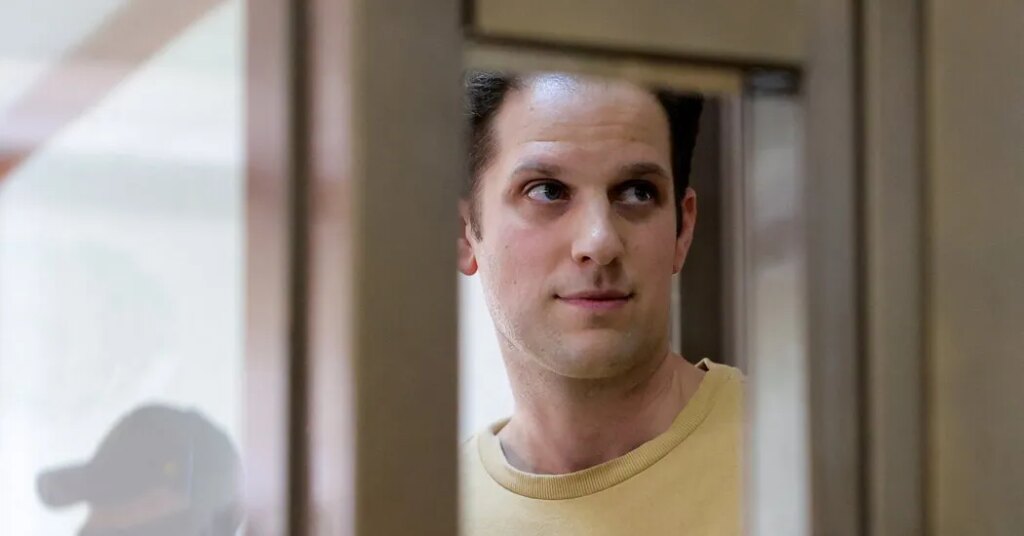
Confined to a cell in the czarist-era Lefortovo Prison in Moscow, but assured by an American diplomat that he would eventually be going home, Gershkovich embarks on a reporting project. For the next 16 months, he keeps a journal, copying his entries onto loose leaf that he mails out each week.
“I get to see the system from the inside,” he writes. “I’m a reporter, after all — a voyeur — and this is the ultimate voyeurism.” In a perverse way, Gershkovich suggests, becoming ensnared in the Russian penal system was the culmination of an existential quest he had been on since childhood. “Did I want to end up here?” he writes in the journal in April 2023. “Was there some subconscious desire to get in here?”
Gershkovich grew up in New Jersey in the 1990s, raised by parents who had emigrated from the Soviet Union in 1979. With a steady diet of borscht and Soviet cartoons, they primed their son to yearn for a country he had never known and that no longer existed. They read him Krylov’s fables, instead of Aesop’s, and they spoke a “fossilized” version of their mother tongue, replete with archaic expressions that were the Russian equivalents of “swell” and “the bee’s knees.”
All this drew Gershkovich back to the place his family had fled. It also made him an ill fit for modern Russian society. When he started writing for The Moscow Times in 2017, it would take some time for Gershkovich to shake off his American informality and update his parlance. At one of his first news conferences, he addresses a politician with a cheery privet (hi) rather than a dignified dobry den (good day). He tells a friend he is vozbuzhdyon (horny) to visit a bathhouse, when he had wanted to use the word vzvolnovan (excited), which, in any case, isn’t a very Russian thing to say. Even so, his new Russian colleagues accept him as one of their own. They call him Vanya, a diminutive for Ivan, the Russian version of Evan.
In the claws of the Russian legal system, Gershkovich’s education gathers speed. He picks up new words: chifir (jailhouse tea), kicha (punishment cell). He learns the finer points of Russian prison etiquette: Wipe your feet before entering a cell, shake no man’s hand until you know what he’s in for.
And he develops relationships with the sorts of Russians that most foreign correspondents would be lucky to interview once: past and future Wagner fighters, prison guards who’ve likely never spoken to the press and hard-bitten defense lawyers too busy fighting the system to chat with a reporter.
Gershkovich has sympathy for all of them. He helps one cellmate add weight to his squats by sitting on his shoulders. He helps another with his English, correcting his pronunciation as he reads aloud from “The Chronicles of Narnia.” In court, he even offers a smile to Pavel, the undercover operative who landed him in this mess.
As weeks turn into months, Gershkovich begins to forget some English words, and traces of his American accent fade. More critically, his very personality seems to morph: less Evan, more Vanya. When Lynne Tracy, the U.S. ambassador to Russia, pays him a visit, he is put off by her “distinctly American mix of cheerfulness and concern.” In the belly of the Russian dictatorship, he writes, “what I wanted — what I needed — was dark humor and a shrug.”
But even as Gershkovich assimilates, his Americanness always holds him apart, protecting him from the worst of his bleak surroundings. His fellow inmates are subjected to beatings, water boarding and mock executions. Gershkovich, meanwhile, is treated as a “commodity to be kept in pristine shape.” He never forgets that he is both here and there, inside and outside the place his parents’ old home has become.
“This Cursed Beautiful Land” is one of a handful of recent books whose ultimate subject is nostalgia for a country overtaken by authoritarianism. The same undercurrent of longing propels Aleksei Navalny’s “Patriot,” even as it delivers the Russian opposition leader to the Arctic penal colony where he died in the winter of 2024. And in “The Renovation,” a darkly comic novel by the Turkish American writer Kenan Orhan, a woman living in Salerno so misses her native Turkey that her bathroom becomes a portal to a notorious political prison in Istanbul — a sinister Narnia that both repels and beckons.
In July 2024, after nearly 500 days in pretrial detention, Gershkovich was given a 16-year sentence. Less than two weeks later, he was on a flight home, released as part of a prisoner swap involving two dozen people and seven countries. That day, the Kremlin also released seven Russian political prisoners.
For some of them, Gershkovich writes, “it wasn’t a feeling of liberation but one of expulsion.” Leaving Russia was a mixed blessing for him, too. Gershkovich’s attachment to Russia is not quite Stockholm syndrome, but it’s close. On the ride to the airport, he looks out at the city. “Would I ever see Moscow again?” he wonders.
The many thousands of Russians who have left since the start of the war with Ukraine, including members of my own family, have asked themselves that very question. Putin has called the exodus a “natural and necessary self-cleansing of society.” Those who departed were “scum and traitors.”
Many will never return, their sense of alienation from Russia only deepening with time, along with their nostalgia. Gershkovich won’t be welcome back anytime soon either. For now, he can at least find a modicum of solace in a line from one of his favorite novels, “The Suitcase,” by the exiled Soviet writer Sergei Dovlatov: “No Russian intellectual who hasn’t been in prison is worth a damn.”
THIS CURSED BEAUTIFUL LAND: A Russian-American Story | By Evan Gershkovich | Crown | 410 pp. | $34
The post He Landed in a Russian Jail Cell. Was It Just Where He Wanted to Be? appeared first on New York Times.