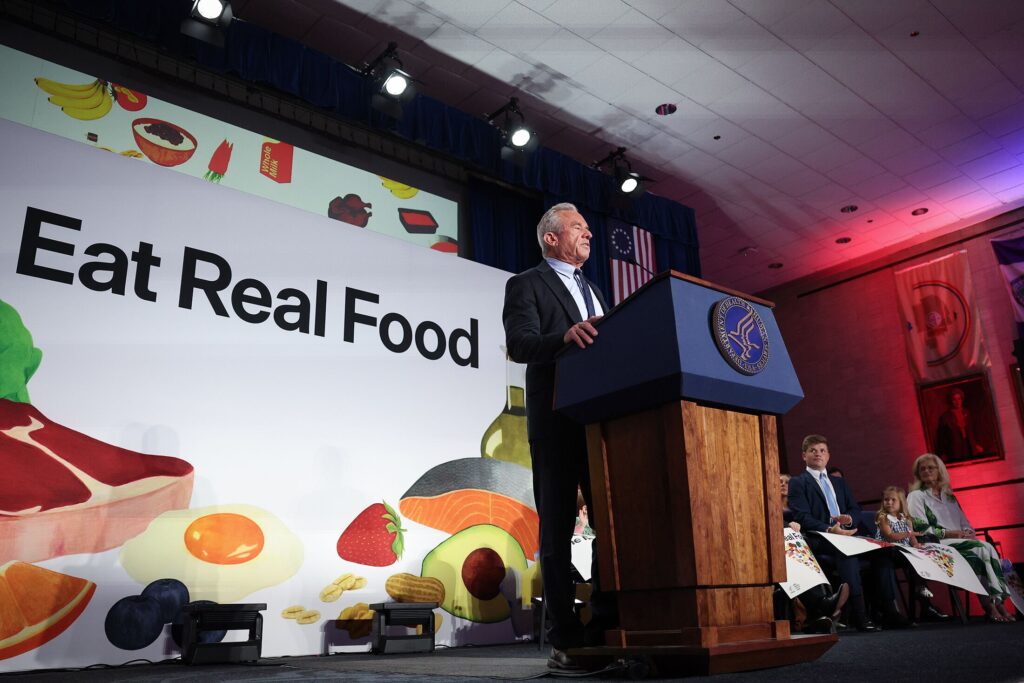
Earlier this year, Health Secretary Robert F. Kennedy Jr. seemed poised to challenge the powerful food industry.
The Department of Health and Human Services had concluded that food companies should produce “any detailed safety studies” showing that certain ingredients common in ultra-processed foods are generally safe and aren’t contributing to chronic health conditions, according to a March draft of a letter that the secretary sent to the White House for review, and that was obtained by The Washington Post. In the draft, Kennedy praised a citizen petition by David Kessler, a former head of the Food and Drug Administration, who asked the agency to scrutinize some of the core ingredients used in industrial processing.
But for months, the potential push has been slow-walked at the White House, according to two people familiar with the matter who spoke on the condition of anonymity to share private details.
It was not immediately clear if the draft response obtained by The Post is the latest version. But the delay over Kennedy’s response — which experts said would have launched a process that could force the industry to reformulate some ultra-processed foods — shows the challenges he is encountering in confronting food companies.
Meanwhile, federal officials were aiming to release information around a standard definition of ultra-processed foods last month, according to three people familiar with the matter, but doing so was delayed at the last minute. A proposed definition is currently under review at the White House budget office.
In the draft letter, Kennedy lauded Kessler’s request, which food experts said could lead to some of the most significant changes for the food industry in decades.
“I believe your petition points toward an historic opportunity to significantly improve the quality of our food supply and thus the health of our citizens,” Kennedy wrote in the draft letter, adding, “We want to see any information that proves these ingredients at the quantities they are being added to the food supply should still be generally considered safe.”
HHS said the notion that Kennedy’s Make America Healthy Again food agenda has been “stalled or slow walked is false.”
“President Trump and Secretary Kennedy are fully aligned on advancing the MAHA agenda, and HHS is working closely with the White House and our federal partners to ensure these consequential policies are scientifically rigorous, legally durable, and effective,” HHS spokeswoman Emily Hilliard said in a statement.
Hilliard noted that the department is working to overhaul the process for foods known as GRAS, or “generally recognized as safe.” HHS released a proposed rule last month aimed at tightening the loophole.
“The Trump Administration is actively advancing the federal government’s first definition of ultra-processed foods and landmark reforms to the GRAS process that will bring greater transparency and accountability to the food supply,” Hilliard said.
Under Kennedy’s tenure, he has revised dietary guidelines, pushed for the food industry to get rid of artificial dyes and proposed to increase transparency into the chemicals in the nation’s food supply. HHS officials say that White House involvement is part of the normal process.
The food industry has generally maintained that its products are safe and has argued that demonizing ultra-processed foods oversimplifies the issue. It has opposed a new definition of ultra-processed foods, arguing it would confuse people and lead to higher grocery costs. Food groups, along with consumer advocates and others, have begun having formal meetings with White House and health officials on the matter in recent weeks.
White House spokesman Kush Desai said that Make America Healthy Again isn’t “just a campaign slogan” but is a “key presidential priority.”
“The White House has repeatedly taken on special interests and broken processes to deliver effective and legally durable MAHA policies,” he said in a statement. “The entire Trump administration continues to work closely with stakeholders and industry leaders to continue overhauling our country’s food and updating nutritional guidance.”
Kennedy has previously claimed that the nation’s food supply has been allowed to “mass poison” this generation of children. The Trump administration has identified ultra-processed foods as a key driver of childhood chronic disease, as more than half of the daily calories Americans consume come from such products.
Until recently, Kennedy, the founder of a prominent anti-vaccine group, had leaned into his broadly popular messaging around food ahead of this year’s midterm elections instead of his deeply controversial efforts to upend the nation’s vaccination system. Polls have found that the majority of Americans on both sides of the aisle say there is insufficient regulation of chemical additives in food, one of the focuses of the MAHA movement championed by Kennedy.
In August 2025, Kessler filed his citizen petition to the agency he once led nearly 30 years ago. He zeroed in on the use of processed, refined carbohydrates — such as high-fructose corn syrups, flours and starches that have been industrially processed — that are often found in store-bought products.
Food manufacturers have marketed products with these ingredients under the decades-old loophole known as “generally recognized as safe.” That means they bypassed a lengthy approval process for these substances. In his petition, Kessler said refined carbohydrates should no longer be able to keep that status, arguing that they can lead to health conditions such as Type 2 diabetes, certain cancers and heart disease.
“Processed refined carbohydrates are allowed on the market because almost 50 years ago they were found to be ‘generally recognized as safe’ but, as this petition demonstrates, the science no longer supports that determination,” wrote Kessler, who served as FDA chief under Republican and Democratic presidents and worked on the Biden administration’s covid response.
Food experts have said the petition is creative because targeting refined carbohydrates would cover a significant portion of ultra-processed foods.
“This is long overdue, and we absolutely need more research and more clarity on the safety of our food supply,” said Christopher Palmer, an assistant professor of psychiatry at Harvard Medical School who researches the intersection of metabolism and mental health.
Specifically, Kessler called on the FDA to require manufacturers to show that their foods are safe and ask for agency approval to continue using the products. If companies couldn’t do so, they’d have to reformulate their products.
The draft response from Kennedy doesn’t go as far as that, though it said a “flood of new scientific data” indicates that the ingredients are linked to chronic health conditions. The draft calls on companies to provide any safety information they have on the health impacts of refined starches and sweeteners so the agency can evaluate whether they should be generally considered safe. The document did not give a timeline for doing so, nor did it lay out potential consequences for not providing the information.
“If the administration wants to make America healthy, acting on this petition is critically important,” Kessler said in an interview. “These ultra-processed foods are responsible for much of the serious metabolic harm America is facing.”
Peter Lurie, president of the nonprofit Center for Science in the Public Interest, said the draft proposal is the process he would expect FDA to follow.
“It’s a reasonable step if one wanted to further regulate this set of chemicals,” said Lurie, who is also a former FDA official.
Palmer, who joined a 2024 health roundtable on Capitol Hill with Kennedy and prominent figures in the MAHA movement, said it would be a “clear, no-cost first step” for the food industry to share the research that it has already conducted.
In February, Kennedy suggested that HHS would look favorably on the petition. During his tenure as the nation’s top health official, he has at times opted to push the industry to voluntarily change rather than imposing mandates.
“I’m not saying that we’re going to regulate ultra-processed food,” Kennedy said on CBS News’s “60 Minutes” earlier this year. “Our job is to make sure that everybody understands what they’re getting, to have an informed public.”
The post White House has not acted on RFK Jr.’s push for proof ultra-processed foods are safe appeared first on Washington Post.