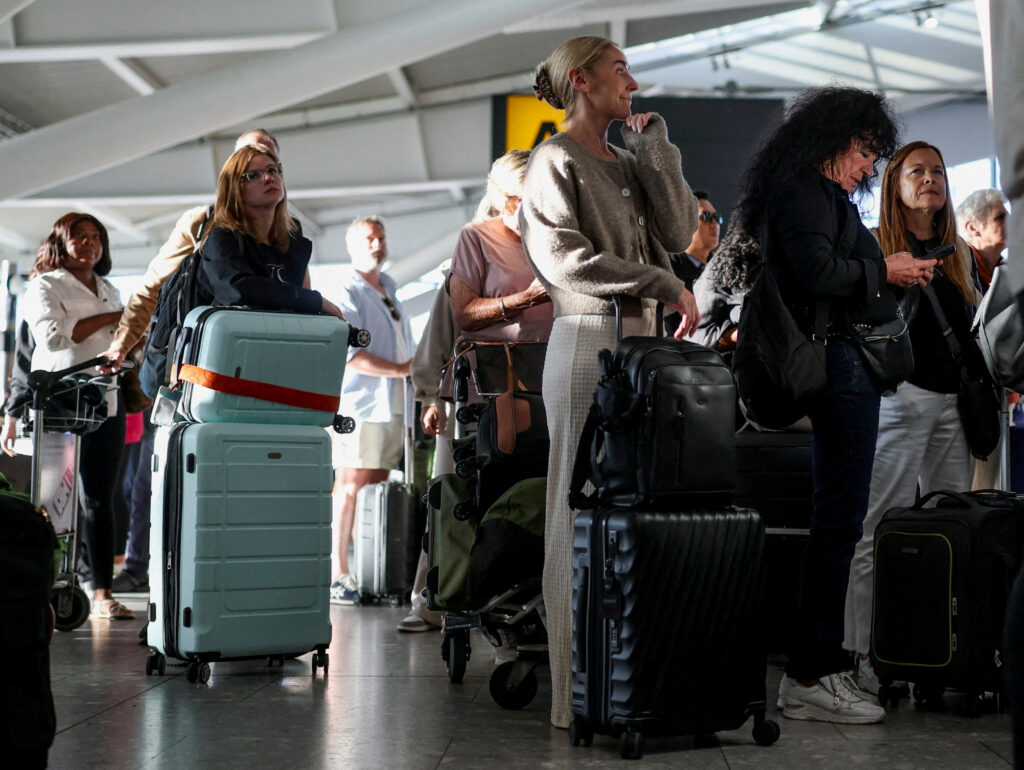
For Ramsey Qubein, London Heathrow is a missed connection he hopes to never meet again.
After too many maddening transits, the Charlotte-based travel journalist, who logs about 400,000 miles per year, has soured on one of the world’s most connected — and baffling — airports.
“I have actively opted to avoid Heathrow due to the ridiculous secondary-security screening, having to wait for security to rummage through your personal items with the same dirty gloves they use for everyone else’s things,” Qubein said. “If you have to change terminals, two hours is almost always necessary.”
Surprisingly, some of the best airports for nonstop flights or long layovers can be the worst for people with connections, especially tight ones. Passengers in transit typically care more about interterminal transportation, walkability and signage than amenities and aesthetics. They need to move as quickly and seamlessly as possible from their arrival gate to their next departure gate, without any detours to the baggage carousel, security or the information desk to ask for directions.
“The best airport for connections is the one where you don’t have to stay there very long,” said Brett Snyder, founder of Cranky Concierge, a travel adviser. “That’s the dream, right?”
Best airports
The 50 best airports in America, ranked
See how your airport ranks among the best in the country
What airport is truly America’s busiest? It’s more complicated than you think.
Denver ranks the worst
Airports that excel at connections share similar traits. The gates are in proximity to each other or are easily accessible by foot. The terminals are linked by moving walkways or an even speedier mode of transit, such as a train or tram. Signage, including flight information boards, is prominent and ubiquitous. The layout is intuitive, not a boxwood maze.
John DiScala, a travel blogger who goes by Johnny Jet, holds up Los Angeles International as a model airport, which three years ago completed a project that unfurled like a red carpet: a two-mile, uninterrupted walk from Terminal 1 to 8. By comparison, John F. Kennedy International Airport in New York feels like a Lego project assembled in the dark.
“LAX is so much easier than JFK. It is compact compared to JFK,” said DiScala, who resides in Los Angeles. “All those terminals [at the New York airport] are stand-alone. You take the AirTrain and have to go outside security. At LAX, you can stay within security, so that makes a huge difference.”
Facilities that fail in these key categories end up on ignominious Reddit threads, such as r/airport’s “Which airport is the worst airport to have a layover in?” and databased lists, such as Josh Koebert’s deep-dive into the connections experience at the 50 biggest U.S. airports.
For the study, Koebert, a data scientist and researcher for Travel Bulletin, calculated scores for “walkability” (distance by foot between two points) and “connection” (total travel time between two points, including train or shuttle transport) for each airport. He also determined the distances between specific goalposts, such as the longest walk between two gates or between the security checkpoint and the farthest gate.
So, which airport ranked as the very worst? Denver International Airport — a surprise to no one.
“Denver is just way too spread out. It has huge distances between gates,” Koebert said. “The design is not built for convenience. It doesn’t get anyone anywhere.”
According to his findings, the airport earned a pitiful 10.9 for walkability and 14.1 for connection, out of a high of 50. (By comparison, Richmond International in Virginia scored a 46.8 and 47.8, respectively.) The longest travel time between two gates is 34 minutes, which includes a spin on its underground train. Traversing an “average” concourse takes 16 minutes.
Though the Cranky Concierge’s Snyder praised Denver for its “pretty mountain scenery,” his warm fuzzies for the Colorado airport stopped there.
“Inside it’s ugly, and they have train problems and you can’t walk between the terminals,” Snyder said.
He had equally sharp words for Miami International — “It feels like absolute chaos at all times” — and Dallas Fort Worth International, another fan unfavorite.
“They have made a lot of changes over the years to make it work better for connections, but the distances can still be pretty far,” Snyder said. “And now that they’re adding another terminal — that’s going to add another stop to the never-ending train.”
In its Summer 2026 Disruption Report, AirHelp — which helps air travelers secure refunds from the airlines — singled out Dallas for having one of the highest missed-connection scores worldwide. Chicago O’Hare and Hartsfield-Jackson Atlanta fared equally unwell, despite Atlanta’s strong on-time performance this summer.
“The lesson for travelers is that a good overall disruption rate doesn’t automatically mean an easy connection,” said Erika Josefsson, a passenger rights expert at AirHelp. “It depends more on how much time you’re actually given to make it.”
Airports that are lost in translation
In addition to long walks and disjointed terminals, passengers connecting in international airports often face additional obstacles, including foreign signage, passport control, security checkpoints and eGates that often require human intervention. Navigating this Tough Mudder course can be hard at your sharpest, and soul-crushing when jet-lagged.
Transiting travelers are unified in their dislike of London Heathrow, Frankfurt Airport in Germany and Paris-Charles de Gaulle. Europe’s airports did not win over any hearts this summer, which was beset with air traffic control glitches and issues with the new European Entry/Exit System.
But many of these airports only have themselves — or their designers — to blame.
“One airport I almost never have a great time connecting at is Frankfurt. It has a high percentage of bus gates, which suck up time,” said Scott Laird, a seasoned traveler and freelance writer. “What seems to make Frankfurt worse is that Lufthansa has a habit of pretending nothing is wrong and schedules hour-long connections that depend heavily on magical thinking.”
Katy Nastro, a travel expert with the app Flighty, was connecting in Paris-Charles de Gaulle and noticed a group of people congregating around stanchions that resembled a barricade. If she had not stopped to investigate, she might have missed her flight home to New York.
“I thought the area was blocked off, but that was actually where I should have been going,” Nastro said. “I would have kept walking, because I was just like, ‘La-di-da, where is the departure area?’ The signage is lackluster at best, but also deceptive.”
To avoid the stress of a foreign transit, Snyder recommends booking an international flight with a connection in a U.S. airport, a strategy that works in both directions. From the connecting domestic airport, you can fly nonstop to your final destination without having to tangle with unfamiliar systems, structures and signage. For example, if you plan to visit València, Spain, one of United Airlines’ new destinations for next summer, you can fly from your home airport to Newark Liberty International Airport in New Jersey, then straight to the Spanish city.
“Would you rather fly through Madrid or Frankfurt or Paris and take your chances with a connection over there,” Snyder said, “or would you rather just go to Newark and know what you’re getting?”
Avoid bad connecting airports or book a long layover
To avoid an airport with a bad transit reputation, simply don’t book it. Check carriers that connect through more favorable hubs, such as KLM and Amsterdam Airport Schiphol, Icelandair and Keflavík International Airport, and Turkish Airlines and Istanbul Airport.
If, however, the best itinerary includes an ill-conceived airport, build in additional transit time, especially if you are traveling during a storm season. Search for itineraries with long layovers or even an overnight stay. The airlines TAP Air Portugal and Emirates, for example, have generous stopover programs.
Researching the transit airport can help ease the stress of connecting, too. Check for construction alerts on the airport’s website, and know in advance whether you can stay airside or whether you will have to pass through passport control and/or security.
“One thing to check when making connections is whether the terminals at your connecting airport are all linked behind security,” Laird said, noting that at the airports in Dallas, Houston and Atlanta, the different terminal buildings are all connected, making them easier to navigate between without going through security again. “At airports like JFK, SFO, and ORD, they’re not, so changing terminals often means a second trip through the checkpoint.”
If you are returning from London Heathrow and connecting through Dallas or Atlanta, take advantage of the Transportation Security Administration’s pilot program One Stop Security, which sends your checked bags to your final destination, cutting out the baggage-retrieval-and-security step. It is available on select carriers.
Before landing, Koebert suggests mapping out your gate-to-gate route. Check your airline’s app, or ask the flight crew, for the departure gate, then plot your course.
“Go to the official airport websites and look up maps, and they’ll show you exactly how far apart things are and where things are,” he said. “They’ll even label which airlines fly out of these concourses.”
If you miss your connection, the airline will rebook you on the next available flight. Hopefully, the worst connection airport is one of the best layover airports. Denver International, for one, offers stuck travelers a slew of distractions, including local eateries, breweries and snuggle sessions with the Canine Airport Therapy Squad.
The post The worst airports if you have a connecting flight appeared first on Washington Post.