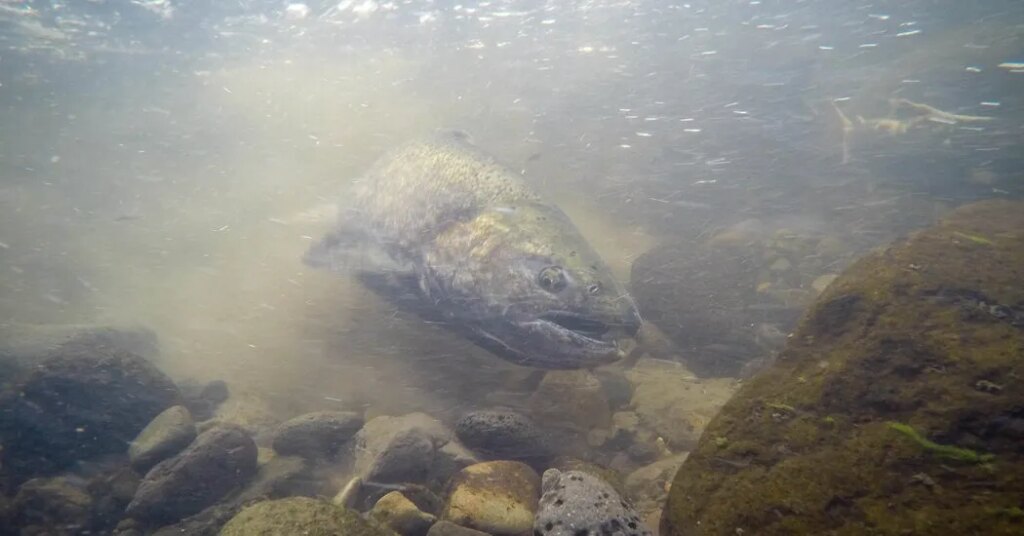
The Klamath River, cleared of big barriers for the first time in more than a century after the largest dam removal project in American history, is experiencing a significant rebound of native chinook salmon, according to a new study.
Thousands of the salmon were recorded passing a former dam site in 2024 and 2025, researchers say, and have reoccupied nearly the full extent of their known historical range.
“I don’t think any of us, in our wildest dreams, expected this many fish this quickly to repatriate that area,” said Keith Parker, a senior fisheries biologist and member of the Yurok Tribe, which led the decades-long campaign to have the dams removed.
The river, which flows about 260 miles through Oregon and California, was spanned by four major hydroelectric dams for decades. After years of contentious debate and careful planning, the last of those dams was removed in 2024. Salmon returned to the river’s headwaters last fall, but early reports gave no clear indication of how the fish might fare.
Now, the new study, published in the journal Scientific Reports in August, suggests that salmon in the river are making a comeback.
“Recovery takes time,” said Damon Goodman, a fish biologist with the conservation organization California Trout who led the report. “We’re not there yet. But the signs are good.”
The researchers used sonar to count fish passing the former Iron Gate Dam site, supplemented by video monitoring and surveys of live salmon and carcasses to estimate how many were chinook.
They expected the fish to “trickle in,” said Mark Hereford, a project lead for the effort at Oregon Department of Fish and Wildlife. Instead, they got a tidal wave.
In 2024, after the dam removal, more than 7,700 adult chinook salmon swam through. In 2025, when chinook returned to the headwaters of the Klamath for the first time in more than a century, the number of them at the same site increased by about 72 percent, to more than 13,300. That was about a fifth of all the chinook salmon in the Klamath basin in both years.
Coho salmon, steelhead trout and Pacific lamprey, also important for Indigenous subsistence fishing, migrated upstream, too.
Researchers spotted chinook essentially anywhere the salmon could spawn. That adaptability is a good sign: Having more habitat options is critical for the fishes’ ability to cope with climate change.
“It’s been quite remarkable, the speed at which this has happened,” said Scott Hinch, a salmon ecologist at the University of British Columbia who was not involved in the study. “Everything has to fall into place to make something like this possible.”
Dr. Hinch highlighted an element of luck with these strong returns: Had ocean conditions been poorer, fewer juvenile salmon would have survived and been able to return as adults. “We have to be careful not to gauge our expectations too high, as oceans continue to warm,” he added.
Early spawning was successful, too. In 2025, more than 300 chinook reached the uppermost tributaries above Upper Klamath Lake. And this spring, the first juvenile chinook were observed after hatching in the upper reaches of the basin. It’s an important milestone, and researchers hope some of those fish will return and spawn in their newly reconnected natal streams, completing the new cycle.
Some tribes, including the Yurok, are already reaping the benefits of stronger fall chinook runs. The Yurok in August held their annual salmon festival; for the first time in years, they actually served salmon. They’re also distributing salmon to elders and schools.
The signs of recovery that the salmon, the river and the ecosystem show so far are encouraging, Mr. Goodman of California Trout said. To see the recovery through, teams will need more monitoring of salmon and other migratory fish. They’ll also need to make improvements to two smaller dams that are used primarily to control water levels and that aren’t up to modern fish-passage standards.
“We’re on pins and needles right now,” Mr. Goodman said. “We’re just so excited to see what this year has in store for us.”
The post Salmon Are Thriving After Klamath River Dam Removals, Study Finds appeared first on New York Times.