The first time he went into cardiac arrest and died, briefly, Dr. Robert Montgomery was hiking up a mountain trail in Patagonia. Wind was blowing snow in his face and he felt his heart racing as he lagged behind his son John and their guide. Then he collapsed, face-down into the snow.
Seconds passed before a medical device implanted in his chest kicked in and delivered a shock that restored his heartbeat and saved his life.
It was 2010, and Montgomery, then 50, recovered quickly. But it was becoming painfully clear that he needed a new heart: The one he was born with was failing.
The odds of him getting a heart transplant were grim. Some 50,000 organs are transplanted in the United States each year, but only a few thousand people are able to get a heart. Hearts are so rare that patients often can’t even get on the waiting list for one until they are in the hospital, close to death.
Montgomery knew this because he was a transplant surgeon himself.
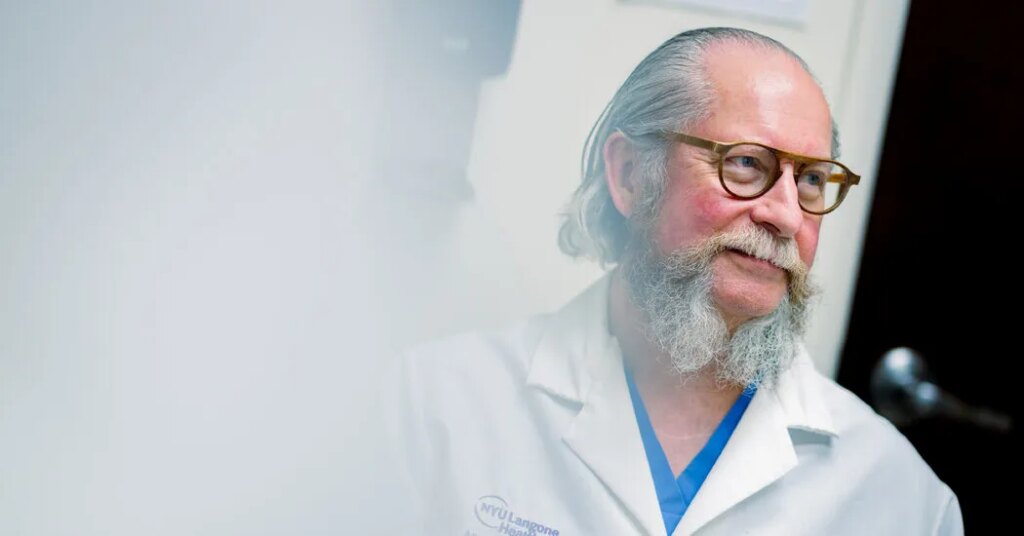
At the time of his Argentina trip, Montgomery was leading one of the nation’s premier organ transplant centers, at NYU Langone Health. He had developed innovative approaches to transplanting kidneys that had been adopted worldwide, and he would go on to play a leading role in the use of organs from genetically modified pigs.
To him, organ transplants were one of the most effective medical treatments ever invented, their power to transform lives thwarted only by the shortage of organs available.
But it looked increasingly likely that he might die before he could get a heart himself. Despite his brush with death on the mountain, he was nowhere near sick enough yet to make it onto the list.
“It’s a terrible position to be in, because you have to be at death’s door,” he said. “And your chances of not making it across the finishing line are so great.”
Driven to Medicine
Montgomery, with his reassuring bedside manner and his penchant for pushing the boundaries of transplants, might seem like he was destined to be a doctor. But as a child, he wanted to be a veterinarian. It was only when, at age 14, his father developed symptoms of dilated cardiomyopathy, that he reconsidered. The rare disease causes the heart’s chambers to stretch and enlarge, and can lead to heart failure, irregular heart beats or arrhythmias, cardiac arrest and sudden death.
His father, Lawrence Montgomery, became increasingly debilitated, and eventually needed a feeding tube after suffering brain damage from a cardiac arrest. Montgomery recalled his mother pleading with his father’s cardiologist for a cure. The cardiologist said that a heart transplant, which was novel at the time, was an option, “but it really doesn’t work, anyway.”
“And I was thinking, ‘Well, why doesn’t it work, and if it’s the last thing left, why don’t they figure it out?’” Montgomery recalled.
By the time Lawrence died in 1976, 16-year-old Bob had decided to become a doctor.
Eleven years later, he had just started a prestigious surgical residency at Johns Hopkins Medicine when he got the worst phone call of his life. His brother Rich, a 35-year-old father of two, had dropped dead that morning while water-skiing.
“He just let go of the rope,” Montgomery said.
Pathologists discovered that Rich also had dilated cardiomyopathy, likely caused by a genetic mutation. Montgomery was evaluated and learned he had the condition too.
Suddenly, his career was in doubt. Surgical training was grueling, and a cardiac arrest or fainting episode could endanger patients.
When medication failed to keep his arrhythmia in check, Montgomery opted for a new medical device called an implantable cardioverter-defibrillator, or ICD, that could shock the heart back into a normal rhythm.
Unsure if he could complete his residency, Montgomery and his wife at the time moved to Oxford, England, so he could study immunology. He decided to pursue a doctorate, just in case surgery didn’t work out.
One evening there was a loud crash on the busy street where they lived. Montgomery heard a woman screaming. Her car had flipped. She had managed to climb out, but her baby was trapped inside.
Montgomery crawled through the car’s window and extricated the toddler. He felt his heart racing. The implanted device shocked him with the force of a sledgehammer, three times.
It was a pivotal moment for Montgomery, who realized he couldn’t be a surgeon if the implanted device was activated so easily.
“I had to completely abolish my fight-or-flight response and adrenaline and all the things that caused my heart to go into arrhythmia, or I would never be able to be what I wanted to be,” he said.
Over the next few years, he trained himself to control his physiological responses to stress. He would think about what made him anxious, and then take deep breaths and visualize peaceful scenes as he told himself all that mattered was that he was alive.
In a Hurry, and ‘Hyper-Focused’
Montgomery returned to Johns Hopkins in 1992. He wanted to specialize in transplant surgery, to get more organs into people who needed them. His own illness was a tremendous motivator.
“I didn’t think I would live a normal life span — I knew I would need a heart transplant or I would die — so I was in a hurry, and I was hyper-focused,” he said.
“I was very cognizant that I was in a position where something I did could have an impact that might someday help my children and my grandchildren,” Montgomery added.
So few heart transplants were done in the early 1990s that becoming a full-time heart transplant surgeon wasn’t an option. Montgomery transplanted livers, pancreases and kidneys, but he focused on kidneys, the most commonly transplanted organ. At Hopkins, he helped develop a minimally invasive surgical technique for retrieving kidneys from healthy living donors, which doctors hoped would lead more people to donate a kidney. It did, and children in need were the first beneficiaries. Over the next few years, “we transplanted all the kids on our pediatric list,” Montgomery said.
In 2001, realizing he could increase the number of patients who got an organ if kidneys were swapped between incompatible, donor-recipient pairs, Montgomery started a program to do just that. Soon he and his team were doing domino donations. An altruistic donor gave a kidney to a stranger, whose nonmatching donor gave a kidney to a second recipient and so on. (In 2010, an eight-way chain earned Montgomery a spot in the Guinness Book of World Records for the most organ transplants done in a day.)
“He was seen as a bit of a cowboy,” said Brigitte Sullivan, the transplant administrator whom Montgomery described as his “fellow visionary.” It didn’t help that Montgomery wore his hair long, had a biker mustache and often donned cowboy boots with his scrubs.
He went on to help develop a new approach to reduce organ rejection in patients at high risk of failed transplants, and supported an initiative to use kidneys recovered from organ donors with H.I.V., transplanting them in H.I.V. positive patients instead of throwing them out. Federal law had to be changed, but this is now standard care.
“Bob was the only person in the country who said, ‘Yeah, you should do that — let’s spend a lot of effort and time and money to make this happen,’” said Dr. Dorry Segev, the transplant surgeon who led the H.I.V. initiative.
In 2016, NYU Langone Health recruited Montgomery to build a world class organ transplant program, and he moved to Manhattan with his wife, the opera singer Denyce Graves, and their daughter. (Montgomery also has three children from previous relationships; his first marriage ended in divorce.). He had met Ms. Graves on a flight to Paris. By the time the plane landed, she had invited him to hear her sing, and he had invited her to watch him operate.
Though he told her he had a serious familial heart condition, Ms. Graves saw someone dynamic and driven, “somebody with a purpose.” He assured her that he “was hard to kill,” she said.
Few of Montgomery’s colleagues and patients had any idea how sick he was.
“There’s this idea that doctors shouldn’t have these vulnerabilities, that there’s a separation between doctors and patients — ‘you’re the doctor, you can’t be sick,’” Montgomery said. “It wasn’t something I would share with my patients then.”
Close to Death
Despite his earlier near-death experience in Patagonia, Montgomery returned to the same spot in 2017. He wanted to spend time with his sons John and Max, but he went into cardiac arrest again. The closest hospital was nearly an hour away, and John did chest compressions on him in the back seat of a Jeep as they raced to it.
When he emerged from a medically induced coma more than a month later in New York, where he had been flown, Montgomery had to learn to walk, talk and eat again.
“As I was having more of these near-death experiences, it became really clear to me that the likelihood of me getting a heart transplant was less than of me dying before I got on the list,” he said. He started wondering how long his luck would last.
A few months later, his heart stopped in the middle of the Broadway show School of Rock. He received CPR in the aisle. At a medical conference in Italy, in September 2018, he experienced four cardiac arrests, one after another. A priest at the hospital gave him last rites.
The upside, he realized, was that he was now so sick that he could finally join the waiting list for a heart. And he knew he would almost certainly be put at the very top.
Montgomery left the hospital in Italy against medical advice, flying home with a physician friend.
“I said, ‘We’ve got to get out of here,’ because now there’s a chance I can get a transplant,” he said. “I was obsessed with that.”
He was admitted to the intensive care unit at NYU Langone and started the wait for an organ. His doctor warned that it could be months, even a year.
“When you’re a transplant surgeon, you’re focused on patients who are lucky enough to get an organ,” he said. It was jarring to be on the other side of it. “You’re waiting for someone to die so that you can live,” he said.
Just before dawn on Sept. 20, he got a call that a heart was available — if he wanted it. The donor, who had died of a heroin overdose, was infected with hepatitis C.
There was reason for pause: The hospital’s heart transplant program was brand-new; Montgomery himself had started it less than a year earlier. And transplants with hepatitis C-positive hearts were so novel that he would be part of a clinical trial if he received one.
“A lot of my colleagues thought I was crazy,” Montgomery recalled. But he believed in the program, and had encouraged his own patients to consider organs with hepatitis C, which could be cured with medication. “So why not me?” he said.
After a six-hour surgery, Montgomery had a new heart.
Most heart transplant patients are so sick by the time they get an organ that they are disabled; only about 30 percent return to work. But two days after the operation, Montgomery was sitting up in bed, reviewing cases.
On Borrowed Time
After his experience, Montgomery began to see all the work he had done to find more viable organs as insufficient — “just rearranging the deck chairs on the Titanic,” as he put it.
“It’s never going to be able to provide enough organs for people with organ failure,” he said. And he felt more in a hurry than ever before.
It was time for a radical move. Experiments had proved that organs from genetically modified pigs could be transplanted into monkeys. The next step was to build a case for transplants to humans. Montgomery decided to try it first in a patient who was brain-dead, something that had never been attempted.
In fall 2021, Montgomery announced that he had for the first time transplanted a kidney from a genetically modified pig into a human. Scientists at United Therapeutics, which produced the pig, had knocked out a gene involved in an aggressive organ rejection response. (The brain-dead patient was an organ donor, and the family consented to the experiment.)
Not only was the kidney not rejected, but it functioned, making urine and excreting waste for 54 hours, the limit set by a hospital ethics panel.
The transplant was a watershed moment. Over the next few years, Montgomery’s team and others in Maryland and Boston transplanted pig kidneys and hearts into a small number of living patients who were terminally ill and had exhausted other treatment options.
The patients died of underlying conditions within months, but none of them mounted the kind of devastating immune rejection that destroys an organ — a major accomplishment that showed that pig organs could be transplanted safely and function properly in humans.
Just before Thanksgiving in 2024, Montgomery transplanted a modified pig’s kidney into Towana Looney, a 53-year-old Alabama woman. Freed of dialysis and its side effects, she said, she had the energy to take long walks around New York and enjoyed eating without nausea for the first time in years. She lived with the kidney for over four months.
Last year, the Food and Drug Administration gave a green light to clinical trials of pig organ transplants in very ill patients who aren’t likely to get a kidney any other way. Montgomery is leading two of them.
He was reluctant to talk about the trials, but since his surgery, he has been more frank about his own transplant. He believes his patients trust him more because of it.
On a recent Thursday morning, Montgomery stopped in to check on a patient whose kidney transplant he had performed that week. He pulled a surgical mask over his bushy mustache before he stepped into the room. The patient, Steve Setteducati, 65, was almost ready to go home, but he had shooting pain down his leg.
Many physicians stand by the bedside when they do their rounds. But Montgomery sat down on Mr. Setteducati’s bed, turning so they were eye-to-eye.
He had a meeting in 15 minutes, but he looked like he had all the time in the world, as he offered Mr. Setteducati a cup of water with his pill, along with some reassurance that the pain would resolve.
“Not that it doesn’t hurt,” he added, “but it will get better.”
The two men high-fived over a good lab result, and Montgomery asked after Mr. Setteducati’s son, who had donated the kidney to his father. “I think he feels richer for it,” Mr. Setteducati said.
The rest of Montgomery’s day was packed. At 66, he is still a man in a hurry. Transplanted organs often don’t last for a lifetime, and he knows it. But the donor heart had made him feel “like a new person,” he said.
“The easiest part of this whole thing was the transplant itself,” he said. “I immediately felt well in a way I hadn’t in many years.”
Since his surgery, he has gone salmon fishing in Alaska with his son John; traveled to Africa with Ms. Graves to celebrate her retirement; and assisted kidney surgeons in Ukraine.
Every morning, to protect his new heart, he walks two miles to work. He sets out before 6 a.m., to make it in time for patient rounds.
The post He Changed the World of Organ Transplants. Would He Die Waiting for His Own? appeared first on New York Times.