At a preview this month for the Lucas Museum of Narrative Art, its lead architect, Ma Yansong, flashing a faint, wry smile, led a phalanx of some 20 reporters around the building. Only about four or five could hear him. Some journalists circled the group, angling to get closer. Many just gave up and watched the tour as sort of an abstract performance.
Ma doesn’t say much; and when he does it’s in phrases that often trail away. Images have always been his most forceful language. And the exuberant visions he now produces, in three dimensions, have helped him become one of the world’s most prominent architects.
Ma is the founder of the Beijing-based firm MAD Architects. Now 50, he leads a team that has completed major cultural and residential projects in 16 countries and counting. Their signature is hard-to-believe designs that do all of the shouting — etched towers churning like hula-hooping women; a museum honed like an ancient stone; an opera house resembling a mountain, bursting from the ground.
At the Lucas Museum, which opened Tuesday, they’ve crafted a curvaceous, $1 billion-plus landmark covered in swirling greenery that appears to levitate over Exposition Park, forming a bridge over a shaded plaza and then tapering down into a rolling landscape.
MAD’s otherworldly buildings enliven and soften their surroundings. But Ma’s target is larger: the modern city itself.
“City planning is all about function, order, technology,” he told me, sitting in the conference room of MAD’s Santa Monica office, just a few blocks from the beach. “Where is the emotion?”
Inventing Worlds
By weaving nature, futuristic design and feeling into the urban core, Ma hopes to help overturn expectations for cities where boxes, grids and barriers are the norm. The heart of MAD’s approach is freedom: Freedom of movement, freedom from the humdrum, and freedom from rigid expectations of what should surround us.
“People need to mentally escape from reality,” Ma said. “Architecture can help.”
For Ma, escape has been an art form since he was a child, the son of two engineers in one of Beijing’s traditional hutongs — the dense alleyways packed with residential courtyards — near the Forbidden City. His family occupied a small room, built a kitchen along their courtyard and used a public toilet.
His first route out of reality was on paper. Each month he waited for Chinese magazines like Young Science and We Love Science, with their exuberant rockets and satellites rendered in atmospheric watercolors, and for comic books like “Astro Boy” and “Star Wars.” They showed him that images blurring fantasy and reality could make people believe another world was possible. A budding artist, he scribbled his own imaginary worlds: futuristic buildings and cities, strange animals.
His next goal was to become a filmmaker — what better way to transport people than the big screen? — but a professor at the Beijing Film Academy saw his drawings and suggested architecture, a profession booming as China furiously remade itself.
The Beijing University of Civil Engineering and Architecture, which was, as Ma put it, “not so systematic about education,” gave him room to tinker and teach himself. The school’s well-stocked library introduced him to Frank Gehry and other architects who treated buildings as far more than practical vessels. “I saw architecture could be art,” Ma said.
He decided to broaden his mind, and his prospects, in America. “I wanted to see that crazy architecture in the magazines,” he said. Scholarships carried him first to the University of Arizona, then to Yale. Gehry, Zaha Hadid, Peter Eisenman and Robert A.M. Stern taught him that architecture could go in any direction — not the one line he was shown in China.
He interned briefly for both Eisenman and Stern. But it was Hadid’s work, with its untethered beauty and experimental digital forms that felt to him like natural forces in motion: “A big wave through the site,” Ma described it. “Something growing out of the place.”
After graduating in 2002, Ma spent about a year at Hadid’s London office, where he met a Japanese architect, Yosuke Hayano, who had studied at London’s avant-garde Architectural Association. Both were soon sent to Beijing, working for Hadid by day and entering competitions by night. They admired her practice but chafed at the dominance of foreign architects in China’s building frenzy, when almost anything modern was assumed to be “Western.” They wanted the future of China to be built from within.
Soon joined by Dang Qun, a Chinese architect educated at Iowa State University, whom Ma met through an email forum, they formed MAD in 2004. Ma, who remains the firm’s leader and public face, often imagines and sketches a project’s core concept. Dang brings logic, attention to detail and technical judgment. Yosuke coordinates MAD’s global teams, consultants, clients and construction.
Ma adopted Hadid’s fluid, algorithmically fueled approach, but bent it in a gentler direction. Where Hadid’s work, like the architect herself, was forceful, imposing its will on its site, Ma would defer to it — more a friendly alien than a conquering one.
Jianfei Zhu, professor of East Asian Architecture at Newcastle University in England, sees a “precious lightness” to Ma’s work.
His hand-sketched spaces, translated into digital form, also allowed for intuitive and human unpredictability.
“You’re doing art, not engineering,” Ma said. “There’s some method, some logic, but there’s also something unexpected …” his words trailed off. “Strange.”
There was another development humming through MAD’s work: Ma’s architecture was inspired by natural forms, but he was most interested in capturing the feelings that nature created in people — how sitting under a tree canopy, or gazing at a wide horizon could induce a state of calm, or how looking down from a bluff could spark a sense of thrill and discovery.
A Breakthrough
MAD developed competition entries for two years, without success. Then in 2006 came a breakthrough: It won an international competition with a design for the 56-story residential Absolute Tower in Mississauga, Ontario, near Toronto. The design, edged with rippling balconies, shifted its floor plan slightly on every level, making the building seem to twist curvaceously. It was quickly nicknamed the Marilyn Monroe tower and sold out, prompting the developer to commission a second tower. And it became, in China, a geopolitical event: A young Beijing firm had won a major project in the West while Western architects were dominating China’s building boom.
The victory gave the firm the cachet to win more work, at home and abroad. Around the same time, MAD was commissioned to design the Ordos Museum in Kangbashi, a new city in the semiarid grasslands of Inner Mongolia. The design, a tawny, aluminum-wrapped boulder concealing luminous interior caverns and some 40,000 objects of regional and cultural history, floated atop a striated, pale stone terrace. It captured the seductive, distant quality of Ma’s early work, a polished landmark evoking nature but not quite fused with it. Ma, too, cultivated what one friend called his “meta-mystery vibe.”
As MAD’s workload grew, it became known for concocting mesmerizing forms. Global architecture — nowhere more so than in China — was testing the limits of modern materials and new digital tools. The firm’s Harbin Opera House in northern China appeared to be shaped by wind and water, with a sinuous white aluminum skin. At Beijing’s Choayang Park Plaza, black glass towers, sculpted as peaks and valleys, were connected by a glass atrium that evoked a waterfall.
Some critics called MAD’s approach superficial, exalting monumental images that were oblivious to their sites or culture. In 2017, The Guardian’s critic Oliver Wainwright called Ma China’s “homegrown conjurer of sinuous, globular forms” with a “penchant for blobs.” Others regarded the buildings as expensive selfie backgrounds, or disembodied objects hiding their engineering behind smooth facades.
Some Chinese designers initially distrusted the work because it didn’t look “particularly Chinese,” Zhu, the professor, said.
Ma, who considers his architecture neither strictly Chinese nor strictly global, doesn’t deny the importance of form and illusion in his fantastical work. But he adds that its disconnect with “context” is precisely his point — a critique of the way modern cities have lost touch with nature and feeling.
In “Shanshui City,” MAD’s manifesto introduced in 2013, Ma found an ancient Eastern context for his futuristic work: Chinese mountain-and-water inkwash paintings, known as “shanshui,” where buildings and terrain merged. Even the hutongs that Ma despised in his youth, which were threaded among trees, lakes and historic buildings, provided inspiration for the idea of nature and habitation harmonizing.
An Evolution
Shortly after “Shinshui City” was introduced, Ma received an invitation from the master creator of engulfing worlds, George Lucas, to compete for his new art museum then being considered for the Chicago waterfront. Lucas had been inspired by MAD’s Ordos Museum, which touched down in a strange world “like a spaceship in the desert,” he told Ma. (The architect, in turn, remembers Ordos being vaguely inspired by the Naboo Royal Starship from “Star Wars.”) MAD won the competition but the project got bogged down in legal battles for years.
Ma’s subsequent plan for Lucas’s museum in Los Angeles helped set the stage for his firm’s evolution from singular objects to experiential topographies — “Shinshui” writ large.
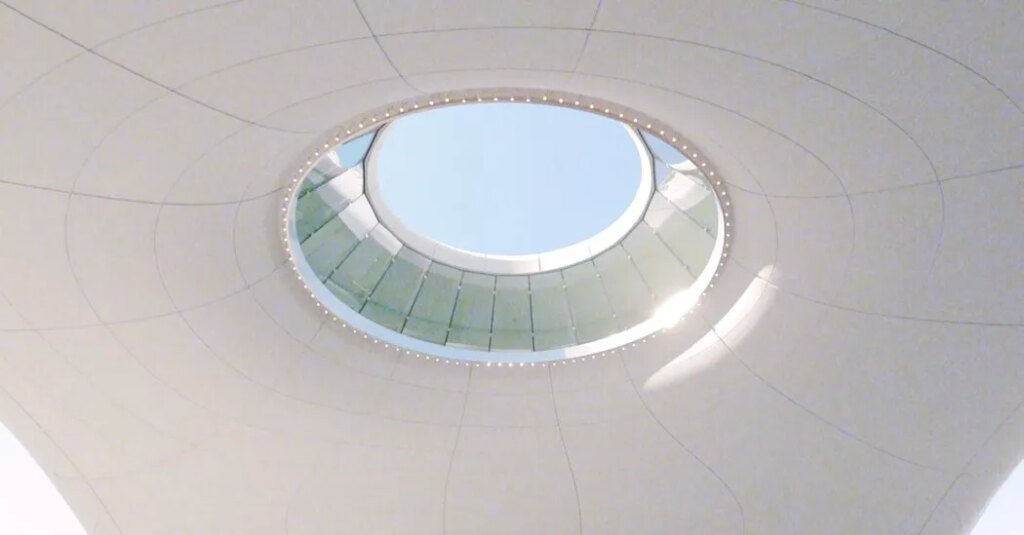
The museum’s roof is planted with alpine grasses and shrubs, woven with curved pathways. Its galleries, though fairly conventional, are edged with wide glass lookouts and a 90-foot-wide oculus, transporting the eye to the sky and city. Its podium sprouts trees and gardens, then pours down into an 11-acre park by Studio-MLA over the museum’s underground parking.
Around the world, his projects have been “swallowed” by nature, he said. (Ma calls this “making architecture weaker and weaker” so that landscape and human experience can become stronger.)
At Quzhou Sports Park in eastern China’s Zheijiang Province, stadiums rise like volcanic craters from rolling greenery. At Shenzhen Bay Culture Square, buildings nestle in an artificial terrain and their roofs become public parks. In a courtyard kindergarten in Beijing, a colorful, undulating rooftop playground weaves around mature trees and historic courtyards.
Ma, now gray around the temples, has changed, too. He seems more at ease, quicker to smile and laugh. Like his newer work, he’s less aloof, more approachable. “He’s still ambitious, but I think he has achieved enough of a level of success to feel more comfortable in his skin,” said Aric Chen, director of the Zaha Hadid Foundation and curator of the exhibition, “Ma Yansong: Architecture and Emotion,” at Rotterdam’s Nieuwe Instituut in 2024.
Ma said his focus is on creating experience rather than spectacle. “I think I’m more clear about what people need. It’s not only about me.”
With more than 30 projects ongoing, Ma constantly jets around the world from his base in Beijing, where he and his wife, Qiushi Yu, are raising their daughter. His second home is Los Angeles, where his two sons went to high school. Ma now stays at Airbnb’s here after losing his Pacific Palisades home in the 2025 fires.
Ma’s latest ambition is to extend his approach, merging architecture with landscape across neighborhoods and even cities. MAD’s Baiziwan social housing project in Beijing contains 4,000 apartments with six enclaves linked by a “floating garden.” He’s now designing an entire district outside Shanghai with towers, malls, multilevel landscapes, and walking areas.
It’s safe to assume the Shanghai project won’t look or act like the world we know, thanks to what Chen calls Ma’s “deeply ingrained rebellious streak.” But what makes Ma’s work resonate at any scale is its ability to tap into an exuberant vision based in feeling.
“He’s trying to reconnect people and societies to things that have been lost in our relentless search for progress,” Chen added. “We thought we could rationalize everything. Look where it’s gotten us.”
The post The Lucas Museum’s Architect Wants to Help You Escape from Reality appeared first on New York Times.