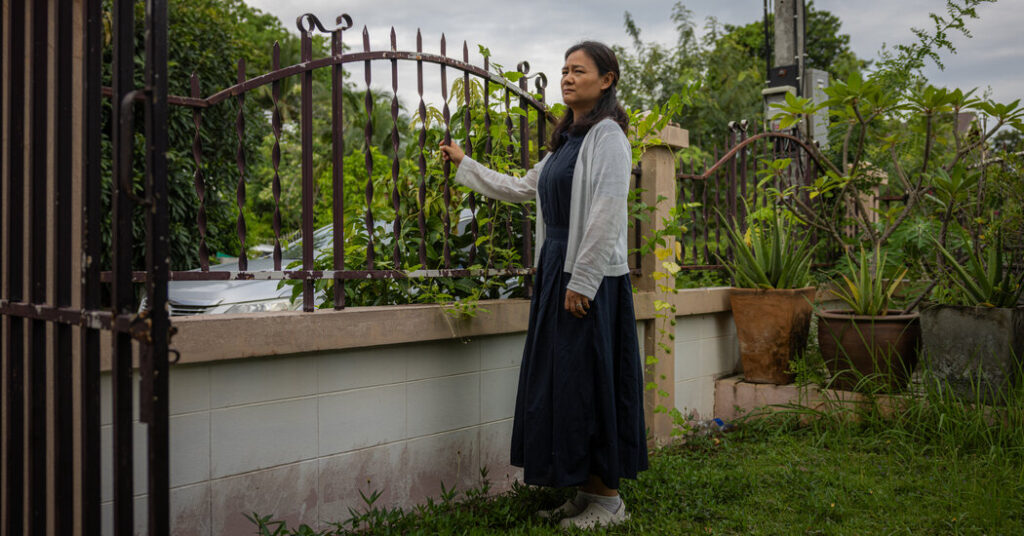
On the 308th day after the Chinese police took her husband, Cherie Geng was making dumplings. The smell of a finished batch wafted from the kitchen as she mixed flour and water at her dining table. Her 6-year-old son was busy trading Pokemon figurines with a friend, so Cherie pushed a plate toward the friend’s mom, who had come to drop him off for the play date.
“This is pretty good — the dough is soft,” the other mom said. “Last time I made dough, it was so hard I felt like I was choking.”
“I’m not great at it either,” Cherie said. “Normally it’s my husband who likes making dumplings.” He had been a one-man assembly line, sifting flour, mixing filling and folding wrappers. “If we were feeding two or three people, he’d say, ‘You don’t need to do anything.’”
Now, though, Cherie had to do everything. Her husband, a pastor at one of China’s biggest underground churches, was seized last October by officers who roused him from bed at 2 a.m. Afterward, Cherie, fearing arrest herself, had fled with their son to Thailand. Since then, she had been in charge of not just cooking, but also renting a home, sorting out visas, finding schools and earning an income. She’d had to figure out where she could find authentic Chinese beef noodles, where to buy Chinese picture books. Having just learned to drive in Beijing, she now had to drive on the other side of the road.
All this while trying to get her husband out of jail. She spent hours learning the intricacies of Chinese law and trying to craft attention-grabbing social media posts. Most days, it felt like all she could do was explain to her son where his father was.
The Chinese government’s crackdown on Zion Church was its biggest roundup of Christians in nearly a decade, as the authorities have increasingly tried to shut down religious groups that do not declare loyalty to the ruling Communist Party. In May, President Trump personally asked China’s leader, Xi Jinping, to free the lead pastor, Ezra Jin; Jin was soon released and now lives in the United States.
But eight church members remain in detention, including Cherie’s husband, Gao Yingjia. China has signaled that it may sentence them to more than 10 years in prison, and their families are desperately trying to keep attention on their cases.
At the same time, they must contend with how the arrests have rippled through their own lives. Most of the relatives who remain free had little public role at the church, and little preparation for what befell them. When Cherie once asked her husband whether they should make a plan in case he was arrested, he replied that they should just place their faith in God.
Now, Cherie, 46, had little choice. It wasn’t easy. She was on her own in a part of Thailand she had never been to before, unsure when she might see her home or her husband again. Even here, she didn’t feel totally safe: She slept with a golf club by her bed and didn’t want her specific location published, in case the Chinese police tried to track her down. Her husband’s trial had recently been postponed without explanation, which gave her faint hope that the charges would be dropped and he would be freed. But Cherie also knew that outcome was most likely preordained, and the delay might just mean more time in limbo.
In her hardest moments, Cherie allowed herself to imagine how things might have been different. Before she became a mother and a pastor’s wife, she had earned a Ph.D. in genetics and held a lucrative job at a pharmaceutical company. She could picture a world in which she had never become a Christian, never married a pastor and just lived a comfortable life.
Still, in some ways her ordeal had made her feel closer to her faith, and her husband, than ever before. Between batches of dumplings, she shared a post on X calling for the pastors’ freedom, and sent a text message to the other pastors’ relatives to confirm a strategy call later that night. Whenever she had time, she typed notes into her phone, both for herself and to write in letters for her husband, even though the jail rarely let mail in or out.
“Dear Yingjia, I miss you,” she began.
***
Relatives of the detainees logged onto the video call from all over the world: a wife who had fled to California, a husband in South Korea, elderly parents inside China. Sitting at her dining table, which was still cluttered with mixing bowls and her son’s toys, Cherie greeted the other church members’ loved ones, 12 in all, on her phone screen.
“Thanks for all your work today,” she said to the father of a pastor who had spent the day writing letters of protest to government officials.
“You haven’t been feeling well lately, right?” she said to another pastor’s husband. “Do you think you have Covid?”
They hadn’t been close before the arrests. Zion Church’s leaders had been scattered across China for years, since the government barred them from gathering in Beijing. The pastors led smaller, low-profile groups instead, coming together on Sundays for sermons streamed on Zoom, many of them given by Cherie’s husband, the church’s second-in-command.
Thousands of people tuned in. The church leaders knew that the police were likely among them, but they believed it was their duty to spread the gospel proudly and fearlessly. Besides, the authorities generally hadn’t imprisoned church leaders as long as they did not directly challenge the government. Yingjia and others had been hauled in for questioning and even held for a few days, but they were always released afterward.
Growing up in the countryside of northern China, Cherie had been introduced to Christianity by her mother, who hid with fellow worshipers in pig stalls to secretly listen to a local pastor. Her mother discouraged Cherie from joining a church herself, worrying that it was dangerous. But Cherie found her own way to faith when her work at the pharmaceutical company left her feeling empty. Bubbly, sociable and fluent in English after her Ph.D. studies, she left her job and started teaching the language to fellow churchgoers.
Still, worry was never far from her mind, especially after she and Yingjia adopted their son, John, in 2021. Her health was also deteriorating — maybe, she thought, because of the stress of frequent police raids on church meetings. Last summer, rumors began spreading that a bigger crackdown might be coming.
It came on Oct. 10, when they were at home in Beijing. Cherie received a call from a lawyer who said Zion’s lead pastor had been arrested, along with around two dozen other church members.
Scrambling, they removed their SIM cards from their phones and drove with their son to a friend’s house. But the police pounded on their friend’s door in the middle of the night and took Yingjia away. They accused him of illegal use of the internet in connection with his online sermons.
Cherie returned home to find her door broken open, her apartment stripped of electronics, books and her diaries. In the following days, she vomited repeatedly. Why hadn’t Yingjia wanted to make a plan? What was she supposed to do now?
At first, she resolved to stay in China. The police wouldn’t let her see her husband, but she could see his lawyers, who were allowed to visit him. She told John that his father was on a long business trip. But John overheard her talking to the lawyers and started having nightmares about her being seized, too.
She arrived in Thailand in January. It was a shock in many ways: the humidity, the noisy streets. She found an English-speaking congregation, and at first she marveled that she could worship without fear of persecution. But she also missed the sense of urgency that had come with Zion’s furtive services in China. The new pastor’s sermons, on comfortable domestic topics like parenting and education, sometimes felt distant from her own concerns.
She hesitated to tell people she met about her situation, not wanting pity or unsolicited advice. The sight of couples and families pained her. A few other Zion members had also fled to Thailand, but Cherie often wanted to be alone. She purposely chose a house way too big for just herself and John so she had a space to withdraw.
Every night, she and John prayed together in their bedroom facing a yard with mango and papaya trees. He always prayed to go back to Beijing.
Now she was at a rented dining table, collecting morsels about her husband’s case in the only way she could: through calls with the families of other detainees. Recently, as the trial loomed, the meetings had become more frequent. Cherie now knew the other relatives’ morning and evening routines, their parents’ names, their deepest fears.
The woman who had fled to California sounded tired as she joined the conversation — it was 5 a.m. there. Her voice shaky, she said the prosecutors were threatening her husband with a decadelong sentence if he didn’t plead guilty.
“Could that be a trap?” one father interjected.
“I think we need to ask the lawyers again what’s going on,” Cherie said. She often found herself in the role of mediator and comforter, her old teaching instincts kicking in. “If anyone else’s lawyers can go, too, they should try to find out if they’re increasing the pressure.”
“Sometimes they just exaggerate,” another caller said. “They might only plan to sentence you to three years, but they say 11.”
The conversation turned to when the court might reschedule the trial, when John, who had been playing on a tablet in the next room, started shouting.
“Mom! What’s wrong with this?” When she didn’t answer, he called again. “Mom, what’s wrong with this?”
She knew that John didn’t like it when she was glued to her phone. Rarely fussy in Beijing, he had become irritable since his father’s arrest. He got into fights at school and called Cherie ugly. She, in turn, sometimes yelled at or spanked him, and always regretted doing so afterward.
Cherie set her phone on the table and walked over. “It’s out of battery,” she said.
“Mom, come with me,” he said, tugging her toward the stairs.
“You go ahead,” she said, trying to dislodge him gently. But he wouldn’t relent, so she followed him.
She returned to the dining room a few minutes later, looking weary. She unmuted herself and put on a cheery voice.
“What’s going on now?” she said.
***
When Cherie and Yingjia first met through Zion, she thought he was too short, too serious and chewed too loudly. Like her, he had done a Ph.D. — his was in theoretical physics — but unlike her, he fulfilled the stereotype of the awkward scientist. But Cherie’s mother kept pressuring her to find a husband, and there weren’t many bachelors at Zion. Cherie decided to think of her marriage as a sacrifice to Christ.
Cherie struggled with her new identity as a pastor’s wife. She felt pressure to be good, but she disliked some people at church, lost her temper with Yingjia and still argued with her parents.
It was Yingjia who told her not to worry, that she should be herself and that God would take care of them. His unflappability drove her crazy at first. But over time, it became part of what she loved about him.
Now he wasn’t around, and she felt herself trying to satisfy others’ expectations again. She was always comforting the families of other jailed members; when she got tired, she took it out on John. Yingjia seemed to know that would happen. In one of his few letters that had reached her by mail, he urged her to stop putting on a happy face. “The fact that you always share the good news but not the bad actually makes me a bit sad, because I don’t get to be by your side during the difficult times,” he wrote in a letter dated May 2.
She especially felt his absence on June 18. That was the day the court was scheduled to decide whether to move forward with the case against Zion or drop it. Cherie, feeling optimistic, considered booking a flight back home so she could greet Yingjia when he was released. But her friends urged her to wait.
The morning of the decision, the lawyer called. Some church members had been released on bail, but Yingjia had not. In fact, the court had added charges, describing the offerings Zion had collected as fraud.
Cherie broke down. Friends swarmed her house to comfort her, but she felt only irritation. Why weren’t they offering her more support? Actually, why wouldn’t they go away — how could they know how she was feeling? What if, Cherie wondered, she went back to China, Yingjia gave up pastoring, they found new jobs and just prayed secretly?
***
So much of her life now was waiting — for news from the lawyers, for a letter from her husband, for some clarity on what the rest of her life would look like. But there was also so much to deal with every day. That was why, early on the Monday after she made dumplings, Cherie nudged a sleepy John out of bed, for her first day of work.
Cherie had hesitated to take a full-time job when she felt she already wasn’t spending enough time with him. But she needed money and a visa. And the job was teaching at a Christian school, so John could attend for free.
Cherie navigated slowly through morning traffic in the used Toyota Camry she had recently bought. It was a 40-minute drive, and she was still a nervous driver, steering down streets lined with tropical flowers and banana trees.
“What song do you want to listen to today?” she asked John.
“I don’t want to listen to songs,” he mumbled, his eyes still closed.
“Let’s listen to the songs I like then,” she said, putting on a Chinese worship song. “Buckle your seatbelt.”
“I don’t have the energy,” he said.
Lately, Cherie had been returning to one song in particular: “Never Ending Grace.” She had awakened with it playing in her head the morning after her husband wasn’t released on bail. It seemed like a sign, a reminder that everything she was going through had a higher purpose.
Every trial faced where I nearly stumbled
Every day that arrived unnoticed
Every peaceful moment taken for granted
What seemed ordinary was actually grace
So she was trying to give herself more grace, too. She had cut back on her meetings with the other families, so she could take John to soccer practice. She went to Muay Thai classes to build up strength (though, she noted in a letter to Yingjia, her abs were still in hiding). She invited her sister to visit from China to help take care of John.
And she prayed, constantly. There was an irony to her situation: Now, when the burden of being a pastor’s wife was heavier than ever, she was finally doing what Yingjia had always advised her to do, just giving up control and trusting in God.
Cherie sang quietly as she drove. She decided to put the lyrics in her next letter to Yingjia.
***
Cherie made it through her first day of work, but she couldn’t rest yet. After a dinner of steamed buns prepared by her sister, Cherie called a family meeting, a tradition from Beijing that had fallen off in the chaos of leaving China. She gathered her sister, her sister’s two children and John around the table to light a candle, sing a hymn and read the Bible.
At least, that was the plan. As Cherie played a hymn on YouTube, John wriggled out of his seat and blew out the candle. While she read aloud from Psalm 29, he stood on his chair, propping one foot on the table in a Superman pose.
“You think Jehovah is so awesome. That’s why you’re standing, right?” Cherie said. “Could you please sit down?”
When he didn’t move, her voice turned firmer: “You’ll break the table. Sit in the chair.”
She asked him to say a prayer. Still giggling, he complied.
“Thank you Jesus thank you Dad come home quickly thank you Mom,” he blurted in one breath. “Amen!”
The next morning, Cherie got up early to write to Yingjia. There was always so much to share. About how John had made a friend and stopped praying to return to Beijing. About how she had lost her temper with the boy, again, and he had bitten his arm until the skin broke. About how he was visibly happier with his aunt and cousins around.
But then John woke up and called for her.
And then it was time to go.
“Sorry, I’m about to be late. I have to go to work now. John wanted me to keep him company just now, so I couldn’t finish writing,” she wrote. “Love you always.”
The post The Other Victims of China’s Church Crackdown appeared first on New York Times.