The Kettle of Fish, a neighborhood bar in Greenwich Village, is a comfortable and welcoming watering hole, except on certain Sundays, Mondays, Thursdays, some Saturdays and for the first time ever, Thanksgiving Eve, when fans of a certain National Football League team transform the bar into sacred rooting turf. These are Green Bay Packers fans, who pay a cover charge of $25 to watch a football game they might view in the privacy of their homes at a lower cost and almost certainly in greater physical comfort.
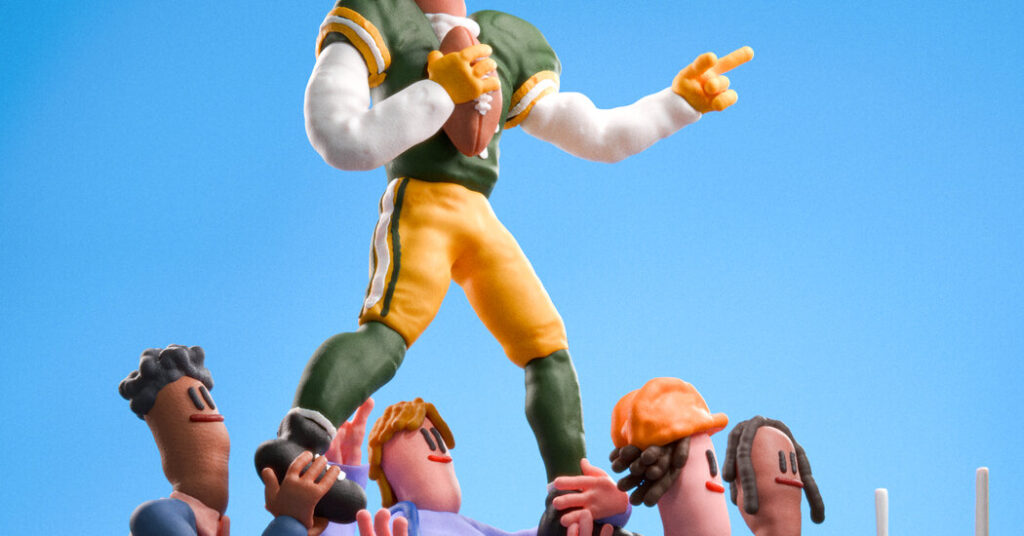
The Packers are a true anomaly in modern American professional sports — a provincial team with an expanding global fan base. According to Packers Everywhere, there are some 1,500 places around the world, from London to São Paulo, Brazil, where Green Bay Packers fans can gather to cheer their favorites. Packers games are a television ratings juggernaut, scoring in the top three on the Nielsen Scarborough N.F.L. Fandom Index, a new popularity gauge. They have won the N.F.L. championship 13 times since 1929, which is why Green Bay calls itself Titletown.
The Packers remain dead last in one stat: owner wealth. That’s because the team doesn’t play the game of global finance marked by astronomical leaps in the price of sports franchises. Its increasing popularity could be a sign that people have had it with all the bling. Let’s hope so.
People in general have a soft spot for the long shot. It’s what draws folks from all walks of life and myriad locations to a football team from a small, northern Wisconsin city most couldn’t find on a map. In our new Gilded Age, when bigger, bolder and brassier is hyped as better, the team remains rooted in the small-is-beautiful ideal.
There are about 1,000 American billionaires, and they all seem to want to buy sports franchises, but there are only 32 N.F.L. teams. This billionaire bauble being in short supply, asset prices are rising rapidly. This year, the Seattle Seahawks sold for a record $9.6 billion to Vinod Khosla, the venture capitalist and a founder of Sun Microsystems, and his family. He sold his stake in the 49ers, which he bought a year ago, to buy an entire team. Just three years ago, the Washington Commanders were bought by a group led by the private equity billionaire Josh Harris for $6 billion, then a record; the team is worth nearly $10 billion today. Walmart heirs bought the Denver Broncos for $4.6 billion in 2022 (another record at the time); looks like they got a discount since the Broncos’ value tops $9 billion today.
Since 1923, the Green Bay Packers have remained in the hands of their stockholders, and most stockholders are local, which is why the team is often referred to as “community owned.” The people who hold shares cannot trade them, because there is no market for the security.
The Packers’ value has increased, too — close to $9 billion, at least on paper. This in a city of 100,000 where the median income is about $66,000. That means the team is worth more than the town, even though the town essentially owns the team.
The Packers are part of the N.F.L.’s marketing machine, but just about everything else about them remains modest in a league that is everything but. Green Bay’s media market is the smallest of any N.F.L. team: 480,000 versus almost six million in Los Angeles. The town they reside in is the league’s smallest. The Packers’ home stadium is Green Bay’s tallest building, and if it seems that everyone in town attends home games, that’s because they probably do. Lambeau Field can hold 76 percent of Green Bay’s population.
Lambeau, built in 1957, is revered by many fans as the Vatican of pro football. It is consistently rated as a top destination by N.F.L. fans. Home games have sold out since October 1960, a 66-year, 412-game streak. Season-ticket rights are often included in wills, no surprise since the waiting list, by some measures, approaches 50 years.
The team, an N.F.L. original, was co-founded in 1919 by Curly Lambeau, a shipping clerk for the Indian Packing Company and the team’s first player-coach. It floundered financially a couple of years later, and the community stumped up the money to buy the team it still owns.
The Packers’ organizational structure reflects that community ownership today — as much Y.M.C.A. as N.F.L. It is governed by a board of directors. The board chooses a president, who picks the team’s management, an organization that is unique in the N.F.L.
There is no big-bucks owner — no “A.T.M.,” as the Packers’ president, Ed Policy, noted at the recent annual meeting — to provide infusions of cash when times run lean. Fans relish the fact that the team has managed to remain mostly about the game of football despite belonging to a mega-money professional sports colossus that has become as much about show business, gambling and glamour. Is it any wonder that this kind of gridiron authenticity in the age of A.I. slop is attracting fans?
Call this a boast of a lifelong Packers fan now in his 80th year. You can find the proof on just about any day in New York City’s Central Park. There, often wearing a Packers T-shirt or hoodie, I can be found trekking toward the goal of 10,000 steps said to prolong life and health. You might think that walking among this diverse humanity, I wouldn’t garner much, if any, recognition of my Packers identity.
That is not the case. I almost always hear a “Go, Pack, go” callout from people. Often, they too are wearing Packers merch. Many certainly aren’t from Wisconsin, including the couple from Britain I encountered on a crisp February day, clad in Packers winter gear that included hats, scarves and gloves.
They said they liked the Packers’ green and gold uniforms. More important, I thought, was their identification with the team as an underdog, a kind of gridiron David taking on the Goliaths of the N.F.L.
It is a love affair I rekindle every summer. Then I see videos of Packers players riding bikes alongside kids to the opening of training camp — another tradition from another day that makes this team so likable. That’s when I’m reminded why I’m a Packers lifer, billionaires be damned.
Robert J. Geline is a semiretired Emmy-winning broadcast business journalist and a former correspondent for Time.
The Times is committed to publishing a diversity of letters to the editor. We’d like to hear what you think about this or any of our articles. Here are some tips. And here’s our email: [email protected].
Follow the New York Times Opinion section on Facebook, Instagram, TikTok, Bluesky, WhatsApp and Threads.
The post The Billionaire-Free Packers Stay True to the Game appeared first on New York Times.