They have almost no chance of winning. Their party, Yabloko, was formally removed from the nationwide ballot in this weekend’s elections. Their fellow party members have been sentenced to years in prison for their antiwar positions.
None of that is stopping them.
The fact that Yabloko, Russia’s oldest liberal opposition party, is fielding 98 candidates in 42 regions feels like a small miracle for antiwar Russians whom restrictive laws have prevented from openly expressing their views. As wartime repression deepens, the country may not see such candidates on the ballot again.
“There were times in Russian history that were worse,” said Grigory Grishin, a Yabloko candidate running for the State Duma, Russia’s lower house of Parliament, in Moscow. “So, as the saying goes, ‘The eyes are afraid, but the hands do the work’ — we are participating. What else is there to do?”
The fate of Yabloko has been the most consequential story line in an election the Kremlin engineered to be as uneventful as possible.
The party, long considered irrelevant by the Russian authorities, became a Kremlin target this summer after it unexpectedly turned into a vessel for antiwar sentiment. The Russian Supreme Court barred the party at the last minute, citing minor copyright infringements and indirect foreign financing that it said violated the law.
Still, the decision left open one avenue for Yabloko candidates to run.
At the ballot box, Russians choose a party and then a candidate from their district. Half of State Duma seats are filled through the party vote — parties must clear a 5 percent threshold — and the other half through the votes for candidates in districts, as in elections for the U.S. Congress.
While the Supreme Court barred Yabloko from the party-list vote, many of the party’s candidates in individual districts remained on the ballot. The authorities later disqualified them in several regions, but as voting began on Friday, nearly 100 were still standing.
Why they were allowed is unclear. There may not have been enough time to drum up cases against every one of them, analysts said. Or the authorities may feel confident that they have disqualified all of the Yabloko district candidates with a good chance of winning and that any unforeseen victories could be fixed with ballot falsifications.
Recent data from ExtremeScan, a Russian pollster, suggested that the authorities may have had reason to fear rising support for Yabloko, the only party running on an antiwar platform.
In a survey this month, 18 percent of respondents said they would have voted for Yabloko on a party-list ballot. It was a surprising figure for a party that has not cleared the threshold to enter the Duma since 1999. The idea that any Yabloko candidate would be allowed to take a seat in the legislature and use the platform to question the war openly is considered unthinkable in today’s Russia.
Aleksei Minyailo, an opposition activist in Moscow and the founder of the independent pollster Chronicles, said one of the most important steps that autocratic authorities took to shape election outcomes was limiting the field of candidates.
“This is the essential thing,” he said. “It’s more essential than who gets what result.”
The Kremlin could ultimately try to use the remaining Yabloko candidates to its advantage, Mr. Minyailo said, presenting a poor showing by them as evidence that antiwar Russians are a marginal minority.
In recent polling, the share of Russians who say they do not support the war has ranged from about 20 to 35 percent.
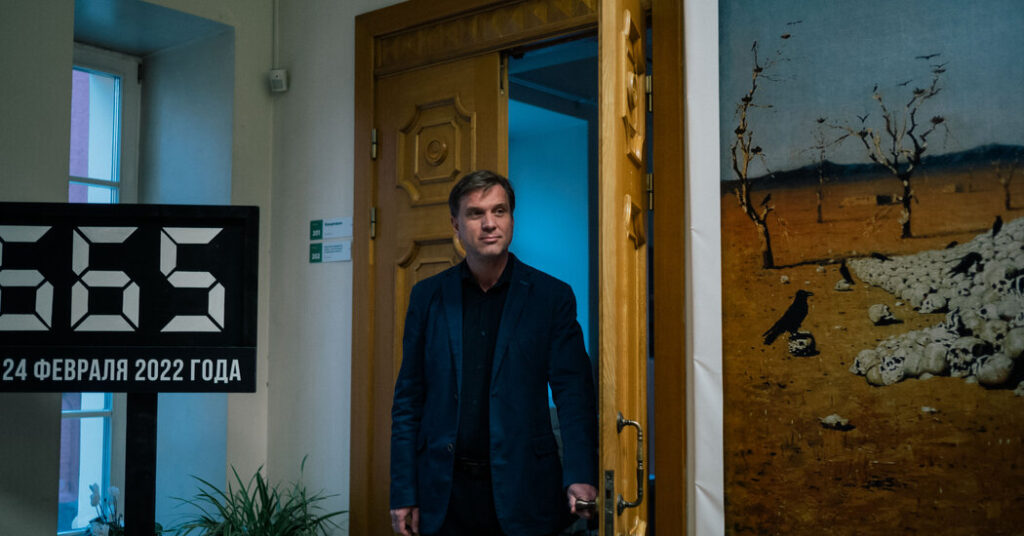
While the mere presence of Yabloko candidates on the ballot may be a victory for them, Mr. Grishin, the district candidate in Moscow, said it was always going to be an uphill battle.
The candidate running against him from the pro-Kremlin governing party, United Russia, had a budget that Mr. Grishin estimated at 40 million rubles, or $500,000. His own budget, raised through donations, was about one-tenth of 1 percent of that.
“We could only print 5,000 leaflets,” he said, proffering one with his portrait and a dove carrying an olive branch. It bore the party’s campaign slogan: “For peace and freedom! For a life without fear!”
Financial troubles were just one of Mr. Grishin’s worries. This month, a day after his newborn daughter arrived at home from the hospital, Mr. Grishin was detained and taken to a police station. He was later accused of “displaying extremist symbols,” a common pretext for removing candidates from the ballot. In Mr. Grishin’s case, the charge referred to a reference he had made on Telegram to the deceased opposition politician Aleksei A. Navalny, whom the Russian authorities branded an extremist.
Had the accusation come three months earlier, Mr. Grishin would have been automatically disqualified from running in the election. But because it occurred so late in the election cycle, the authorities could not remove him from the ballot.
Some candidates have been disqualified after parties loyal to the Kremlin brought cases against them. Iya Boronina, who leads Yabloko’s regional branch in the central Russian republic of Udmurtia, was barred after being accused of copyright infringement, echoing the case that the party itself faced in the Supreme Court.
Her campaign video featured the 1982 rock anthem “Bad to the Bone.” Representatives of the nationalist party A Just Russia contended that Ms. Boronina, because of sanctions against Russia, could not have paid in U.S. dollars for the legal right to use the song.
Eight Yabloko members are currently in prison for their antiwar stances. One deputy chairman, Maxim Kruglov, is serving a seven-year sentence, and another deputy, Lev Shlosberg, is serving 11 years.
Yabloko’s leader, Nikolai I. Rybakov, said that despite the harsh penalties faced by its leaders, the party had become a beacon for Russia’s youngest voters, who dislike the increasing government restrictions on the internet, speech and culture. More than 13,000 people applied to become party members during the election cycle, he said.
“They removed us from the election list because real support belongs to Yabloko, and they cannot defeat us in an election,” Mr. Rybakov said in an interview in his party’s library as his shelter dog, Morty, sat quietly by his side.
Mr. Rybakov pulled a book from the piles around him. It was Roberto Carnero’s essays on the gay Italian filmmaker and writer Pier Paolo Pasolini. About 15 percent of its words were blacked out. On some pages, only a few words were visible.
“The young people who come here are absolutely free people,” said Mr. Rybakov, who himself was disqualified from the election because of a post he wrote after Mr. Navalny died in prison in what five European countries said was a poisoning.
“They want nobody telling them what color their hair should be, what clothes to wear, what to say, what to think, who to love, where to work, or which professor to study with,” he added.
Several young people who attended Yabloko meetings spoke of the psychological solace of speaking with others who opposed the war.
Many of the questions Mr. Rybakov fielded addressed a growing rift between the opposition forces inside Russia centered around Yabloko and those forced into exile, including Mr. Navalny’s team. They have differed over the best strategy for voters to try to express discontent in the election.
As Mr. Rybakov was speaking on a recent night, news broke that another Yabloko candidate, Aleksandr Muravyov, had been barred from the election. Another party had filed a complaint alleging that Mr. Muravyov’s use of the slogan “For a free internet without blocks” created a negative image of other candidates and parties.
The post Russia Barred Their Party, but These Antiwar Voices Are Still Standing appeared first on New York Times.