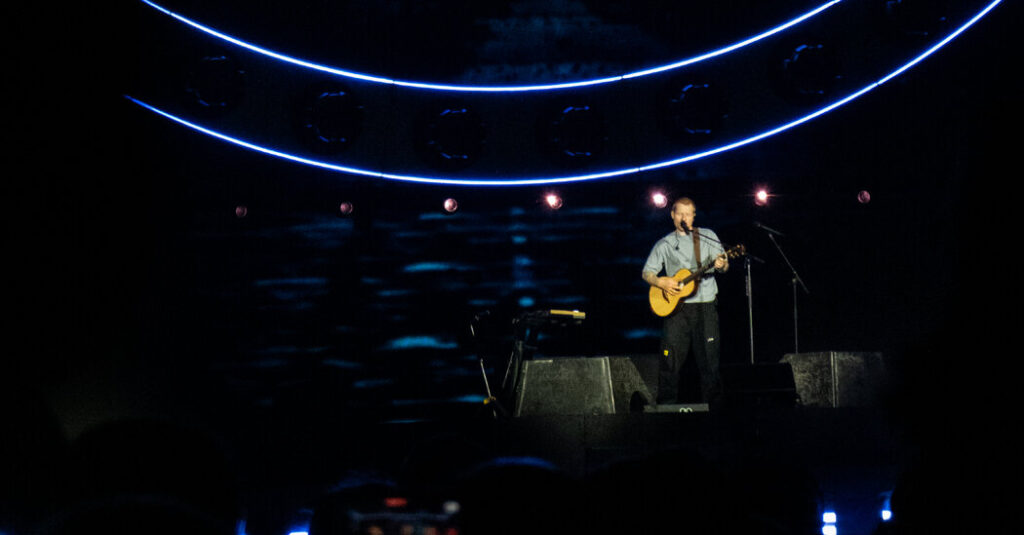
Ed Sheeran was all alone.
Stepping onto the stage on Saturday night, after his stadium tour had been roiled by the removal of an opening act over comments about the war in Gaza, Sheeran acknowledged that he had made “mistakes” in how he handled the situation, and apologized for disappointing his fans.
“I’ve tried in my career to not be a political commentator of any kind because I want my music and shows to be about unity, not division, about humanity, not politics,” Sheeran said, standing on the darkened stage of Lincoln Financial Field in a plain blue T-shirt. “But this is a humanitarian issue and I cannot hide how I feel about it anymore.”
He called Hamas’s attack on Israel on Oct. 7, 2023, “horrific,” and said that “what is happening in Gaza is catastrophic and unjustifiable and disproportionate.” He added: “My heart has been broken by the scale of devastation and loss of civilians’ lives, children’s lives. And the systemic injustice we’re seeing unfold in the West Bank, it cannot be overlooked.”
With his voice breaking, Sheeran said his concerts were “still a place where everyone is welcome and everyone can stand beside people that have opposing views” and enjoy his songs of “love, hope and unity,” before he played his soaring hit “Castle on the Hill” to cheers from the crowd.
His ballads, aching love songs and pop earworms written for acts like Justin Bieber and One Direction have been streamed billions of times, making Sheeran, 35, one of music’s biggest yet most benign hitmakers. But his Loop tour, and possibly his career, had seemed on the verge of collapse last week after he appeared to acquiesce to the demands of a handful of powerful N.F.L. team owners.
Those men, including Robert Kraft, whose company owns the New England Patriots and Gillette Stadium outside Boston, decided that Sheeran’s tour could not play in their stadiums if it continued with Macklemore, a Seattle indie rapper who proclaimed “Free Palestine” at two of Sheeran’s shows in New Jersey this month. Macklemore also sang a protest song that accused Israel of genocide in Gaza — a performance that drew condemnation from activist groups like StopAntisemitism and the Israeli-American Council.
A statement by Sheeran, saying the decision to remove Macklemore was “not mine,” but belonged to the venues and his promoter, was followed within hours by the resignation of every other support act for the remainder of the tour, along with that of an Irish folk band that backed Sheeran up for part of his two-hour-plus set each night. Sheeran added, “Those who come to my shows do not expect a political forum.”
His response, especially his position of apolitical neutrality, drew harsh attacks. Online commentators found that posture not just untenable but also hypocritical, pointing out that Sheeran had taken political positions in the past, like signing an open letter opposing Brexit and taking part in a fund-raiser for humanitarian relief in Ukraine.
Sheeran, at that point, seemed too radioactive for any other act to join him, even if he could manage to retool the show before the next scheduled date. During Saturday’s performance, Sheeran said that he had been urged by people around him to cancel the tour. Instead, he stepped into the spotlight to talk directly to fans.
For his appearance in Philadelphia, the first tour stop since the controversy erupted, Sheeran had no opening acts and carried the show by himself. The tour’s name is a reference to Sheeran’s method of making music by himself onstage, using an array of guitar pedals to loop and layer short snippets of sounds to create a live, repeating backing track. Sheeran employed this technique throughout his career, making him unusually well equipped to cover the departure of other musicians by simply playing most of everything himself.
On Saturday, he was joined for just a few songs by a new backing group that included the violinist Alicia Enstrom. The musicians, he said, had only three days to learn the material.
In his statement at the start of the show, Sheeran also addressed concerns about the concentration of power in the concert business, saying he was “deeply worried about the idea that venues should preapprove content for performers.”
Earlier that afternoon, a few dozen people, many in kaffiyehs and face coverings, protested at a transit station near the stadium, chanting lines like “Ed Sheeran is a clown / Zionists, get out of town.”
As fans arrived at the show, many said they wanted their entertainment to be free of politics, echoing Sheeran’s description of his shows as a form of “escapism.”
“I think music should just be music and not bring in the political stuff,” said Marlena Wood, 57, who was tailgating in the parking lot.
Others struck a more subdued tone, saying that the controversy surrounding the tour, and the brutal criticism of Sheeran, was coming close to spoiling the experience.
“It puts a weight on it,” said Allie Iacovella, a 21-year-old from Bucks County, Pa., outside Philadelphia, “like I can’t fully enjoy it because of what’s going on.”
Lauren Ashley, 40, a teacher, said the proper way to deal with major political issues like the war in Gaza “is go to the ballot box in November.”
For days leading up to the show, resale prices for his tour plunged, leading to speculation on social media that attendance would plummet. But the stands appeared nearly full, and Sheeran’s extensive merch table was doing brisk business.
His set, close to three hours long, included fan favorites like “The A Team,” “Sapphire,” “Thinking Out Loud,” “Photograph” and “Perfect,” and snippets of songs by Stevie Wonder and Bill Withers.
Toward the end of the night, Sheeran told the crowd: “The last week of my life has been one of the worst weeks of my life. Today has been one of the weirdest days of my life. Tonight has been, honestly, the best show of my life.”
He said that he had been tracking ticket sales in the days before Saturday’s show, and that even as he was being widely attacked online, he noticed that fans were still buying tickets. With tears welling in his eyes, Sheeran said he would never stop touring.
“I can’t let you guys down,” he said.
The post Ed Sheeran Apologizes to Fans After Palestinian Debate Splinters Tour appeared first on New York Times.