For most of its existence, The New York Times corrected errors of spelling and facts with a sentence or two, usually tucked inside the newspaper. It wasn’t until it was well into its second century that the paper began to dig deeper into its own lapses and explain its mistakes to readers, or at least some of them. Corrections moved to more prominent positions, typically Page 2 or the front of the second section, and sometimes even to the front page.
One of the first signs of this new era came in the early 1980s, when Abe Rosenthal, the executive editor at the time, created the “editors’ note,” designed, he said in a memo announcing the new policy, to “amplify articles or rectify what the editors consider significant lapses of fairness, balance or perspective.” Rosenthal wrote one of the first notes himself in 1985 after he objected to what he said was the snide tone of a Times story about a friend, Mortimer Zuckerman, the publisher and real estate developer. “Through opinionated phrases and unattributed characterizations, the article established a tone that cast its subject in an unfavorable light,” said the note, which was unsigned.
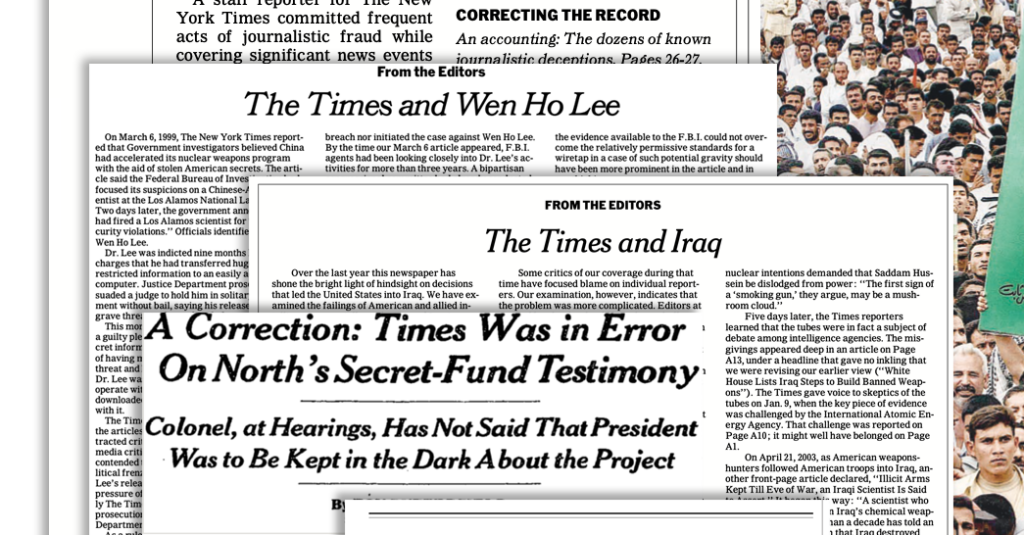
By 1987, under a different executive editor, Max Frankel, The Times published a correction of more than 1,200 words — as long as many news stories — addressing mistakes in an article that recounted the congressional testimony of Lt. Col. Oliver L. North about the Iran-contra scandal. This appeared on July 13, 1987, under a headline that ran across two columns of the front page: “A Correction: Times Was in Error on North’s Secret-Fund Testimony.”
The remedy may have seemed excessive. “I wouldn’t have insisted on putting a correction on the top of Page 1 to make a point,” Joseph Lelyveld, whom Frankel later named his managing editor, told me years later for a book I wrote on the modern history of The Times.
But the world was changing. This was the post-Watergate and the post-Vietnam War era. There was more skepticism and scrutiny of big institutions, including The Times. Critics and readers were finding new platforms to challenge what The Times was reporting, even before the explosion of social media. The paper, which had long enjoyed an if-it’s-in-The-Times-it-must-be-true status, was under pressure to account for missteps and, at times, the failings of its reporters and editors. In short, to acknowledge that the paper itself, like the institutions it covered, was not immune to errors.
Over the years, this direction of travel has remained constant, producing shifts in the way The Times responds to potential errors and criticism from readers. In 2003, more than 15 years after Rosenthal wrote that editors’ note, The Times appointed Allan M. Siegal, an assistant managing editor who had long served in an informal role as the paper’s internal watchdog, as its first standards editor, and created the position of public editor. The appointments came after The Times discovered that a young reporter had systematically fabricated and plagiarized stories that had appeared in its pages.
The Iraq war was another factor. The Times’ coverage of the lead-up to the conflict promoted the idea that Saddam Hussein was on the verge of assembling a stockpile of weapons of mass destruction. After re-examining its reporting, the newspaper conceded that it had been too credulous in its work, and strengthened its procedures around its use of unnamed sources.
The public editor position was eliminated in 2017. But in 2020, as the newsroom expanded in size and onto new platforms, The Times created a team of seven editors, working under the standards editor, to become the newsroom’s voice for all standards and ethics questions relating to content and news coverage. More recently, The Times formed a Trust team to explain the paper’s decision-making to readers and help field and grapple with complaints.
For all this, it can still take a while to fix an error, with results appearing only after weeks of prodding (and re-reporting). The small still has the tendency to triumph over the large. The paper might, for instance, correct a reporter’s mistaken reference to Tweetie Pie (Tweety Bird!), but leave unaddressed deeper and more consequential errors of judgment. The Times all but ignored the Holocaust, a failure Max Frankel explored in an article written for The Times’ 150th anniversary. It also largely brushed aside concerns that its Moscow correspondent in the 1930s, Walter Duranty, downplayed the existence of the genocidal famine in Soviet Ukraine caused by Stalin’s policies.
However flawed it may sometimes be in its execution, the ethic of addressing errors has continued to drive the newspaper. Here’s (an admittedly incomplete) look at a few of the more notable mistakes The Times has corrected over the years.
Wen Ho Lee
In March 1999, The Times wrote the first in a series of stories, columns and editorials that portrayed Wen Ho Lee, a Taiwanese-born American scientist assigned to the Los Alamos National Laboratory, as a spy who helped China steal nuclear secrets to build bombs. Lee was indicted by a federal grand jury in New Mexico on 59 counts related to illegally moving classified information from the Los Alamos weapons lab to an easily accessible computer. He was branded a security risk, was imprisoned without bail and spent nine months in solitary confinement. But the case ended when Lee pleaded guilty to a single count of mishandling classified information.
In a note from the editors titled “The Times and Wen Ho Lee,” published on Sept. 26, 2000, The Times said it stood by much of the story, but acknowledged the criticism that “contended that our reporting had stimulated a political frenzy amounting to a witch hunt.”
“We could have pushed harder to uncover weaknesses in the F.B.I. case against Dr. Lee,” the note said. “In place of a tone of journalistic detachment from our sources, we occasionally used language that adopted the sense of alarm that was contained in official reports and was being voiced to us by investigators, members of Congress and administration officials with knowledge of the case.”
The note did not announce any changes in editorial procedures at the paper but instead said it had instructed its reporters to go back and continue their reporting. “Our coverage of this case is not over,” it said.
Jayson Blair
In one of the most significant breakdowns in Times history, Jayson Blair, a young reporter at the paper, wrote articles that contained both plagiarized information from other news outlets and outright fabrications. As Blair later acknowledged, he had made up stories in his apartment while telling editors he was on the road. He resigned in 2003 after questioning by editors. “The Times apologizes to its readers for a grave breach of its journalistic standards,” the executive editor, Howell Raines, said in a story about the reporter’s deceptions. Less than two weeks later, a team of Times reporters produced an exhaustive accounting of Blair’s work that appeared on the front page, under the headline: “Correcting the Record; Times Reporter Who Resigned Leaves Long Trail of Deception.”
Raines and his managing editor, Gerald Boyd, did not participate in the preparation of the story. Raines was at his weekend home in Pennsylvania when he saw the Sunday front page. He immediately thought that his career at The Times was over, he told me years later. He was correct; both he and Boyd left the paper.
Iraq
After the attacks of Sept. 11, 2001, The Times ran stories by Judith Miller, a national security reporter, and others based largely on anonymous sources suggesting that the United States had evidence that Iraq was gathering materials to build weapons of mass destruction. These accounts contained warnings about the threat a nuclear-armed Iraq posed to the United States and world security.
On May 26, 2004, after sustained criticism, and with a new public editor about to publish a column, the newspaper issued an editors’ note, nearly 1,200 words long, titled “The Times and Iraq.” The stories, it said, were too often dependent on Iraqi exiles and defectors whose credibility had been challenged at home.
“We have found a number of instances of coverage that was not as rigorous as it should have been,” the note said. “In some cases, information that was controversial then, and seems questionable now, was insufficiently qualified or allowed to stand unchallenged. Looking back, we wish we had been more aggressive in re-examining the claims as new evidence emerged — or failed to emerge.”
‘Caliphate’
In 2018, The Times released “Caliphate,” a 12-part podcast series focused on an Islamic terrorist network. Many of the episodes were based on the story of a man calling himself Abu Huzayfah, who said he was a member of the Islamic State and had taken part in killings in Syria. More than two years later, Mr. Huzayfah was arrested by the Canadian police and charged with perpetrating a terrorist hoax. The police said he had even fabricated his identity: His real name was Shehroze Chaudhry.
The Times published an editors’ note saying that, after the arrest, it had re-examined Mr. Chaudhry’s account and “found a history of misrepresentations by Mr. Chaudhry and no corroboration that he committed the atrocities he described in the ‘Caliphate’ podcast.”
“As a result, The Times has concluded that the episodes of ‘Caliphate’ that presented Mr. Chaudhry’s claims did not meet our standards for accuracy,” the note went on. “It is also clear that elements of the original fact-checking process were not sufficiently rigorous,” it added. “Times journalists were too credulous about the verification steps that were undertaken and dismissive of the lack of corroboration of essential aspects of Mr. Chaudhry’s account.”
The Times returned a Peabody Award it had received for the coverage. It affixed an editors’ note to the web page for each “Caliphate” podcast episode and added a new installment to the series, “An Examination of ‘Caliphate,’” which discusses the missteps. The newspaper also assigned an editor to create a process to vet stories produced by the audio unit.
Of course, not all corrections rise to this level of significance. Which is not to say they can’t still be mortifying. The name of the family that owns The Times can be challenging to spell. That said, one would think The Times, of all news organizations, would get the boss’s name down. Nope. “An article in Business Day on Wednesday about investors in The New York Times Company who withheld their votes for directors misspelled the name of the family that has controlled the company since 1896. It is Ochs-Sulzberger, not Ochs-Sulzburger.”
This was hardly the only eyebrow-raising institutional mistake. The newspaper of March 14, 1995, celebrated the 50,000th issue of The New York Times. A correction followed: There had been a miscount, and the milestone would not come for another year.
And, if you’re wondering, some mistakes never happened. Yes, The Times has a strict policy on honorifics. But no, Meat Loaf, the musician, was never referred to as “Mr. Loaf” on second reference. Believable, to be sure, but incorrect.
The post Mistakes? We’ve Made a Few appeared first on New York Times.