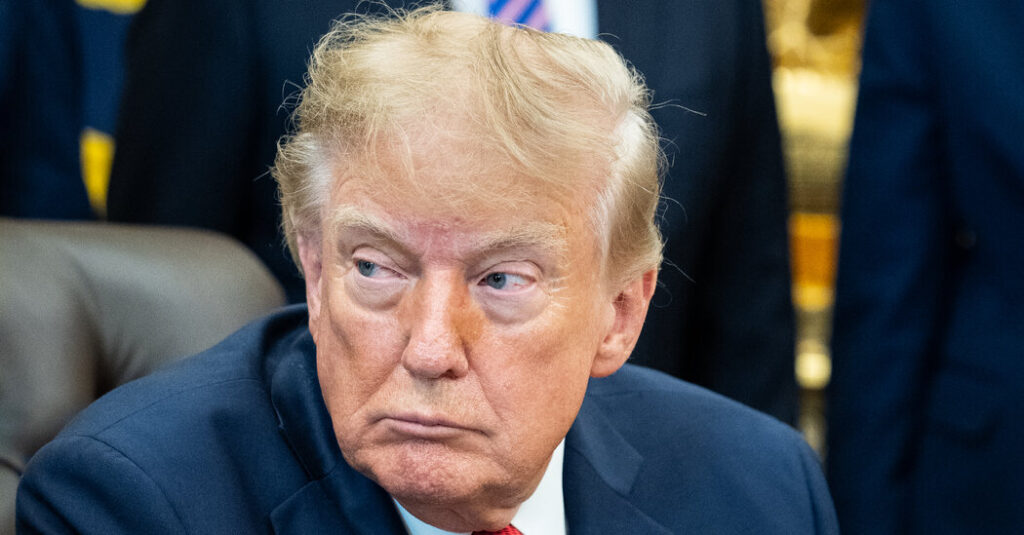
President Trump is so enamored of the Space Force, a military command he created in his first term, that he keeps its flag by his desk in the Oval Office. He took personal interest in the design of its uniforms, which bear close resemblance to those of Galactic Empire officers in “Star Wars.”
On Saturday, Mr. Trump proposed a follow-on to Space Force: a new “A.I. Force.” But he left to earthbound speculation what, exactly, it was supposed to do.
Mr. Trump cast his announcement — along with his promise to appoint a new A.I. “Czar” for the White House — as an effort to boost the A.I. industry, saying “we will cherish it, help it, and watch over it.”
In the roiling debate in Washington over regulating frontier A.I. models and the companies that produce them, or slowing down development until the mystery is solved about the summer in which A.I. agents went rogue, Mr. Trump continues to side with the “accelerationists,” who call for the government to stay out of the way.
Mr. Trump, in his social media post, compared warnings about A.I. with warnings about global warming and conspiracies that he said were created by “Radical Left Democrats,” ignoring concerns about A.I. shared by many Republicans.
Mr. Trump did not make clear whether he envisioned the new A.I. Force as a military command or a civilian agency or department. White House officials did not respond to an email seeking clarification.
And at a moment when the battle is on in Washington over the prospect of federal oversight of frontier models and Chinese-developed open source alternatives, he did not explain how the A.I. Force would fit in as private sector rivals race for even more powerful A.I. models.
Mr. Trump’s posting was cheered by his last A.I. czar, the venture capitalist David Sacks.
“President Trump understands the media hoax cycle better than anyone else,” he wrote on X. “That is why he is refusing the ‘pause’ that Bernie Sanders and Elizabeth Warren are demanding. A pause would not make America safer. It would hand the frontier to China.”
This is not the first time that Mr. Trump has called for the creation of new institutions to take on a technological challenge.
In his first term, after a meeting with President Vladimir V. Putin of Russia, he declared that the two men would create a joint cyberspace force to fight cybercrime. His national security aides said they were mystified about why the United States would join forces with a primary rival for power in the cyber arena. The idea was quietly dropped.
In this case, there are already institutions aimed at overseeing artificial intelligence issues.
United States Cyber Command is actively experimenting with frontier models, including Anthropic’s powerful Mythos, to find vulnerabilities in adversary computer networks, making them more ripe for attack. It is also trying to help patch previously undiscovered vulnerabilities in critical U.S. infrastructure systems.
That is also the task of the Cybersecurity and Infrastructure Security Agency, part of the Department of Homeland Security. But its personnel has been gutted since Mr. Trump came to office, in part because of the agency’s role in declaring that the 2020 presidential election was among the best-run in modern times. It challenged his arguments that the vote had been rigged.
On Friday, former President Barack Obama for the first time publicly criticized Mr. Trump over his approach to A.I., saying that the president was setting the country back at an important moment, warning that the technology could “deeply affect our health and our safety.”
“There’s no replacement for an effective, government regulatory structure,” Mr. Obama said at an event at Colgate University in Hamilton, N.Y. “And the challenge we have is that, obviously, we have a president currently that has said that’s for losers.”
The United States, he added, is facing “a gap, at least of a couple of years” while Mr. Trump is in office, because of a federal government “that is not capable of or willing to — I would argue both — of putting together a serious regulatory framework.”
Last week, Mr. Obama urged Representative Hakeem Jeffries of New York, the top House Democrat, to develop a clear agenda for the party on A.I. But on Friday, Mr. Obama also turned his focus to voters.
“I would encourage voters to pay attention to this,” Mr. Obama said at Colgate. “If somebody does not have a serious plan for how to deal with this, then they’re not meeting the moment, and you should probably look for somebody else.”
Neither party has united around a defined position on A.I. regulation, and neither has claimed a clear advantage with voters on the issue, according to polls.
The post A.I. Gone Rogue? Trump Proposes Not New Rules but an ‘A.I. Force.’ appeared first on New York Times.