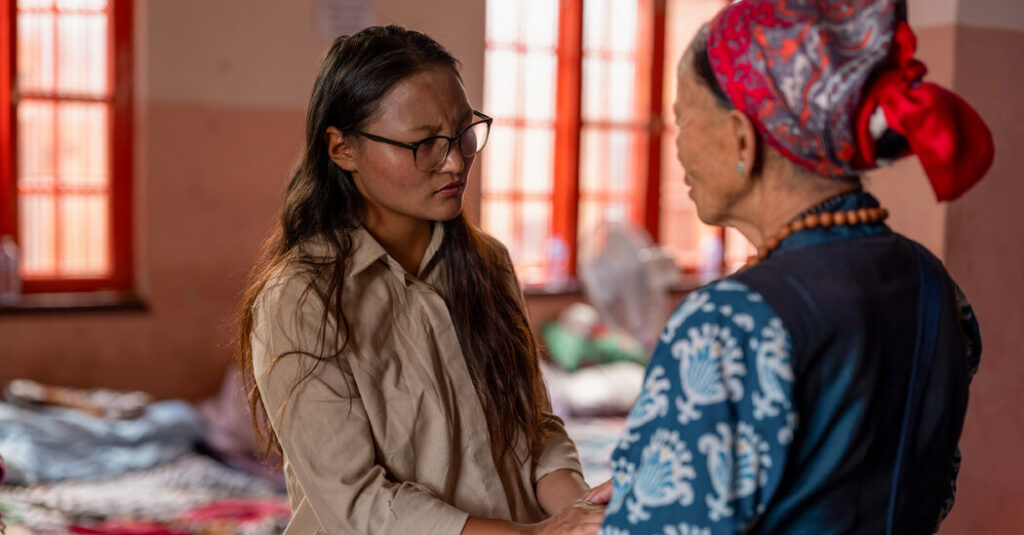
When Tashi Lhazom was 11, a glacial lake overflowed and inundated her home in a high Himalayan valley. Of her family’s hundreds of shaggy yaks, only two survived. In 2025, another flash flood cascaded into the village, the result, scientists say, of melting permafrost on a warming planet.
Such natural disasters spurred Ms. Lhazom’s political awakening. When Nepali young people protested a year ago, she joined other climate activists on the forefront of a Gen Z revolution that eventually ushered in a youth-dominated government in March.
Last month, when a glacial collapse created an inland tsunami that left more than 8,000 dead or missing in other Himalayan valleys in Nepal and Tibet, Ms. Lhazom again raised her voice. Now 26, she demanded that the world’s most polluting countries compensate Nepal for what she calls a “climate national emergency.”
“It’s high time we shift from the language of foreign aid to the language of climate compensation and even reparations,” she said. “This is not a crime that we in Nepal committed, but we are the ones who are suffering.”
After the Aug. 26 floods, the Nepali government has made climate justice its global calling card. Next week, Balendra Shah, the 36-year-old prime minister of Nepal, is expected to address the United Nations General Assembly and push for industrialized powers to foot the bills faced by lesser-developed countries disproportionately affected by climate-linked disasters. The prime minister’s office is now in close contact with Greta Thunberg, the young campaigner who made a video supporting Nepal’s quest for climate reparations.
“As a government that came after Gen Z, we feel our election victory was prepared by these young people, and climate change is primarily their issue,” Shisir Khanal, the foreign minister of Nepal, said in an interview. “We believe that we can be the voice of not just the Nepali young people, but of young people of the world.”
Whether Nepal can persuade industrialized powers to make climate reparations is far from certain — and there is no consensus on which nations should pay.
Under President Trump, the United States, historically the world’s largest polluter, has distanced itself from climate science and the multilateral institutions that could provide a path for compensation. China and India, currently the first- and third-largest producers of greenhouse gases, chafe at being held liable for what they say are the sins of less populous Western nations that polluted with impunity for centuries. Geographically, Nepal is wedged between India and China.
“That’s one of the trickiest and most challenging conversations, not just for Nepal, but in a broader climate discourse,” Mr. Khanal said, when asked which heavy carbon emitters should be liable for climate-linked catastrophes striking smaller, poorer countries.
“We just so happen to be neighbors of two, but they have their own sets of arguments about climate change not just happening in the past 20 years,” he added.
Nepal has put the initial price tag for flood recovery and reconstruction at $4.74 billion. The nation is still paying off loans for international assistance from an earthquake 11 years ago. During his appearance before the General Assembly in New York next week, Mr. Shah will have to balance an urgent appeal on behalf of the world’s least-developed nations with a charm campaign toward richer countries that may not appreciate being targeted for climate compensation.
This year, the Nepali government was provisionally allocated about $20 million from a special U.N. fund for nations vulnerable to climate change, according to Nepali officials. But an emergency request that the Nepali government made after the floods has yet to receive a reply. The U.N. fund, which was set up in 2023 with the hopes of contributions from countries like the United States, is underfinanced and overwhelmed with requests.
The science, climate experts say, is straightforward. Unlike its giant Asian neighbors, Nepal produces a negligible wisp of greenhouse gases. Nearly all of its energy generation comes from hydropower. The country is importing fleets of electric vehicles from China. More than 45 percent of the country is forested, and that green cover is increasing, courtesy of community management programs.
A week after the flooding, Gita Chaudhary, Nepal’s environment minister, represented her country at a meeting of the 44 nations recognized by the United Nations as least developed, where she pushed for climate financing. Ms. Chaudhary, 33, is from an Indigenous community and grew up in what is now a national park.
“Historical emitters need to be held accountable,” Ms. Chaudhary said in an interview, referring to Western nations, adding that current ones, such as India and China, bore responsibility, too.
This year, Mr. Trump pulled the United States out of the Paris climate agreement for the second time.
“If the U.S. won’t agree to anything, what can I say?” Ms. Chaudhary said. “That’s why a global movement is necessary, and that’s why Nepal is going on the global stage.”
In initial reports, Nepali scientists and officials said they were confident that the floods last month were catalyzed by industrial emissions causing glaciers to melt. Others, however, caution that they cannot make a definitive link without further study.
Prakriti Bhattarai Basnet, 28, a technology policy researcher for an opposition political party, was not willing to wait. Four days after the torrent of mud, rock and debris wiped out entire communities, she posted a fiery video on social media.
“We the people of Nepal are done getting your sympathy videos,” she said in the video. “What we want is for your countries to pay up.”
“I was angry,” Ms. Bhattarai Basnet said. “I felt like the world is going to forget us next month when the experts finally come back with their research, so we need to collect as much money and commitments now.”
Rhetoric about climate justice is not limited to Nepal’s younger generation. Two years ago, K.P. Sharma Oli, the septuagenarian prime minister ousted by the Gen Z protests, also addressed the General Assembly, urging wealthy nations to compensate Nepal.
But Ms. Lhazom said that Nepal’s old leaders were unwilling to adequately address climate change. Even her own party, which now governs Nepal, she said, has not acknowledged it as a pressing issue in its platform.
Last week, Mr. Shah, the prime minister, met with businesspeople to talk about possibly reviving an airport project that had been quashed for environmental concerns. For days after the floods hit, he did not address the public, apart from social media posts.
“Our nation was drowning,” Ms. Lhazom said. “We couldn’t wait for our party leaders to tell us what to do.”
She took leave from work to organize relief supplies and medical teams that treated more than 600 people in three days. The destruction she saw brought back memories of the repeated devastation of her own Himalayan valley. Returning to Kathmandu, the national capital, she helped internally displaced people from the disaster zone sheltering in Buddhist monasteries.
Soniya Ghale, 19, was attending a Kathmandu high school with her sister when the rush of glacial debris swept through her village on Aug. 26. Himalayan students often move to the capital for schooling. She took part in the Gen Z rallies a year ago, when 19 young protesters were killed by security forces, provoking a national outrage that brought down the government.
Ms. Ghale’s parents supported her activism, saying their generation depended on the next to fix the nation’s problems.
“Climate change is seriously affecting my home,” she said, listing the impacts on valleys perched under melting glaciers.
Her father, who worked at a bank on the border of Nepal and Tibet, disappeared during the floods and is among the 6,145 people in Nepal still missing and feared dead.
Waiting for news, Ms. Ghale commutes to school. She is studying science.
Binod Ghimire contributed reporting.
The post Nepal’s Gen Z Is Taking on the World’s Polluters Over Climate Disasters appeared first on New York Times.