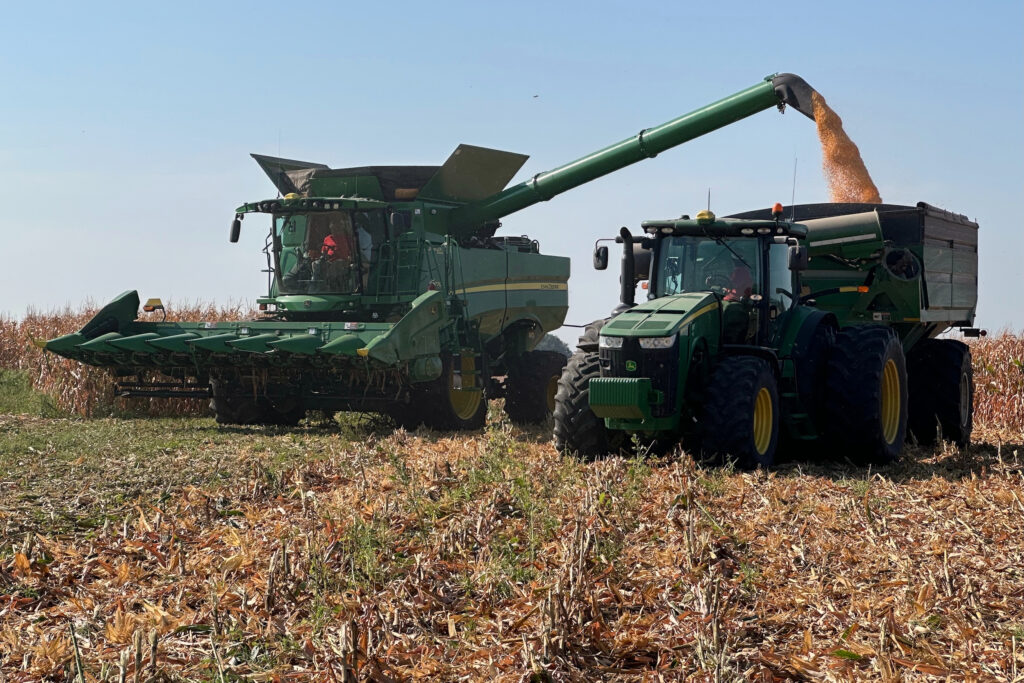
Farmers are struggling under the pressure of higher energy costs, tariffs and fluctuating crop prices. Congress wants to help but has been deadlocked for three years on how to do so.
Now, lawmakers are the closest they have come in nearly eight years to getting a new farm bill done. The Senate Agriculture Committee voted Wednesday to advance its bill to the full Senate. The House passed its bill in April.
Farmers may not get relief anytime soon, though, because there is still a lot of work to be done, including resolving differences between the House and Senate versions.
And many Democrats say they will not support either bill, which would doom the effort in the Senate, where the measure needs some bipartisan support. The current farm bill expires at the end of September, but most of the funding for programs in the law will not run out until the end of the year.
Here’s what is holding up the bill.
Delays to some SNAP cuts
Republicans’ One Big Beautiful Bill, which passed last year, made many changes to reduce how much the federal government pays for the Supplemental Nutrition Assistance Program, or SNAP, the nation’s largest food assistance program. Some of the changes have led to more than 4 million people losing food aid since the law took effect in July 2025.
Under the nutrition section of this new farm bill, Democrats want language to delay a provision of last year’s SNAP cuts that requires states to pay for a larger share of the federal benefits based on how accurately a state calculates and manages its food benefits. This provision is slated to take effect in October 2027 for most states, which means they will have to pull billions of dollars from their own budgets to keep the program afloat — or cut the number of residents receiving food assistance.
Democrats are demanding a two-year delay to give all states more time to prepare for the 2027 cuts.
The House’s version of the bill leaves the original SNAP cuts fully intact, but Senate Republicans added a one-year delay in their version of the farm bill to gain some Democratic support.
During Wednesday’s meeting, Sen. Amy Klobuchar (Minnesota), the ranking Democrat on the Senate Agriculture Committee, said that delay was not enough. “It’s about treating all states equally. Treating the states with middle-error rates, so that they could get their error rates down, the same as those high-error-rate states,” said Klobuchar, who voted against advancing the farm bill, along with the rest of the Democrats on the panel.
Senate Agriculture Committee Chairman John Boozman (R-Arkansas) told The Washington Post on Thursday that there is no appetite among Senate Republicans for a delay that is longer than one year.
“To be honest, I think if we give them two years, or whatever, none of them are going to vote for it anyway,” Boozman said.
The measure will need at least some Democratic support in the Senate.
‘Save Our Bacon’ vs. California
The House included a provision in its farm bill called “Save Our Bacon,” which would limit a California law known as Proposition 12 that requires pork, veal and egg producers to meet certain state production standards to be able to sell in California.
Lawmakers from agricultural states have pushed to use the farm bill to address California’s mandate, arguing that it allows one state to dictate farming practices nationwide and burdens producers.
Rep. Austin Scott (R-Georgia), vice chairman of the House Agriculture Committee, said the California proposition is an “overreach” that comes “at a tremendous cost to the American consumer.”
The Senate’s version of the farm bill does not address the issue. During Wednesday’s Senate Agriculture Committee meeting, Sen. Joni Ernst (R-Iowa) wanted an amendment to be considered that would leave California’s law intact but bar states in the future from creating agricultural mandates applying nationwide. It didn’t make the bill.
Sen. Chuck Grassley (R-Iowa) agreed, saying, “We’re the number one pork-producing state in the nation … it’s just stupid that we don’t have a chance to bring Iowa’s interest to this debate.”
Boozman told The Post on Thursday that he expects there will be a provision in the final version of the farm bill that addresses lawmakers’ concerns regarding California’s mandate.
Oil vs. corn as an energy source
The Senate Agriculture Committee’s version of the farm bill also authorizes permanent year-round sales of E15, a gasoline blend that contains 15 percent ethanol and 85 percent petroleum gasoline.
Some farm-state advocates, predominantly from corn-producing states, have pushed for the permanent authorization of year-round sales of E15 — rather than only in the summer — to boost and stabilize demand for corn. E15 gasoline typically is also cheaper for consumers at the pump.
Grassley said in June that Republicans should welcome the implementation of year-round E15 sales. “It’s good for the consumers, because it would reduce gas prices 20 to 40 cents,” he said, “but it’s also good because our major crop in Iowa, corn, is [what] ethanol is manufactured from.”
House lawmakers from oil-dominant states like Texas, however, have pushed against adding such a provision, arguing that oil refineries would suffer from a year-round increase of ethanol blend sales. House Republicans left the E15 provision out of their version of the farm bill to avoid losing votes and instead passed a stand-alone bill allowing E15 sales year-round.
That measure is unlikely to pass in the Senate on its own, and the farm bill is viewed as the vehicle to get it done.
A key difference between the House and Senate E15 proposals comes down to biofuel mandate rules. The House measure seeks to protect large refiners, while the Senate’s leans toward helping small and midsize refiners.
The post Farmers want relief from Congress. Here’s the holdup. appeared first on Washington Post.