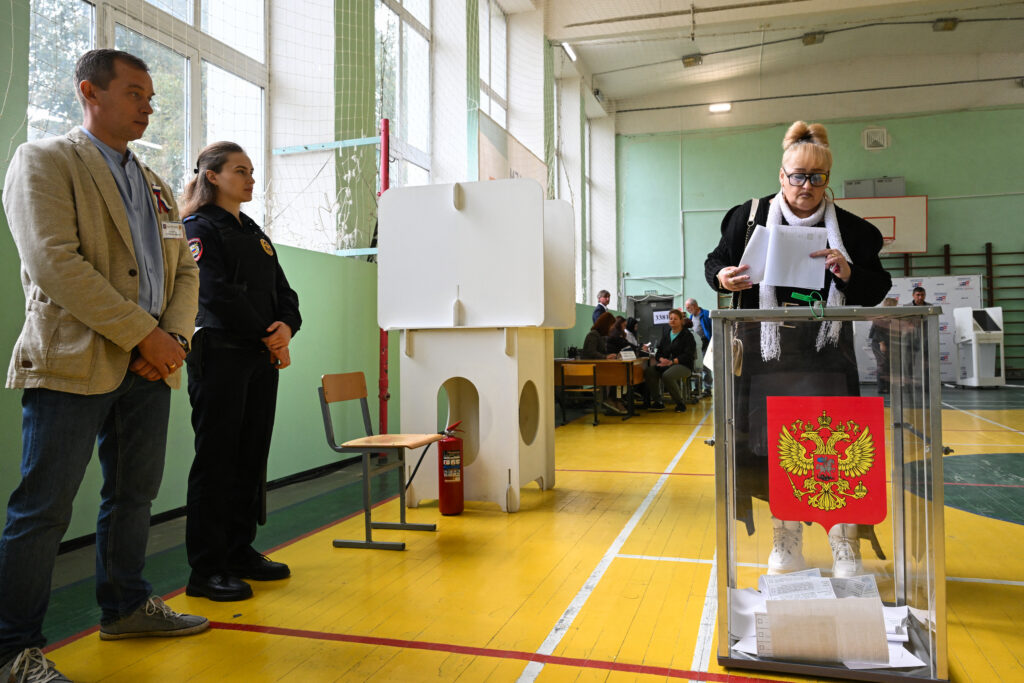
For anyone living in Russia today, there are many unknowns: When will the war in Ukraine end? Will there be enough gasoline to fill the car tomorrow to drive to work? Should we send our sons abroad, in case Russian President Vladimir Putin calls for a new military mobilization?
But one thing that remains assured — a true constant in Russian life — is the predictable outcome of its elections. And this weekend’s national parliamentary vote, the first since the full-scale invasion of Ukraine in 2022, is no exception.
United Russia, the governing party that has long supported Putin and functions as an extension of his administrative apparatus, will once again win a majority in the Duma, the lower house of parliament. Putin will remain firmly in control, amid inevitable speculation of who will succeed him once he’s gone.
A week before the election, the two main government-run pollsters who are accused of delivering Kremlin-friendly numbers put United Russia’s approval rating at 33 percent and 37 percent, and they project the party will win 47 to 53 percent of the vote.
To secure the desired results, Russian authorities cleared the field, banning Yabloko, the only party with an anti-war platform, last month after its candidate list gathered wide support online.
“Putin’s goal is to turn election day into a symbol of unity between the leader and the nation,” said Ilya Yashin, an exiled opposition politician who was jailed in Russia and released during a prisoner exchange in 2024. “He needs this to demonstrate public support and claim a symbolic mandate to continue his aggression against Ukraine.”
But while the United States is gearing up for competitive midterm elections, with tight races in many states and control of both the House and Senate up for grabs, the election in Russia is purposefully boring — in part to dissuade voters not loyal to the Kremlin from going to the polls.
Pre-election debates have turned into a farce, which fits Russia’s broader lack of a culture of political competition. Putin has not participated in a single debate during his 26 years in power — but this cycle pushed that further into the absurd, with United Russia candidates skipping debates altogether or, if they did show up, simply standing by in silence.
Aside from sparsely placed campaign banners in Moscow, artificial intelligence-generated social media content and the occasional television ad featuring pro-war influencers — including a handful of high-ranking officials and NHL superstar Alex Ovechkin — one could easily miss that a national election was underway.
But the vote matters for Putin and the wider Russian government as it provides an opportunity to declare that the Russian people have granted legitimacy to the path that they have chosen for the country — fighting a full-scale war against Ukraine that will soon reach a five-year mark with no end in sight.
Putin and other top officials repeatedly have questioned the legitimacy of Ukrainian President Volodymyr Zelensky, in part by noting that Ukraine has not held elections since the start of Russia’s invasion in 2022.
The Ukrainian constitution and other laws prohibit voting while martial law is in effect, and international election experts say it would be impossible to hold a vote that meets democratic standards, with millions of Ukrainians displaced by the war and hundreds of thousands of soldiers deployed away from home.
Yashin, who recently launched the Peaceful Russia party in Berlin, called on Russians to go to polling stations at noon on Sunday and vote for any party other than United Russia — a sort of camouflaged demonstration to channel opposition to the war. Open criticism of the war is illegal in Russia and public protest can lead to stiff punishment.
Rampant rumors that something big will happen after the election — a general military mobilization, further encroachment on already limited personal freedoms or some form of escalation in Ukraine or with the West — have left many Russians on edge.
In interviews, Russians in Moscow and in regions bordering Ukraine have described the past year as living inside a pressure cooker, and many worry that the lid will come off after the election.
A 52-year-old language teacher in Moscow said she felt panic among her friends, some of whom have sent their draft-age sons abroad for a few weeks as a precaution in case a new conscription drive does occur after the vote.
The teacher, like others interviewed for this article, spoke on the condition of anonymity for fear of retribution by authorities.
“I expect all hell will break loose after this weekend,” she said. “No gasoline, the upcoming hikes in the cost of utilities, squeezing businesses for cash with new taxes, more propaganda on television, on billboards, in schools and kindergartens — all explained by the fact that the entire nation has voted to stand by Putin and his policy.”
Young men in Moscow largely have been spared during what the Kremlin called a “partial mobilization” in 2022, which sent hundreds of thousands of Russians rushing to border crossings. Some expect that if another wave comes, authorities will again be wary of creating chaos in the capital and instead will turn to forcing men from poorer regions to the frontline.
“I’m passively afraid of mobilization — in my own specific case I only hope that being from Moscow will save me, that it’ll blow over and I personally won’t get caught up in it,” said a 35-year-old entrepreneur. “But honestly it’s frightening in general. The war brings nothing good to ordinary people.”
“There’s a constant tightening of the screws,” the entrepreneur added, “and I feel it every day.”
In regions closer to Ukraine and the frontline, where the effects of the invasion, and Ukraine’s retaliatory strikes, have long been far more palpable, the parliamentary race hardly appears to be on people’s minds.
“I haven’t even discussed the election with anyone, because it’s unclear now how to even discuss politics,” said a 31-year-old designer from the Krasnodar region on the Black Sea. “The war is here — several of my friends had close calls, like drone debris falling 400 meters from them. All around me people have felt the war, have slept in basements.”
“People are scared,” she said. “So I’m not sure many are listening to election slogans.”
The eventual makeup of the Russian parliament, which is chosen for a six-year term, still may shed some light on where the country is headed, and on how much support Russians are actually willing to lend the continuing war.
There is a new contender in this election cycle, the New People party, a Kremlin-engineered project set up in 2020 to placate disgruntled liberal voters.
On the surface, it positions itself as a reasonable voice among ultraconservative rivals, pushing back against bans and prohibitions — such as the sweeping internet restrictions imposed this year — yet it stops short of crossing the line on the issues that matter most to the Kremlin, such as the war in Ukraine.
In an otherwise purged political landscape, parts of the younger, protest-minded electorate have come to see New People as an acceptable alternative to United Russia. Government-financed polls project it could take third place in the election.
The party is believed to have been created by Sergei Kiriyenko, the powerful domestic policy chief who has solved some of the thorniest problems for Putin — including engineering the constitutional change that allows the president to stay in power until 2036.
Kiriyenko has built significant influence through civic projects, such as a training program that brings Ukraine war veterans into positions of power.
Mikhail Khodorkovsky, the former oil tycoon who is now an opposition figure living in exile, said the party is likely a vehicle for Kiriyenko to place people loyal to him in parliament, in case Putin leaves office within the next six years and members of United Russia disperse.
“There is a significant nuance here — Putin is 73, and by the end of this Duma’s term he will be around 79,” Khodorkovsky said. “Everyone in Russia keeps in mind that this could be the Duma of a transition period … and it will matter who is in parliament.”
“Kiriyenko wants his people there because he’s confident that if Putin dies, he can pull United Russia’s people into New People,” Khodorkovsky added.
Some exiled opposition leaders have urged supporters to vote for New People anyway, on the rationale that any party is better than United Russia.
Others, like Khodorkovsky, argued that the better bet for anti-war Russians is to vote for remaining Yabloko candidates.
Although Yabloko’s party list was struck from the ballot, it still has roughly 100 candidates running individually in single-mandate districts — the half of Duma seats decided by local, first-past-the-post races rather than filled by party lists based on the national results.
Russians in those districts can still vote for a Yabloko candidate by name. While their success won’t change the overall outcome of the election, even if a handful of these candidates post a strong showing, analysts said, it would send the Kremlin a rare, visible signal that part of the electorate wants the war to end.
Catherine Belton contributed to this report.
The post In Russia, the election result is easy to guess. Much else there is uncertain. appeared first on Washington Post.