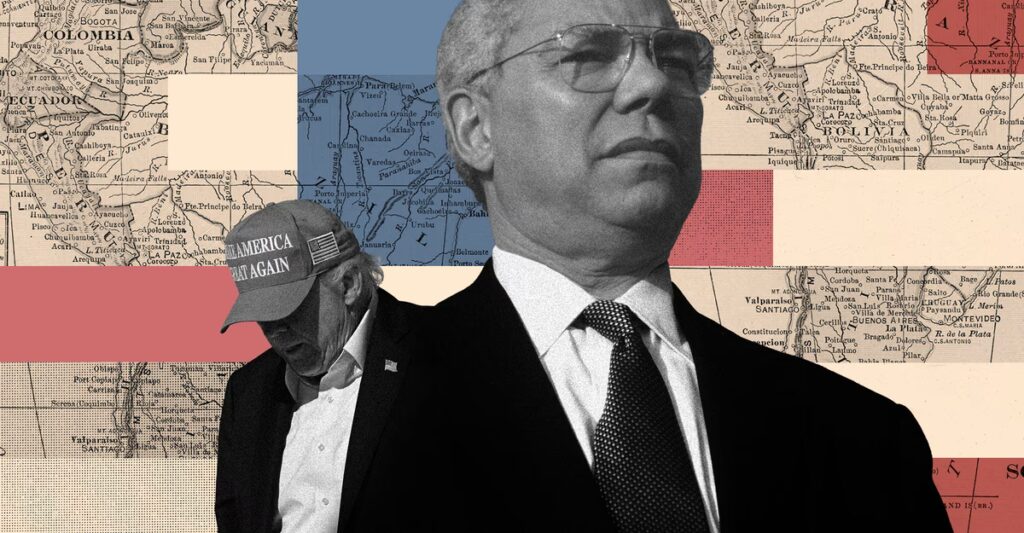
Secretary of State Colin Powell was having breakfast with Peru’s president in Lima’s historic center on September 11, 2001, when an aide passed him a note to inform him that a plane had struck the World Trade Center. Minutes later, he received a second note. “Oh my God,” Powell said aloud.
Later that morning, as the scale of the destruction in New York and Washington was starting to become clear, Powell delivered remarks in a cavernous hotel ballroom. Fears of additional attacks had forced the closure of U.S. airspace. Even senior Cabinet members remained in the dark about President George W. Bush’s whereabouts. Peru’s leaders knew that the secretary of state—the fourth in line to succeed the president—would likely need to depart. But Powell, a former chairman of the Joint Chiefs before he was picked by Bush to lead the Foreign Service, opted to stay—at least for a while.
The former general was in Peru, along with foreign ministers from across the Americas, to cement a new hemisphere-wide democracy charter that would enshrine the region’s commitment to free and fair elections and the rule of law. I was there as a Lima-based correspondent covering the visit. Countries across Latin America were emerging from a long period of despotism and military dictatorship. The United States wanted to make sure the region didn’t backslide. “A terrible, terrible tragedy has befallen my nation, but it has befallen all of the nations of this region, all the nations of the world, and befallen all those who believe in democracy,” Powell told the room full of officials, his voice grave but steady. “It is important that I remain here for a bit longer in order to be part of the consensus of this new charter.”
As the magnitude of the events in the United States washed over me, Powell’s composure and his focus on a point of principle stood out. Even at an extreme, wounded moment in America’s history, he was affirming that the country’s security was inextricably bound up with how U.S. allies represented—or didn’t represent—the will of their people. Strong democracies would support America’s ability to keep itself safe. Powell could have bolted home. But he lingered to make the point. The ministers adopted the charter by acclamation, and by 12:30 p.m. eastern time, Powell had taken his leave for Washington, D.C.—and for everything that followed from the events of that day.
This week, 25 years later, I watched a different secretary of state visit Lima. Marco Rubio is meeting Peruvian leaders today on a tour of Andean nations that have taken a turn to the political right. Given the magnitude of what followed 9/11—the wars, the excesses, the lives lost—Powell’s connection to Peru that day has receded from our collective memory. But his insistence on linking democracy promotion to national security seems remote. Donald Trump rose to power, in part, on the backlash to the post-9/11 wars in Iraq and Afghanistan. In his view, the idea of spreading democracy around the world was an expensive folly, and he’s sold his supporters on a very different approach to foreign policy.
[Read: Rubio won; liberty lost]
In Latin America, the Trump administration has pushed the “Donroe Doctrine,” a 21st-century version of the 19th-century Monroe Doctrine that’s designed to secure “American preeminence” and allied support for the president’s priorities of shutting out drugs, migrants, and U.S. rivals such as China. Trump’s second-term National Security Strategy elevates “flexible realism” and brass-tacks interests such as access to strategic resources in the region. “Democracy” is mentioned three times, while “interests” are cited 36 times. Mutual benefits with other countries can be pursued “without imposing on them democratic or other social change that differs widely from their traditions and histories,” the document says.
In practice, that has meant partnerships with those willing to embrace Trump’s militarized approach to combating drugs, crime, and illegal migration, regardless of those countries’ governing systems. The deportation of migrants to a nightmarish prison in El Salvador is a prime example, as is the ouster of the leftist Nicolás Maduro in Venezuela and the norm-busting oil deal made with Maduro’s deputy. Or consider the militarized counter-drug operations the Pentagon has pursued with Ecuadorean President Daniel Noboa, who at the same time has dissolved opposition parties and targeted rivals. Trump has enthusiastically waded into the region’s elections to endorse candidates who share his political vision: Javier Milei of Argentina, Abelardo de la Espriella of Colombia, Tito Asfura of Honduras. Meanwhile, the Trump administration’s campaign of boat strikes against alleged narco-traffickers in the Caribbean and the Pacific, which critics label as extrajudicial killings, grinds on.
“Politeness and a good bit of decorum are all to the good, but over the last generation, things have gone too far,” Elbridge Colby, the Pentagon’s policy chief, told Latin American defense officials in a speech in Peru earlier this year. “Our rhetoric became wildly detached from the reality of our interests. We talked about the fate of people halfway around the world as if they were as important to us as our neighbors.”
Instead of trying to build ideal societies in far-flung countries, Colby said, the United States would now advance its hard-nosed interests in its immediate neighborhood, using the U.S. military to help allies assert control over lawless areas, treating drug traffickers like the Pentagon treats jihadist groups, and blocking U.S. adversaries’ access to minerals and other key resources. What he dubbed the “Peace Corps” approach to reducing the throngs of migrants and crime headed toward the U.S. had failed, Colby said. If it’s a Latin America democracy that partners with Washington to achieve those goals, great. If it’s not, no one’s going to spend much time worrying about that.
The State Department spokesperson Tommy Piggott told me in a written statement that the United States is “working together with our allies and partners to address the shared opportunities in our hemisphere, and to confront the shared challenges, including defeating the scourge of narcoterrorism that has killed so many.”
Many Latin Americans are ready to at least entertain this shift, according to polls. Spiraling crime, ineffective governance, and the hangover of the COVID era has made trading political liberties for security and economic growth a conceivable option. One of the most popular politicians in the region is Nayib Bukele, the Salvadoran strongman responsible for some of the region’s most flagrant democratic reversals but whose taming of rampant gang violence has made him an icon to many. Democratic backsliding has also occurred on Latin America’s left. After this year’s Colombian elections, Gustavo Petro, de la Espriella’s leftist predecessor, made unsubstantiated allegations of fraud intended to sow doubt about the results.
Rubio presents a plausible case that the armed groups now fueling rampant violence across many Latin American nations are the public’s paramount concern. Those groups not only traffic drugs; they are in some places better bankrolled and armed than the state. In stops in Colombia and Ecuador this week, Rubio made an impassioned case for action. “You have to make a choice here. We’re going to choose on the side of leaders that are going to be serious about taking these groups on and eliminating them once and for all,” he said after talks with Noboa yesterday. “Otherwise, those groups—those terrorist groups—will eat these countries up.”
But the people of the region are also setting limits on how far America’s reach is allowed to extend. Noboa has allowed U.S. forces to begin joint military operations, but Ecuadoreans rejected a proposal last year that would have permitted the United States to establish military bases in the country. This week, Rubio announced that Peru, under conservative President Keiko Fujimori, will be joining the administration’s “Shield of the Americas,” Trump’s militarized counter-drug program. It’s unclear how far Fujimori, whose father, Alberto Fujimori, is both lionized and vilified in Peru for his autocratic campaign against armed leftist movements in the 1990s, will feel she can go in cooperation with Washington.
[Read: Venezuela seems to be going … well?]
“What I see is less of a story about Trump and his government urging allies to go down this road, and more a story of these sovereign countries, these societies, having this debate about the trade-offs between political liberties and anti-crime policy,” Brian Winter, a Latin America expert who is the editor in chief of Americas Quarterly, told me. Based on my years of working in Latin America, the long shadow of yanqui meddling is hard to overstate. And polls show that many people in Latin America today see China, not the United States, as the more reliable superpower.
The U.S. interest in promoting democracy as a pillar of national security didn’t begin in 2001. It may have reached its peak in the 1990s. But the grand U.S.-led experiments of Afghanistan and Iraq, as well as movements elsewhere to overthrow dictators, dominated the first decade of this century—with disappointing results. Several years after 9/11, I was in Baghdad, chronicling the U.S. effort to extract Iraq from the sectarian bloodshed unleashed by the 2003 invasion. Since then, Iraq has managed to emerge as a deeply flawed but surprisingly enduring democracy. I covered Libyan rebels’ overthrow of the dictator Muammar Qaddafi in Tripoli in 2011. Libya remains a failed state, 15 years later. And I was covering the Biden administration when the two-decade effort to build a stable democracy in Afghanistan fell apart in a matter of days.
Perhaps not surprisingly, the consensus of many Americans, and certainly of MAGA supporters, is that the push to elevate democracy in the farthest reaches of the world proved to be a waste of time and money. That conclusion underpins the Trump administration’s approach in Latin America and beyond. When Trump went to war with Iran in February, democracy was an afterthought, and opponents to the country’s authoritarian regime were left to fend for themselves.
[Read: Ukraine’s short-lived comeback]
But the failures of America’s democracy-promotion experiments have eclipsed notable successes across Eastern Europe and parts of Asia. Steven Levitsky, the director of the David Rockefeller Center for Latin American Studies at Harvard University, told me that Latin America has proven to be a democratic success story. The chief exceptions—among them Nicaragua, El Salvador, and Cuba—need to be set against the region’s largest nations. That big countries such as Brazil and Argentina have generally stayed the democratic course despite extreme inequality, high crime, and a global democratic recession, Levitsky said, “is a sign of extraordinary resilience.”
Venezuela presents the most explicit test of how traditional U.S. values will play into Trump’s pursuit of what he sees as America’s national interest. Predictions that the country would descend into chaos after Maduro’s ouster have so far proved wrong. Yet the most tangible sign of American involvement in Venezuela’s affairs to date has been a new oil deal, which gives an office in the Pentagon a stake in the nation’s future output. Rubio has laid out a three-stage plan for shepherding Venezuela to legitimate and elected governance, and he has stressed that the country first needs to rebuild its legal and institutional structures. He argues that the oil pact will benefit Venezuelans. No date for elections—and therefore no date for democracy to return to Caracas—has been set.
Powell, who died in 2021, might have had something to say about that. In the hotel ballroom in Lima, with the U.S. homeland under its most serious attack since Pearl Harbor, he talked about a different model, one that linked democracy to achieving prosperity and peace. He noted that the countries represented around him had their own tragic histories with terrorism—Peru’s battle with the Shining Path, for instance. “It is something we must all unite behind,” Powell said. “We unite behind it as democratic nations committed to individual liberties, committed to the rights of people to live in peace and freedom in a way in which they, and not terrorists, select their leaders or define how they will be governed.” It was the means, not only the ends, that he clung to that day.
The post What Colin Powell Did on 9/11 appeared first on The Atlantic.