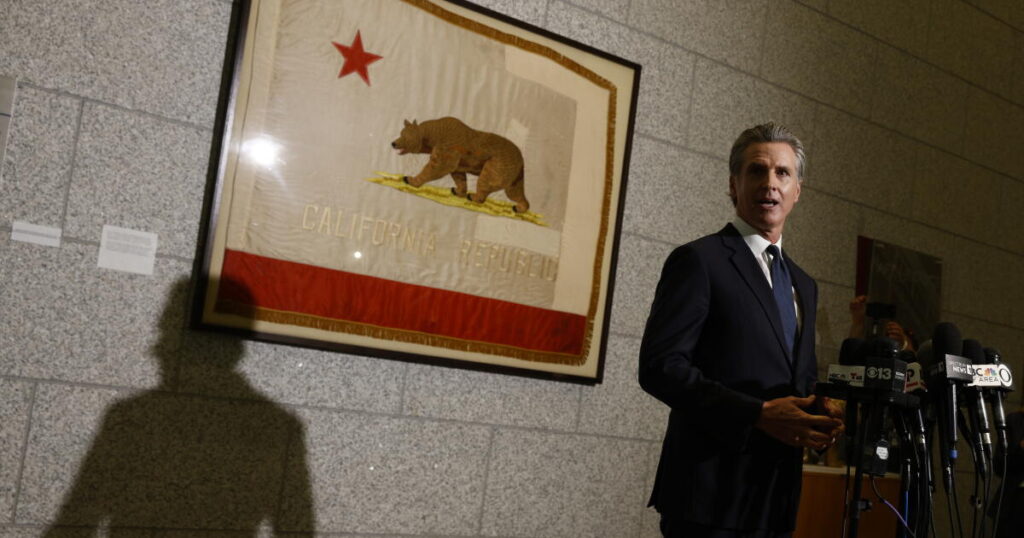
Hollywood’s film and TV post-production workers took their case directly to Gov. Gavin Newsom on Thursday, urging him to sign a bill that would create the state’s first standalone post-production tax incentive.
Workers like editors, singers and sound supervisors joined the bill’s author Assemblymember Nick Schultz (D-Burbank) and Mayor Karen Bass at a press conference Thursday morning in front of the Television Academy’s headquarters in North Hollywood.
The bill, AB 2319, is aimed at supporting the industry’s editors, sound mixers, composers and visual effects artists. It passed the state Senate 33 to 5 on August 30, and the Assembly approved the final version 72 to 2 the same day. Newsom, who has not taken a public position on the measure, has until Sept. 30 to sign or veto it.
Bass urged supporters not to let up before then.
“We need our industry in full force,” Bass said. “It’s all a part of making our city more affordable. We know that this is one of the biggest issues in our city, and so having a strong, robust industry helps Angelenos across the board.”
Under its terms, the incentive allows a 35% to 50% credit on qualified expenses relating specifically to post-production in California. The state’s existing film and TV tax credit program already covers post-production, but only if 75% of filming or the overall budget is spent in the state. The new credit doesn’t require productions to shoot in California. Instead, it’s aimed at projects that don’t receive the state’s production tax credit.
Even if Newsom signs, the program would start small. Schultz initially proposed $100 million to fund the effort, but the Legislature’s end-of-session budget sets aside $10 million to launch it.
“When you think about production, it’s easy to think about the actors, the directors and the writers; you don’t think about all that happens when the camera stops rolling,” Schultz said. “What’s changed is that they’re now telling their story about the struggles they’re facing.”
For Karen Baker Landers, the decline in local post-production work is impossible to overlook. A two-time Oscar-winning supervising sound editor, Baker Landers is vice president of California Post Alliance, the group sponsoring the bill. She has worked in sound for more than 35 years. At the industry’s peak, she worked with crews of up to 20 people for as long as six months. Today, she’s more likely to be working with fewer than 10 people for just a few weeks.
“It’s affecting people in huge ways, like losing their health insurance. I get people calling me asking to get just two weeks of work to qualify for coverage,” said Baker Landers. “It’s really difficult.”
Last year, California expanded its film and TV tax credit program, more than doubling the old $330-million cap to $750 million through June 30, 2030. But a state budget measure Newsom signed in June capped how much in tax credits a business can claim each year, a limit industry groups warned would undercut the expanded program. Lawmakers passed a fix on the final day of the legislative session and it is also awaiting the governor’s signature.
Despite the state’s bigger bet on the industry — and this summer’s fight over the cap — L.A. City Councilmember Adrin Nazarian, whose district includes North Hollywood, argued at the press conference that this is the right moment to keep asking for more.
“It’s that exact momentum that we need. When you double down on something, you’re giving more than hope, and you’re saying welcome back. Please come and do your work. Don’t stop doing this,” Nazarian said. “This is the time to act on it. This is the time to make that investment. This is the time to double down.”
The post Post-production workers and Mayor Bass press Gov. Newsom to sign first-of-its-kind tax credit appeared first on Los Angeles Times.