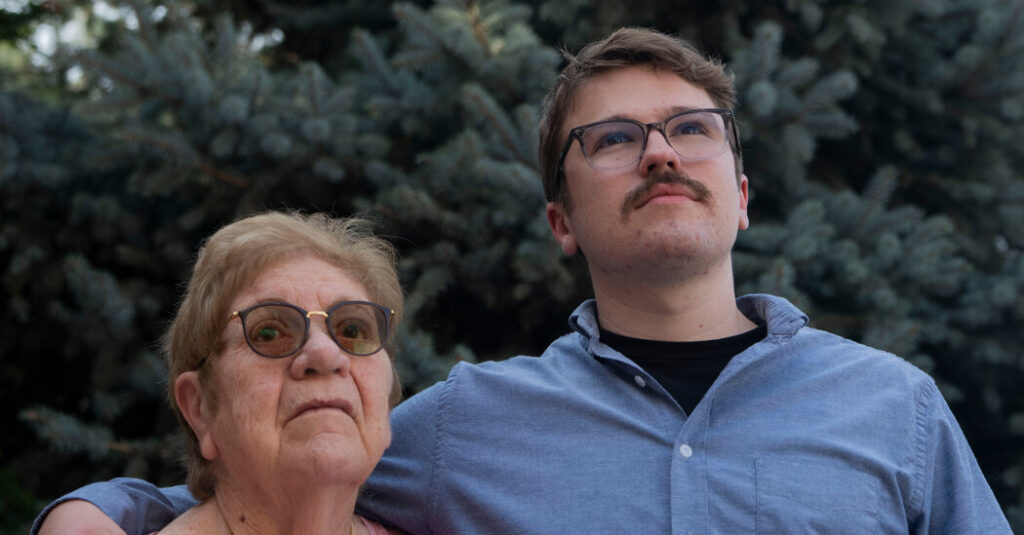
Jacob Campbell and his grandmother were in a dark movie theater in Sayville, N.Y., waiting for a screening of his film, “Those Left Behind,” about his quest to know his mother, who died in the Sept. 11 attacks.
But before the film was screened, Jake and his grandmother, Jeanne Maurer, 85, would have to white-knuckle it through “9/11: An American Requiem,” a 2011 documentary with harrowing images of towers spewing black smoke and fire and witnesses talking about jumpers.
As pictures of destruction flashed on the screen, Jake, 25, whispered to me. “Tell her she doesn’t need to do this,” he said.
Jeanne was sitting on the other side of me with her eyes squeezed shut. Her fingers plugged her ears.
Over the past quarter-century, Jeanne had done her best to steer clear of such footage. What she could not look at, though, Jake cannot avoid. That is in part because he grew up on the internet, where such images were inescapable.
But it is also because, through the passage of time and a relentless series of challenges, he had come to realize that he had no choice but to look squarely at all that had shaped and haunted him since the very beginning of his life.
‘Something Was Off’
The morning Jill died, at age 31, her parents, Jeanne and Joseph Maurer, had come to her Middle Village, Queens, apartment as usual. As their daughter put on her makeup and dashed for the train, Grandma Jeanne and Grandpa Joe waited for 10-month-old Jake to wake, then fed him and drove the few blocks back to their house.
When they arrived, there was a message on the answering machine.
“An airplane hit the World Trade Center, the other tower,” Jill’s voice said.
“We’re all safe,” she said. “I don’t think they’re even evacuating us.”
Jeanne turned on the television. Then she and her husband watched a plane hit the South Tower, exploding through the 78th floor, where their daughter worked as an administrative assistant.
In the following days and weeks, Jeanne vacillated between hysteria and magical thinking, convinced that Jill was roaming Manhattan with amnesia.
Joe, a retired Fire Department captain, knew better.
“My husband, from the very beginning did not think we would ever find her because he said she was at the point of impact,” said Jeanne. “‘She was vaporized,’ he said.”
Jill’s husband, Steve Campbell, was a Police Department officer. He visited his young son at the Maurers’ house, and Jeanne and Joe thought Steve would take Jake home once he had his bearings. When it became apparent to the Maurers that Jake would remain with them, they moved their grandson’s bassinet upstairs from the living room. What had been Jill’s childhood bedroom would become Jake’s.
In many ways, he had a typical and happy upbringing, raised in a middle-class neighborhood. There were Little League games. Visits to Santa’s Village. Catholic school. Church on Sunday — and Mets games, the family’s other religion.
Still, Jake told me recently, “It was sort of unavoidable that something was off.” He felt an emptiness. “The person that brought me into the world — the reason I existed, the anchor to my own existence — just was not there,” he said. “It’s hard to describe the strangeness of the feeling.”
In a nightly bedtime ritual, Jeanne and Joe would hand Jake a framed photograph of his mother for him to kiss. Among his earliest childhood memories is the feel of glass against his lips.
The medical examiner never identified any remains as Jill’s, so ground zero became the cemetery the family visited every Sept. 11 and on Jill’s birthday in June.
Like most curious children, Jake had many questions. But he often was afraid to ask them, not wanting to see his grandparents sad.
One day when he was 4, he summoned his courage and approached his grandparents about the woman in all the pictures: Did my mom talk?
Jake pored over Jill’s scrapbooks and family photo albums. He watched grainy VHS tapes, like the one with Jill swaying with baby Jake in her arms at his baptism, with the Lee Ann Womack song “I Hope You Dance” playing in the background. Jake loved the home movies because he could “see her move and see her being herself in a way that was not someone telling me about her,” he told me.
One of his favorites was a video his father gave him. His mother was pregnant, and “she was kind of annoyed that he kept sticking the camera in her face,” Jake said. “Those moments show the little things that make a person who they are.”
Sometimes information came when he was not prepared. When Jake was 7, he asked his grandfather who the bearded man on the cover of the newspaper was.
“He’s the man who killed your mother,” Joe said.
Jake had not understood until then that she had not simply died. Someone had taken her from him.
‘I Didn’t Want to Disappear’
Jeanne did not need videos to understand what she had lost.
She had 31 years of memories playing on repeat in her mind. And they were often too difficult to talk about.
While her contemporaries were shifting into carefree grandparenting, spoiling little ones with ice cream and toys, she was starting over, raising a child.
“Jake was a gift from Jill,” Jeanne told me. “He gave us something to live for.”
She resolutely refused to cry in front of her grandson, but Jake still sensed that his family lived under a veil of sadness.
“Never Forget” became something of a family mantra, with banners on walls showing the American flag flying in front of the twin towers and a framed flag sent by U.S. soldiers in Afghanistan with a plaque honoring Jill. Sept. 11 lived among them, and more and more space was made to accommodate that housemate.
By now, Jeanne struggled to believe in God. When she prayed, she prayed to Jill.
“Three long years without your sweet smile,” she wrote on an internet memorial page for her daughter in 2004.
“Wish we could turn back the clock,” she wrote in another message, “and keep you from going to work that day.”
“It breaks my heart to not be able to hold you,” she wrote on one of Jill’s birthdays.
The cloud of Sept. 11 grew darker when Joe, who had helped with recovery efforts after the towers came down, developed esophageal cancer — an illness that has been linked to exposure to toxins at the World Trade Center site.
When he died, just as Jake was starting high school, it hit the family hard.
“Joe was my whole world,” said Jeanne.
“I felt lost,” Jake said.
As Jeanne sunk deeper into sorrow, Jake started to rebel against his sense that his identity was being swallowed by Sept. 11. Was this all he was meant to be? Part of a tragic household of martyrs?
Even before his grandfather died, he said, “I always felt that they were wallowing in the pain and the feeling that they always had to remember the event and remember her.”
“I thought, ‘I have to get away from this in order to be myself,’” he said. “I gave it its place, on the anniversary I went to ground zero, but outside of that, I didn’t want to do anything with it.”
There would be more losses to bear. When Jake was 16, his father, whom he had been estranged from for three months, died from a heart attack at 52.
“It was just unbelievable to me that this was continuing to happen,” Jake said.
Weeks later, on a cruise with his grandmother and aunt, he stepped out on a ledge over the dark water with a plan to jump.
He thought about what his aunt and his grandmother would face once they realized he was missing.
He stepped back. “I didn’t want to disappear like my mom.”
‘We Will Have Lost Me’
Jake left for the University of Michigan a year later. But starting fresh was not so simple.
Everyone at his high school had known Jake’s story. But in Ann Arbor, there was no way to casually answer questions about his family.
He struggled to make friends and then stopped trying. He was drinking and smoking weed alone, and he continued to think about suicide.
Jake had been determined to reject the life of grief that he believed had engulfed his family, but he did not know how. “I went so full force into putting it in a little box and trying to avoid it,” he said, “that I wound up coming back around the other side like a horseshoe.”
The coronavirus pandemic hit his sophomore year, and he traveled to Georgia to stay with his half brother, Steven Campbell, the son of Jake’s father and his first wife.
Steven, nine years older than Jake, challenged him to stop feeling sorry for himself. “He loved my mother,” Jake said, “but he wasn’t destroyed by her death. I got a different perspective.”
Jake and his brother took walks and watched movies. Jake began to think, maybe this is what happiness is — the simple things.
He started picking classes that excited him — philosophy and history — and weaned himself from alcohol and weed.
“This happened 10 months into my life,” he said. “So, if I stay miserable, that means it will have ruined my entire life. If I let that happen, we would have lost my mother, we would have lost Grandpa and we will have lost me.”
He started weekly sessions with a therapist he found through an app. And he turned back to the Catholicism of his youth.
Jake was particularly taken by a Gospel story in which the disciple Peter denies knowing Jesus amid the furor leading up to the crucifixion. And yet, Peter was forgiven. “There is at no point anyone or any situation that is beyond hope or beyond redemption,” Jake said.
Jake also found himself moved by an interview in which the talk show host Stephen Colbert discussed losing his father and two of his brothers in a plane crash when he was a child.
In the interview with Anderson Cooper, Mr. Colbert said he came to recognize and even appreciate the goodness that has come as a result of the loss — that he had allowed himself to view tragedy through a lens of gratitude. “What punishments of God are not gifts?” Mr. Colbert said, quoting J.R.R. Tolkien.
Jake transcribed Mr. Colbert’s comments into a journal and has returned to them so often he has nearly memorized them.
‘I Recognized Bits of Myself’
In 2018, I read an article about Jake in The Wall Street Journal. It ran with a photograph that showed how he had placed a “Michigan Mom” T-shirt over the spot where Jill’s name is cut into the bronze of the Sept. 11 memorial.
My own mother, who died in 2005, was a Michigan mom. I reached out to Jake on Facebook, and my sister and I sent him a care package of Michigan swag. He and I kept in touch. The next summer, over lunch, he told me how he had been reading more history and nonfiction about Sept. 11. I encouraged him to write about trying to learn about his mother by studying the event that ended her life.
When the Opinion desk of The New York Times published his essay “Growing With Grief in the Shadow of Sept. 11,” Jake felt a shift. Maybe he could try to process the impact of Sept. 11 in his life using his brain and his pen.
And so after he graduated with a business degree in hand, Jake applied and was accepted into a graduate creative writing program at Dartmouth. A new start.
Then he looked at the school calendar. The first day of classes would be Sept. 11, 2023. Jake felt caught between his past and his future. He chose the future, skipping the ground zero ceremony for the first time.
On that first day of class, he met a high-energy graduate student named Abby, who would become his girlfriend.
“It’s a day that I have given new meaning to,” he said. “I think my mother would be happy.”
But less than two months into his new beginning, his Aunt Linda, who lived her adult life in the bedroom next to his, grew critically ill. He sat by her bedside for days before she died. “I felt like I was stepping up a little bit instead of buckling,” he said.
As he dug into filmmaking at Dartmouth, Jake began to think more about how to reconcile his desire to reject the culture of mourning he was raised in with his longing to connect with the very subject of that mourning.
Maybe the answer was seeking the woman his mother was when alive, before she became a myth.
She had gone skydiving, so he went skydiving. She went backpacking in Europe, so he did too. She traveled to Australia, and off he went.
While he was there, he spent a few weeks with the family of a woman who had traveled with his mother decades before and later became her pen pal. She shared letters with Jake that Jill had written. About talking to the actor Matt Dillon at a bar at 2 in the morning. About a tour guide who had hit on her. About dating Jake’s father.
“Growing up, I heard stories,” Jake told me. “But it was a hagiography, not necessarily a real person’s story — a saint’s story with some truth sprinkled in.”
“Reading the letters,” he said, “was a tremendous experience for me. They were really funny because she doesn’t hold anything back.”
It was Jill telling her own stories, he said, “and I recognized bits of myself.”
On a visit home to Queens, he started scrounging cabinets for more. He happened upon student videos Jill had made while in college, shot at a fire station where Joe had worked. Then his grandmother told him that Jill once worked as an editor for a video company.
Learning that they shared a love of filmmaking gave Jake what he called “the courage and the clarity” to finally contend with her death in a way that felt authentic.
The result is his film, a 22-minute documentary. In it, he asks a foundational question: “What is it like to miss someone you don’t know?”
Jill is the inspiration. But Jeanne is the star.
‘I’ll Never Have an Answer for That’
The film, “Those Left Behind,” was selected for the Sayville International Film Festival, and Jake returned home for the festivities in August.
With the 25th anniversary of Sept. 11 approaching, I asked Jake and Jeanne if they would consider talking to me, not as a family friend but as a reporter. I had many anguished conversations with each of them.
A few days before the film festival screening on Long Island, I drove out to Queens to see them both.
Over turkey sandwiches, we talked about grief.
I asked Jeanne why she would not let herself cry in front of Jake. “I’m trying to protect him,” Jeanne said. “I’m his grandmother.”
Jake told her she did not have to keep things bottled up. “I don’t want you to have to be a little turtle, sort of hiding everything inside,” he said.
But when she asked him how he would feel to see her cry, he told her he did not know.
At my suggestion, Jake pulled up the clip of Mr. Colbert talking about finding gratitude in personal tragedy — the insight that helped Jake reframe his own attitude about the loss of his mother.
When Mr. Colbert quoted Tolkien — “What punishments of God are not gifts?” — Jeanne looked taken aback.
“It’s hard for me to feel like that, really,” she said afterward. Yes, there were gifts, the closeness of her relationship to Jake foremost among them. “But I’ll never be grateful for the punishment of losing her,” she said.
“I’m not asking you to,” Jake said softly, but Jeanne was not done speaking.
“Why does it have to happen?” she said. “Even if good does come out of it, why does it have to happen?”
“I’ll never have an answer for that,” he said.
She turned to me.
“I want him to be at peace, you know, and to be happy in his life,” she said. “I’m very happy for him that he has gone back to God.”
But she just could not square his equanimity with the losses.
“How many kids his age have gone through what he’s gone through?” she asked. Her lost faith in God, she added, is not just about Jake. “There is too much suffering.”
Jake looked at his grandmother. “You can say there is suffering,” he said, “or you can also say that it’s people like you who, faced with that suffering, decided to raise a baby and give all of yourself to something that was helpless.”
“It’s not that, Jake,” she replied. “When I see these children that are suffering, it breaks my heart.”
He threw his arms up in frustration.
“That was me!” he said. “I was the child!”
He paused and then spoke softly. “There are children out there who are suffering, and they are helped,” he said. “There are people out there who are in the midst of tragedy, and are helped. There is love in the world in equal measure to the suffering.”
‘Still Here, Still Trying’
Two days later, we all met in Sayville, N.Y., along with some of Jake’s friends and relatives, as well as his girlfriend, Abby, and her parents.
“Those Left Behind” opens in his childhood bedroom — also Jill’s. In voiceover, Jake explains that as a child at night, he felt the presence of his mother — “nondescript and unmistakable” — in the corner.
Later on, he talks about imagining how his mother felt at the very end of her life.
“Part of me believes that if I can conjure that moment as vividly as possible — if I can place myself in it with her, if I can see her — then I can, through some strange transference, let her know that I’m there,” he says. “I become the ghost. I sit down with her, and I tell her that I’ll be OK. That I’m still here, still trying.”
After it ended, the crowd applauded him. When they realized that Jeanne was also in the theater, they applauded her, too.
The next day, at the festival’s wrap-up luncheon, Jake was presented with one of the “best director” awards. Jake, Jeanne and Abby called me from the car ride back to Queens. I asked Jeanne how it felt to see her grandson win an award for something that had brought him closer than ever to his mom.
She answered simply: “We raised an amazing young man.”
The post He Lost His Mother on 9/11. He Grew Up in Her Childhood Bedroom. appeared first on New York Times.