It has no seats in the German Parliament. It is polling at less than 5 percent in national opinion surveys. In a state election on Sunday in Saxony-Anhalt, eastern Germany, it barely scraped into the statehouse.
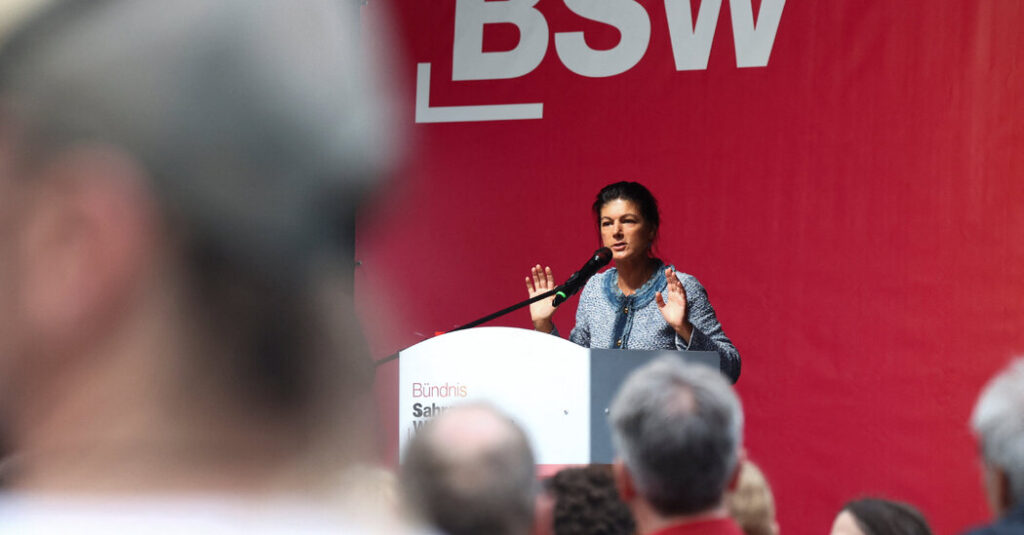
Yet the Sahra Wagenknecht Alliance, a tiny anti-establishment party, suddenly wields outsized influence. Its handful of newly elected state lawmakers could give power to Germany’s far right for the first time since 1945.
The alliance, known by its German initials BSW, is the only party in Saxony-Anhalt that has refused to rule out working with a state government led by the Alternative for Germany, the far-right group that finished first in the election but fell short of an outright majority.
The Alternative for Germany, widely known as the AfD, won 39 of the 83 seats in the Saxony-Anhalt statehouse, three short of what it needed to bypass the other parties and govern alone. Depending on the outcome of negotiations in the coming weeks, BSW’s five lawmakers could vote the AfD into office — a seismic shift for a postwar political system that was designed, after the fall of Nazism, to block parties deemed extremist from entering office.
“They find themselves in a pivotal position, which they will now use to push through their political ideas,” said Benjamin Höhne, a political scientist who researches the BSW.
Here’s what to know about the group.
Who is Sahra Wagenknecht?
Sahra Wagenknecht, 57, is a former academic and longtime politician who once led lawmakers from Die Linke, a major leftist group that emerged from the ashes of the Communist Party in East Germany. The daughter of an Iranian father and a German mother, she gradually adopted more conservative views on social issues, including immigration, and split from Die Linke in 2023.
Ms. Wagenknecht founded BSW in early 2024, pledging to stand up for those to whom “the categories of left and right are no longer comprehensible,” she told The New York Times that year.
But the party failed to win widespread support, and she resigned as its leader in 2025, even though it is still named for her.
What does the alliance stand for?
BSW’s policies are an unusual hybrid of left-wing economics and social conservatism. The party supports protecting the welfare state and limiting immigration. It is critical of NATO and Germany’s support for Ukraine. Its members are skeptical of the social justice movement, which they say no longer represents working-class interests and stops people from saying what they think.
“We grew uncomfortable with constraints on our freedom of speech,” Claudia Wittig, a BSW leader in Saxony-Anhalt, said of the group’s divergence from the traditional left.
What is its relationship with the AfD?
Initially, the alliance marketed itself as a respectable alternative to the AfD, whose leaders have diminished the significance of the Holocaust and repeated Nazi slogans. Rivals even saw the BSW as a useful magnet for voters tempted to support the AfD, but ultimately put off by its association with extremism.
Now, the BSW says it is prepared to work with the AfD in certain contexts.
BSW leaders in Saxony-Anhalt say their lawmakers could vote to break the statehouse deadlock and give the AfD power, though they wouldn’t seek cabinet roles in an AfD-led government. The BSW is also open, its leaders said, to working with the AfD on certain common goals, including curbs on migration, ending sanctions against Russia, and initiating an inquiry into perceived governmental missteps during the coronavirus pandemic.
That shift marks a rupture with Germany’s mainstream parties, which for decades since Nazism have refused to work with those they deem extremist.
When might the BSW make a decision?
Not for at least a week, according to Ms. Wittig.
She said in an interview on Monday that BSW leaders were exchanging text messages with the AfD about setting up negotiations, but no meeting had yet been organized.
Nothing was likely to be agreed on until after another round of state elections elsewhere in Germany on Sept. 20, Ms. Wittig said. Politicians from all parties may be reluctant to make any compromises that jeopardize their colleagues’ standings in those other races.
Negotiations could yet stall over who would lead the government. The BSW says it won’t support a government led by Ulrich Siegmund, the AfD’s candidate for governor, and would prefer a technocratic figure to lead in his stead.
The post This Tiny Anti-Establishment Party May Put Germany’s Far Right in Power appeared first on New York Times.