Yascha Mounk is a professor of the practice of international affairs at Johns Hopkins and the founder of Persuasion.
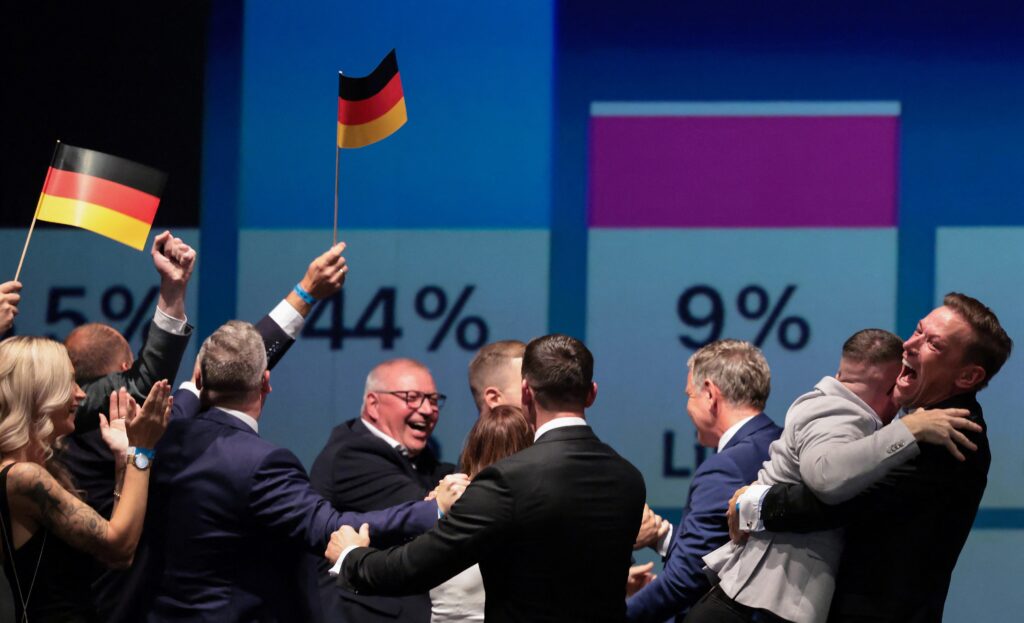
The Alternative for Germany has just achieved the best result of any far-right party in the country’s postwar history. In regional elections in Saxony-Anhalt, a state in eastern Germany, the party more than doubled its share of the vote, and is projected to take about 44 percent, likely just short of an absolute majority.
The result could put the state into a political deadlock. It would take an extremely broad coalition of all other parties represented in the state parliament to keep the far right out of office. Since these parties range from the far left to the center right, the best case scenario now is a dysfunctional and incoherent government, known among local political journalists as a “Frankenstein coalition.” The worst case is that one of these parties defects, allowing the AfD to take power.
So why did German voters — who have in recent decades proved to be much more moderate than their neighbors — embrace such a radical party?
There are many partial explanations. The country’s economy is in terrible shape. The industries in which Germany has traditionally excelled, such as car manufacturing, no longer lead the world in cutting-edge technology. The German tech sector is in an even more lamentable state. While China and the United States battle for supremacy in robotics and artificial intelligence, German companies have fallen behind even European neighbors like France.
Social cohesion in the country is also at perilously low levels. When a huge wave of immigrants arrived in 2015, Chancellor Angela Merkel famously reassured her country that “we can do this.” But a decade later, the rate of labor market participation among recent immigrants remains lower than that of native-born Germans, with rates of dependency on welfare benefits much higher. Perceptions of public safety have notably deteriorated. Individuals who have no legal right to remain in the country have perpetrated a series of bloody terrorist attacks.
In the memorable formulation of political scientist Constanze Stelzenmüller, Germany has long outsourced its security needs to the U.S., its supply of cheap energy to Russia and the sources of its economic growth to China. All three elements of that model are now in tatters. President Donald Trump is putting pressure on European nations to look after their own defense. Russian President Vladimir Putin’s invasion of Ukraine and his increasingly overt aggression against other European nations show how shortsighted generations of German leaders were to entrust their energy security to Russia. And with China producing increasingly sophisticated goods, the country has gone from being one of Germany’s best customers to posing the biggest threat to the survival of its vaunted manufacturing sector.
Figuring out how to replace this model would be a tall order under any circumstances. But the truly striking thing is that Germany is barely even trying. Leading politicians are consumed by infighting, and for the most part appear oblivious to the gravity of the crisis. Meanwhile, German journalists and intellectuals are quick to lament the country’s sorry state but surprisingly unwilling to imagine a genuine alternative.
The reason for this failure of imagination is rooted in German history. In the first half of the 20th century, Germany rapidly cycled through a series of failed social, economic and political models, with each proving more brittle and unstable than the last. The result was an unmitigated disaster — for the world, of course, but also for the country itself.
After 1945, Germany finally stumbled upon a model that worked. The devastation of World War II cured the country of nostalgia. Occupation by France, Britain and the U.S. forced West Germany to adopt democratic institutions. The political class that founded the Federal Republic proved surprisingly public-spirited. And the economic boom that soon took hold across most parts of Western Europe gave the new institutions a deep stock of legitimacy.
In the postwar period, large swaths of the German political and intellectual class took a simple lesson from the contrast between the country’s disastrous past and its successful present: Anybody who sought radical change was being irresponsible. Konrad Adenauer, the dominating political figure of those years, won reelection on a simple slogan: “Keine Experimente” (no experiments). Those words in some ways became the founding credo of postwar Germany; even today, they deeply inflect the mindset of its elites.
That mindset served the country well for the better part of a century. It helped to banish the extremists that had thrived in so many previous periods of Germany’s history. It allowed the country to temper the upheavals of the 1960s better than many of its neighbors. It allowed leaders from Willy Brandt to Helmut Kohl to earn the international trust that made reunification possible. And when some part of the model started to show a few signs of wear and tear, or broader circumstances changed in some small way, it allowed German leaders to respond with moderate reforms.
But now that Germany is in need of much more radical change, that same mindset is proving to be the biggest impediment. As long as the country’s political and intellectual leaders remain convinced that anybody who wants to change major elements of the country’s model is deeply irresponsible, it will remain impossible to have a productive debate about Germany’s future. Building new economic and societal foundations for a democracy that can retain some sense of stability under radically changed circumstances will require exactly what Adenauer warned against: a willingness to engage in experiments.
Elements of the party that now leads national polls by a wide margin are obsessed with the idea that Germany must unlearn the lessons of World War II. As one of the AfD’s more moderate leaders has said, “Hitler and the Nazis are merely a speck of bird poop in 1,000 years of successful German history.” The real change in historical consciousness the country needs is rather different. To build a new model for the coming decades, Germany needs to unlearn the lessons it took from the postwar period: To defend the values that have defined the country since World War II, it must grow willing to embrace disruptive change.
The post The AfD is exploiting Germany’s fear of change appeared first on Washington Post.