WESTWEGO, La. — His daughters were playing Uno at the kitchen table, so Wilton Lemieux stepped outside to record another video he didn’t want them to see.
The message he’d typed in his Notes app on this late summer afternoon was too heavy, he figured, for the fourth- and sixth-graders.
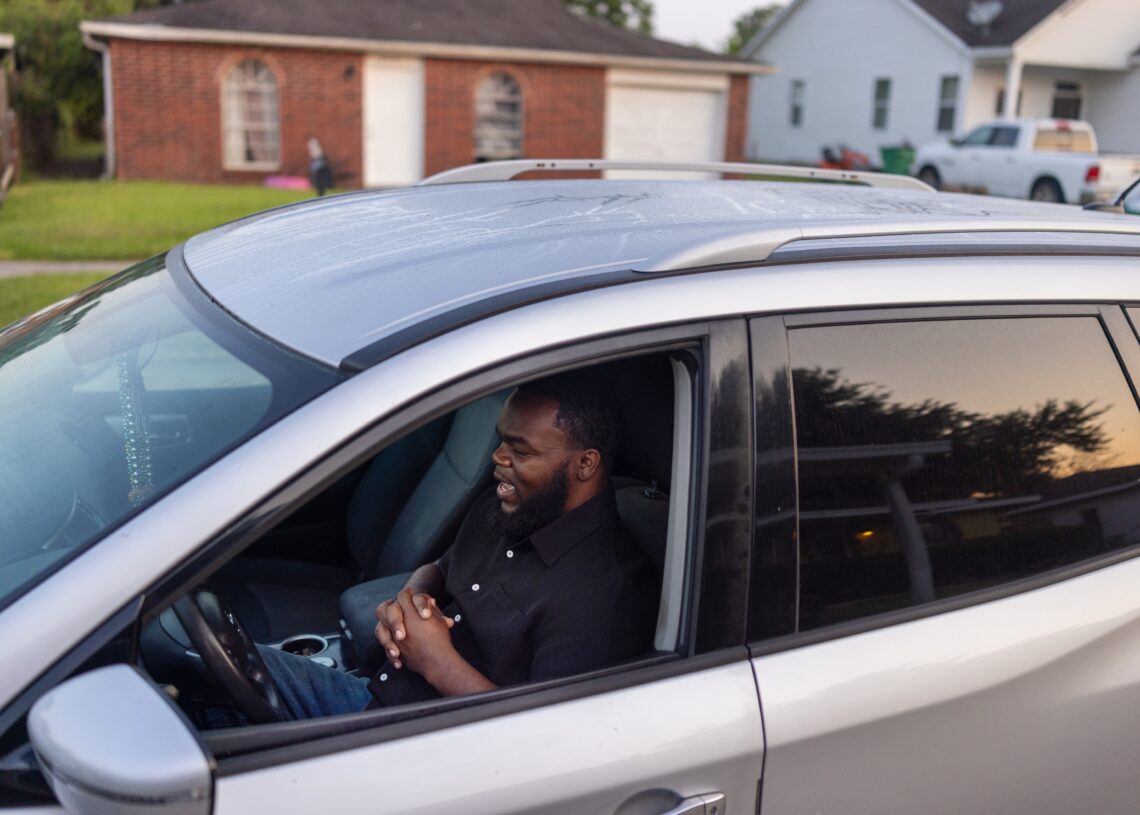
He walked down the driveway to his silver Nissan Pathfinder with the cracked windshield, sagging bumper and license plate frame that said AFGHANISTAN VETERAN. He slid into the front seat, where sun-faded photos of his late grandma and the girls obscured the speedometer, and propped his matte black iPhone on the steering wheel. He opened TikTok and stared into the camera.
“Why are they lying to the American public?” Wilton asked.
The 34-year-old single father pondered that question at the grocery store and the gas station, where $20 now filled a quarter of his tank instead of the usual half. His $200 weekly budget couldn’t keep up. For the fourth month, he’d dipped into his savings to cover the basics.
Alone in the car, Wilton pasted his words into a teleprompter app. He repeated himself three times, four times, five times until the tone he tried to keep gentle at home matched his inner monologue: angry, betrayed, grieving all he’d lost while trying to do everything right.
“Why are they lying to the American public?”
“They” were his shorthand for politicians, corporate suits and tech bros — the elites he viewed as too preoccupied with artificial intelligence and a White House ballroom and a war that never made sense to him while everyone he knew struggled with the rising cost of survival. Yet the president was on his television, declaring, “We never had the American Dream like we have it right now,” which sounded to Wilton like a sales pitch or a delusion or both.
Four months earlier, his faith in that national ideal died one evening at an ExxonMobil pump. Wilton remembers rage at yet another price hike, then clarity, then an ache to vent about what he couldn’t train his brain to stop noticing, like how sad his mom’s neighbor looked when she talked about working for 41 straight years and not being able to afford a vacation for the last 12.
He pulled out his phone and filmed a takedown of the American Dream.
“It’s all an illusion of something better that never is going to come,” Wilton spat out.
Pressing “post” on that selfie video felt like a satisfying micro-protest. Wilton drove home and went to bed, expecting a bit of grief from his Army buddies. Then he woke to 25,000 comments that were overwhelmingly supportive.
Through some algorithmic magic, his 36-second speech had garnered 2.8 million views. People were watching from across the country and four other continents, according to his analytics page. In seven hours, his few dozen followers blew past 30,000.
Here was an audience for ideas the younger version of himself would have found unpatriotic. A potentially lucrative one, too, from what he understood about the attention economy.
Maybe he could make it in America by arguing that you can’t.
I don’t want to live the American dream
… because I’m too awake
♬ Disturbing Suspense-Psychological Thriller (with drama)(887886) – CHROMA

Nothing about his circumstances screamed “influencer,” but Wilton had heard of de-influencers coaching the masses on what not to buy or feel bad about. A de-influencer wouldn’t care about stains from little hands all over the gray interior of his SUV. A de-influencer would post, anyway, so week after week, Wilton kept ranting:
“In these times we’re living in, people are one step from a breakdown,” he said in his next video.
“Gas prices are so insane right now, I just stay away for my mental health,” he said in his 62nd.
“Many of us choose between a balanced meal and an endless list of overinflated bills,” he said in the 107th.
“Why are they lying to the American public?” he asked again now.
‘Can’t give up’
Video No. 139 uploaded, Wilton exited the car and headed back to the yellow stucco house that had inspired his old worldview.
The mid-century ranch was an abandoned eyesore when his stepdad, a master plumber, bought it three decades ago for $50,000 and gradually fixed it up into their extended family’s favorite hangout. After Hurricane Katrina obliterated the roof in 2005, Wilton helped him replace the drywall. It was a lesson, he thought, in forging your destiny through grit. His teenage mantra became: “Tenacity, consistency,” and Wilton imagined what he’d build for his children someday. They installed marble countertops, terra-cotta tiles and a glass chandelier over the two dining tables that sat 16 but still couldn’t fit everyone who came for his mom’s Cajun gumbo.
Lately, she’d been skipping the pricier ingredients.
“No crabmeat,” Carla was saying now, chopping what was left of her andouille sausage. “Everything’s just …”
“Way too much,” Wilton said, finishing her sentence. The girls, giggling, didn’t look up from their cards. “Like $66 for a half-bushel, I saw.”
That was steep for his working-class hometown on the west bank of the Mississippi River, where fishermen sold seafood in coolers at the Shrimp Lot. His grandfather, a longshoreman, and grandmother, a homemaker, had climbed from poverty to the middle class. His mom and stepdad had done better. Wilton had at one point been on track to do best of all. These days, he went crabbing for free protein in the marshes.
Growing up, he aspired to live off the land as a cowboy. A middle school teacher told his class the city’s name — Westwego — came from 19th-century settlers caravanning toward California, proclaiming, as legend had it, “West we go.”
The military had offered the next best adventure. Wilton joined the Army two weeks after his 17th birthday. He helped clean up the BP oil spill in the Gulf of Mexico before deploying to Afghanistan, where he repaired bridges during Operation Enduring Freedom.
Serving gave him a sense of purpose, which carried him through risky assignments and the deaths of soldiers he called brothers. But nothing compared to the intensity of being a father. Shortly after he landed in Helmand province, his wife gave birth to a baby girl. Over the phone, they named her Whitlynn. He cried watching videos of the newborn, thinking: Daddy will meet you soon. Four months later, a chaplain knocked on his door. Whitlynn had died in her sleep.
Wilton flew home. He told a Department of Veterans Affairs doctor that he was “anxious to a level that can make your brain burst.” He made a plan to commit suicide but sought psychiatric care instead, determined to be there for his wife, who was soon pregnant again. For a couple of years, he worked in billeting at the Jackson Barracks in New Orleans, but Wilton barely slept. His panic attacks, he told another doctor, felt like “falling off a mountain.” The VA diagnosis: Permanently disabled with PTSD.
He left the military just before his youngest was born and returned to school for a year, thinking he could teach English and lead an ROTC program, but his short-term memory was fried. Words blurred together on his laptop screen. He could no longer cover the mortgage for the house he had bought with a VA loan when he was 21. His marriage ended, and when his ex-wife moved away, the girls stayed with him.
“Can’t give up,” Wilton had thought when he enrolled last year in an online coding course for veterans. Still struggling to concentrate, he dropped out again.
Now he tracked with a calculator how he spent his $2,500 monthly disability check, which was buying less and less for his family. The kids needed healthy food. Broccoli, berries, sardines. Yet the refrigerator looked half-stocked after he paid the rent on their two-bedroom apartment ($1,000), the car bill ($250), the car insurance bill ($300) and his phone bill ($100).
He’d wanted to view that as another challenge to overcome, but the more he watched the news, the angrier he got.
Wilton blamed Washington for the tariffs and the war with Iran hiking prices throughout the supply chain. He’d sacrificed the chance to meet Whitlynn for this country, he thought, only to wait months sometimes to see a VA doctor. And watch his mom and stepdad, who’d also been working since they were teenagers, worry about retirement. And blow his July budget at Aldi that morning, despite skipping the KitKat bars (30 cents cheaper at the Dollar General) and putting back the lean ground beef ($7.39 for a pound?!).
At least his daughters loved dining at Grandma’s.
“I’ll just eat their scraps,” he told his mom as she set one of the tables for lunch.
The real him
Wilton wouldn’t touch a plate until 12-year-old Riylee and 9-year-old Nurii ate what he hoped would be enough shrimp patties, red beans and rice, cornbread and crabless gumbo.
The same went for Alicia Johnson, who’d lived next door to his mom for 27 years and popped in now for Carla’s home-cooked spread.
“Hey, Miss Alicia,” Wilton said, hugging the 58-year-old school bus driver. The woman with a ponytail of curly gray hair seemed tired. Wilton wished she was on a cruise or in a water aerobics class — something relaxing for someone he rarely saw take a break. They were both waiting for the next check.
“Sometimes, if it weren’t for Carla, I don’t know …” Johnson said as she sat next to Wilton and scooped herself some of the rice.
She made $22 an hour — a good wage, she thought — and was still looking for a second job. How else would she settle her $47,000 mortgage and $10,000 in credit card debt? Johnson yearned to visit her son, a soldier in Colorado, but she needed the shifts, and had they seen the cost of flights? The last time she’d taken a vacation, Barack Obama was president.
“You try to make a living and it’s just not there,” she said.
“It’s not,” Wilton’s mom agreed.
Carla liked to say she was a Christian and a caterer, so anyone around her was getting fed. She and her husband weren’t rich — he was out somewhere installing a toilet — but they’d paid off the house, and Carla suspected that at least four of their neighbors would go hungry if she didn’t hand-deliver them meals.
“Like me,” Johnson half-joked.
Wilton dreaded being a burden, and he sensed TikTok could ease some of his financial strain. But chasing money on social media came with its own pitfalls. After ditching the coding course, he’d created his first account, regurgitating news articles he’d read without showing his face. A few of those videos went viral, and Wilton made $2,000 from a couple minutes of work before the app removed his account for what he guessed was violent wording in an Iran war update.
During those months, he’d checked his views obsessively when he should have been present for his family and posted what he thought would draw the most eyeballs.
He wanted his new account — @DadSacrificeCode — to show the real him. This time, he hadn’t monetized it. This time, he waited for his daughters to go to bed before reading the comments.
Done eating, Riylee and Nurii wandered off to play. “Okay, now I’m hungry,” Wilton said, grabbing a plate.
‘I make more … and I’m more broke’
Wilton tried not to dwell on the reaction to his videos.
A viral hit brought a dopamine rush. A flop stung. He noticed a few military friends had unfollowed his account.
Not everyone is ready, he knew, to tough-love America. He marveled though at the tens of thousands of strangers commenting on his page. Did he actually make them feel better?
Wilton didn’t know that a woman in Michigan, exhausted from a day of work and solo parenting, had stopped scrolling when she heard him say, “F— the whole United States of America, including me.”
He didn’t know that she watched the message again. And then 10 more times.
“Including me?” she’d thought. “Go on.”
Shani Rasor, 30, pressed the “follow” icon. This bearded guy could be anyone, anywhere, talking to her from the front seat of a shabby car. That didn’t matter. She recognized his pain.
Rasor worked for a personal loan company, listening every Monday through Friday to hours of recorded collection calls. Her job was to flag language like, “I’m going to sue you.” But mostly, she heard people begging for extra time or understanding.
She wanted to tell them, “I get you.” Her salary was $50,000, which sounded high to her at first, but Rasor still dozed off on the couch so her 7-year-old daughter could sleep in their only bed.
“I make more than I ever have and I’m more broke than I’ve ever been,” she wrote on Wilton’s video.
Soon, notifications filled her screen. Someone liked her comment. Someone else liked her comment. Every day for the last 13 weeks, someone new had liked her comment, bringing the total of tiny digital hearts to 6,517.
@DadSacrificeCode’s page felt to her like a support group.
“I’m tired of waking up every morning with heavy anxiety.”
“My mother can hardly afford food..after working for 36 years…”
“I make 70k a year before taxes and I live paycheck to paycheck.”
“Work work work work but nothing around me changes.”
“70 and can’t retire.”
“EVERYONE IS BROKE AND TIRED.”
A formula for success?
No matter how broke or tired he felt, Wilton had to entertain the girls, so off he went with Nurii into nature.
“Take care,” he told the booth attendant at Bayou Segnette State Park, handing her $6.
That brought him to $10.75 in the red, meaning his savings had dipped below $3,000, the number he saw as a decent emergency fund. Wilton tried to focus on bonding with his 9-year-old on one of her last days of summer break.
He kept his phone in his jeans pocket. His daughters weren’t allowed to have one until they could drive, so, as far as he knew, they hadn’t seen any of his videos. Riylee wanted to be a doctor. Nurii wanted to be a veterinarian. Wilton didn’t want to blunt their straight-A ambitions, but he’d try to protect them from feeling like a failure the way he had. What jobs would even be left in an increasingly automated society?
“Come on, crabbies!” Nurii exclaimed, bending over the murky water’s edge.
“Back up, baby,” Wilton told her. “You’re too close.”
He grabbed a raw chicken drumstick from a portable red Igloo cooler, tied it on to the end of some Dollar General string and then chucked it into the bayou. Plonk.
They were alone with the buzzing cicadas except for another fisherman, a teenager, who nodded approvingly at Wilton’s toss and said, “All this is crab island over here.”
Sal Yusuf wasn’t worried about the future. The 16-year-old lured catfish. He rebuilt boats from scrap parts that he found on Facebook Marketplace. He planned to turn it all into a YouTube series with his friends. “Bayou Boyz.”
The formula for internet success sounded daunting, but Yusuf had watched all kinds of people strike it big. If he attracted at least 1,000 subscribers, and they watched 4,000 hours of his content over a year, he’d qualify for payments-per-view. Then there could be sponsorships.
At the moment, though, Yusuf wasn’t recording anything. His line was slack.
“It’s a northwest wind coming in, bro,” he told Wilton, disappointed, “so everything is going out.”
Except for whatever had attached to the drumstick. The string jiggled. Wilton reeled in a blue crab.
“It looks like he’s climbing on it,” Nurii said.
“He’s just a baby,” Wilton said.
They tossed it back before redeploying the drumstick. A sweltering hour passed. More jiggles. More babies.
“We can still eat the babies,” Nurii suggested.
“Wouldn’t be worth the waste of life,” Wilton replied.
Here was a chance to lead by example. He clipped the string and dropped the chicken into the water.
“Let’s give ’em a little thank you,” he said.
The luxury of choice
Before sunrise the next morning, Wilton was back in the Pathfinder with his phone on the steering wheel.
He’d been up since 4 a.m., mulling what to broadcast in video No. 140. That teenage fisherman had the right instincts, Wilton thought. The digital frontier offered one of the only paths to prosperity he could imagine. Going viral could lead to subscriber-only upgrades, brand deals, speaking gigs — whatever else influencers meant when they gushed about working for themselves.
And what if he struck it big? Would it cheapen his message? Did that matter as long as his daughters were fed? Maybe they could buy some farmland and name it Whitlynn’s Ranch. Wilton envisioned opening a sanctuary with horse therapy for veterans with PTSD.
Even if he never made a dollar, this might be the vocation that stuck. Wilton could write mini-scripts when his brain was calm and work in bursts with the teleprompter app. Or he could plug his words into an AI tool that generated a song, like he was doing now.
“Washington ain’t America,” sang a fake baritone voice that Wilton had prompted to sound soulful.
Washington Ain’t Never Been America
Making robotic tunes was another trick he’d learned from spending more and more time on the app. Creators found bigger audiences when they generated “sounds” that others could mash into their own videos.
Wilton stared into the camera and faintly smiled. He’d opted for positivity after watching clips of World Cup tourists praising American hospitality.
“America’s the people holding each other up,” the automated singer continued as the lyrics scrolled below Wilton’s face.
For the first time in years, he felt a sense of purpose outside his family. TikTok’s rewards program paid those who’d hit at least 100,000 views, and he’d topped 5.9 million already. The app had been prompting him to join with a little thumbs-up icon that said: recommended. One click could turn his therapeutic outlet into a business.
Yet he worried about getting addicted again to his performance metrics and tailoring his content to a market that he sensed rewarded fury. Yes, he was furious, but not at the people around him.
“America’s the mom,” his song continued. “America’s the neighbor checking if you’re getting along.”
His happier messages weren’t as popular. Later, he’d notice that video No. 140 racked up just 1,199 views.
Well, he’d been real, Wilton would think as he willed his focus away from his followers — they’d just surpassed 50,000 — and back to his daughters.
He’d ask what they needed for the new school year. He’d calculate the cost of backpacks, lunch boxes, hair gel, ribbons and Nike sneakers.
He wouldn’t monetize his TikTok account, not that day. But pretty soon, Wilton worried, he’d run out of money.
We are all exhausted
The post He raged against the American Dream. His audience wanted more. appeared first on Washington Post.