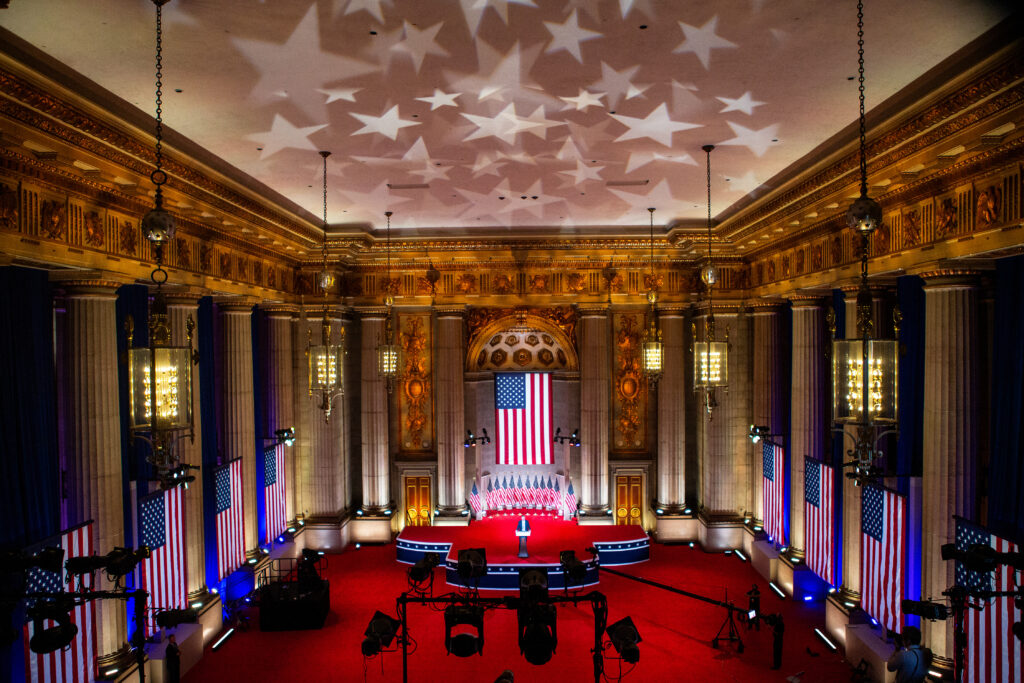
The answer to President Donald Trump’s ballroom dream is less than a mile from the White House. Located on Constitution Avenue across the street from the Smithsonian’s National Museum of American History, the Andrew W. Mellon Auditorium has all the amenities and gold bling Trump could want, and he and his entourage could drive there in minutes.
Completed in 1935, it’s a neoclassical beauty with a temple front featuring six fluted 62-foot Roman Doric columns. Inside, a grand staircase leads to a multipurpose 8,000-square-foot auditorium with a 60-foot ceiling that can function as a ballroom for more than 650 seated guests or as many as 1,000 for a standing reception. And its perimeter is lined by 45-foot-tall Roman Doric columns that support a newly restored, gilded gold frieze that wraps around the entire room.
The building has a storied history. President Harry S. Truman signed the North Atlantic Treaty in the auditorium, establishing the North Atlantic Treaty Organization. And, as it turns out, Trump is no stranger to the building, which hosts both government and private events. He attended an AI summit there in July 2025 and a press event promoting Trump Accounts in January.
The projected price tag for Trump’s ballroom, according to its contractor, is now $600 million, all for a building that would rarely be needed given that presidents have hosted only 32 state dinners since 2001. Why not use a building that has already been built and paid for?
Elliott Negin, Washington
The problem with Trump’s ballroom win
The Sept. 1 editorial “Trump’s narrow ballroom win” said that the Supreme Court’s 5-4 decision allowing President Donald Trump to continue with his demolition of part of the White House “was a conservative decision, not a pro-Trump one.” The editorial also said, “It’s a shame that the separation of powers didn’t work as intended, with Trump and Congress agreeing on what reasonable construction would look like.” But it is hard to see anything “conservative” in this decision or to view it as not being “pro-Trump.”
The five-person majority that allowed Trump to continue with his costly reconstruction of part of the White House —none of it approved by Congress — did so on the grounds that the National Trust for Historic Preservation and its members didn’t have a sufficiently “‘concrete and particularized’ injury” to bring a lawsuit. Therefore, five justices said the lawsuit couldn’t proceed, and Trump could.
All five justices are self-described “originalists.” Yet there is nothing in the Constitution that speaks of the need for a “concrete and particularized injury” or that explains what qualifies one to bring a lawsuit under that standard.
Finally, regarding The Post’s regret that “the separation of powers didn’t work as intended,” it seems to me that it didn’t work because the Supreme Court didn’t do its job and step in to stop unconstitutional executive action. As Chief Justice John G. Roberts Jr. said in his dissent, “Today’s decision is no victory for the separation of powers.” Decisions like this help explain why favorable views of the Supreme Court are near historic lows.
Walter Smith, Washington
Article IV, Section 3, of the Constitution says this about government property: “The Congress shall have power to dispose of and make all needful rules and regulations respecting the territory or other property belonging to the United States.” I see no mention of presidential power or the authority to decide unilaterally what happens to government property — whether the White House, a federally owned golf course or anything else.
Robert Tiller, Silver Spring
My airplane habit isn’t just a quirk
I enjoyed the Aug. 30 online Travel article “Why some passengers touch the plane before boarding.” I’m a frequent flier, and I always place my right hand on the right side of the airplane door when entering a plane. Once a flight attendant even commented on my habit, implying it was a funny eccentricity, but I have a good reason: It is possible to trip when transitioning from jet bridge to the aircraft, and there are rare cases of people falling through the gap between the two.
Touching the plane on entry and exit can be a safety practice similar to running a hand along the handrail of a set of stairs as one ascends or descends. Incidentally, if the jet is wet or dirty, I might not touch it, as much as hover my hand over it, ready in case of emergency.
Stuart Gallant, Belmont, Massachusetts
Letter submissions
Send letters to [email protected].
Submissions must be exclusive to The Post and should include the writer’s address and day and evening telephone numbers. Letters are subject to editing and abridgment. Please do not send letters as attachments. Because of the volume of material we receive, we are unable to acknowledge submissions; writers whose letters are under consideration for publication will be contacted.
The post The answer to Trump’s ballroom dream is less than a mile from the White House appeared first on Washington Post.