Valerie Stivers is a senior editor for UnHerd, from which this article was adapted.
The actress Natalie Portman has always seemed like a person who wants to brand herself as smart and bookish — a trait that appears to have gotten her into trouble, if it is true that she allowed the author Rachel Cusk to write a book about her. Portman has read many Rachel Cusk books. She picked “Parade,” published in 2024, for her Instagram book club in June. In 2022, she hosted a discussion with the writer about Cusk’s 11th novel, “Second Place,” and picked it for the book club as well. Yet no one in her right mind who understood Rachel Cusk’s work would allow the author to write about her — at least, no one with a sense of self-preservation and a public image to protect.
Cusk is brilliant, but her skill has always been at reducing the human to the product of cold existential forces: the violent struggle between men and women; the wounds left by abuse; the emptiness at the heart of identity. In other words, a Cusk book about you is never going to be flattering.
Chatter in New York literary circles this summer said that Cusk’s novel, “Life of M,” which was published Aug. 25, is based on Cusk’s relationship with Portman. The novel is about a famous actress, M, and a nameless writer friend’s project to chronicle her. M’s biography is similar to Portman’s. The actress’s dissatisfaction and betrayal at the finished product, as recorded in the book, is also said to be true to life. If so, it is ironic in the extreme, since the impossibility of identity itself — and thus of anything being “true to life” — is the book’s central theme, a fact that says more about Cusk than it ever could about Portman.
The author character points this out to the angry actress, but to no avail.
Since the book’s publication, anonymous sources close to Portman have denied that she and the writer were ever friends, and Cusk has declined to comment on whether she and Portman discussed the book. One source said Portman finds the book “annoying.”
“Life of M” begins: “A little while ago, I told the actor M that I was thinking of writing her autobiography. She liked the idea. She’s a good sport.” The narrator-author explains that she met M in a bookstore (M is “interested in books”) and that “in addition to being a film star, she was the model for a major brand, and her image looked out everywhere, from shop windows and hoardings and the rain-streaked perspex of bus shelters.”
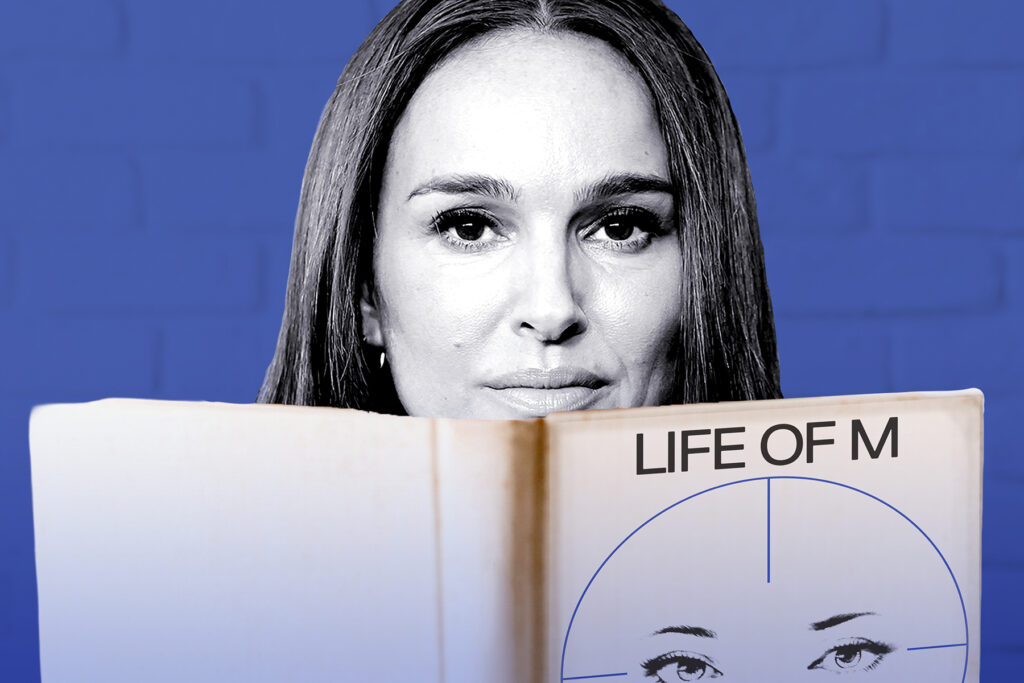
Portman, famously, pulled back from acting to attend Harvard from 1999 to 2003, following her casting in the Star Wars franchise. She runs a book club, and often posts book selfies on Instagram — with a coy eye peeking around the cover of whatever she is reading — so she is clearly “interested in books.” She is a global brand ambassador for Christian Dior and has been the face of the Miss Dior perfume since 2011; she is one of the few actresses whose face still is everywhere. The two characters live in an unnamed European capital with a central river, which could be Paris, where both Cusk and Portman reside.
The narrator tells us, directly after an allusion to a book about a woman who was sexually abused when she was young, that M became famous as a child, and that “the script of her first film originally included several scenes in which the child was shown wanting or inviting sexual interaction with the central male character.” The scenes were cut after M’s mother objected, Cusk writes.
Portman, famously, was catapulted to stardom by her turn in the 1994 Luc Besson film, “Léon: The Professional,” filmed when she was 11 and 12 years old. The movie’s plot is about Portman’s character’s Lolita-like (though unconsummated) relationship with an adult hit man, Léon, played by Jean Reno. Portman’s mother demanded that more explicitly sexual material be cut from the script. Nonetheless, Portman is lavishly sexualized in the movie, and she has called her adult relationship to the film “complicated.” She has also revealed that she was harassed after its success, a traumatizing experience shared by M.
There is more. M claims that the narrator-author has made her “identifiable,” yet filled the book “with things she herself didn’t recognize.” M says the book is full of factual errors. She has not been to the places the author describes or done the things the author says she has. “It isn’t you,” the narrator-author replies. “It isn’t anyone.” The portrait in the book is what anyone could have written, based on M’s publicly available work and biography.
Cusk is a slippery and layered writer, and has long trafficked in the roles and archetypes that plague even ordinary mortals. The exploration of a character who is explicitly playing herself, or is trying to, but has no real self underneath — as she characterizes M’s existence — would naturally be attractive to her. In the author’s cosmology, it is a universal condition of the haute bourgeoisie. And a character whose “self” is an object or commodity also has a rich appeal. Cusk has always seen people as vessels; M’s container is more valuable than most.
The resulting book is a feat, outwardly simpler and more direct than “Parade,” with its multiple plotlines and experimental structure, but also more crystalline and as complex beneath the surface. Cusk is at her best with aphorism and insight, always a strength of her work. For readers who have yet to fall in love with Cusk, this might be the place to start.
It doesn’t hurt that the book also brims with juicy revelations about M’s psychology. It feels like readers are catching a glimpse of Portman. “M had told me that starring in a film as a child had immediately brought her childhood to an end,” the narrator-author recounts. This event, with its undercurrents of sexual abuse, is primal violence of a kind the author also believes she has suffered, a violence that detaches both women from reality and their own identities. It becomes the actress’s healing quest “not to create, but to try to make her life seem more normal.” M occasionally picks up her children from school in the nanny’s stead; she goes to parties and talks to non-famous people; she reads the news, as if it will teach her how to be human.
M wants to be real, but for her “there was nowhere to go back to. There was no dream country where the original self might one day be found.”
To anyone other than Cusk, it might seem cruel to dash M’s dreams of normality and selfhood. But a darker, more fascinating portrait of celebrity emerges, in which M is both victim and perpetrator. She lives in a cold, palatial house that is “like a big doll’s house, with her as a doll inside it.” She attends meetings in gloriously expensive rooms, takes vacations in equally luxurious faux farmhouses and goes to a spa that is a “stern and celestial oasis in the sky.” Everywhere doors are magically opened for her, conveniences are arranged, and she is served by people with “specialized roles” there “to do M’s bidding.” Cusk’s penchant for satire of this nature — especially the embedded satire of the movie star with pretensions to reading — seems not to have pleased the real-life Portman.
And M wants to live this way. She is secretly irritated when ugliness and inconvenience intrude. When a visiting relative is hit by a car, and M has to supervise the recovery, it is not an opportunity for compassion and connection, but “an episode of primal confusion.” She finds listening to friends talk about themselves in cafes a little challenging, and so on. Still, the reader feels sorry for her, as the extent of her alienation sinks in.
It is one of Cusk’s regular narrative innovations to include in her works sections told in a choral “we” voice. Here, the “we” may represent the narrator and other writers, but it also may speak for herself and M, the pair of friends. In one of these sections, the narrator speculates that “we” have lost the capacity to love — something about “our” separation from reality prevents it. In a beautiful, terrifying passage, she writes about “our” longest love relationship, which ended in a “meticulous and detailed” hatred that appeared “to form a total condemnation of our character. … The hate felt like the stone or the pit that was left when all the fruit of love had been eaten.”
Cusk tends to land in such places: hatred, somehow, instead of love. The cold intellectualism with which she approaches the human seems to naturally produce this result. As an artist, she has never spared herself the bitter fruit of her own creation — including in several memoirs. M should not have expected anything else from the narrator. And if the result of the two women’s friendship is a very strong Cusk book indeed, everyone should be happy — including, if her art appreciation is real, Natalie Portman.
The post This novel may or may not be about Natalie Portman. Does it matter? appeared first on Washington Post.