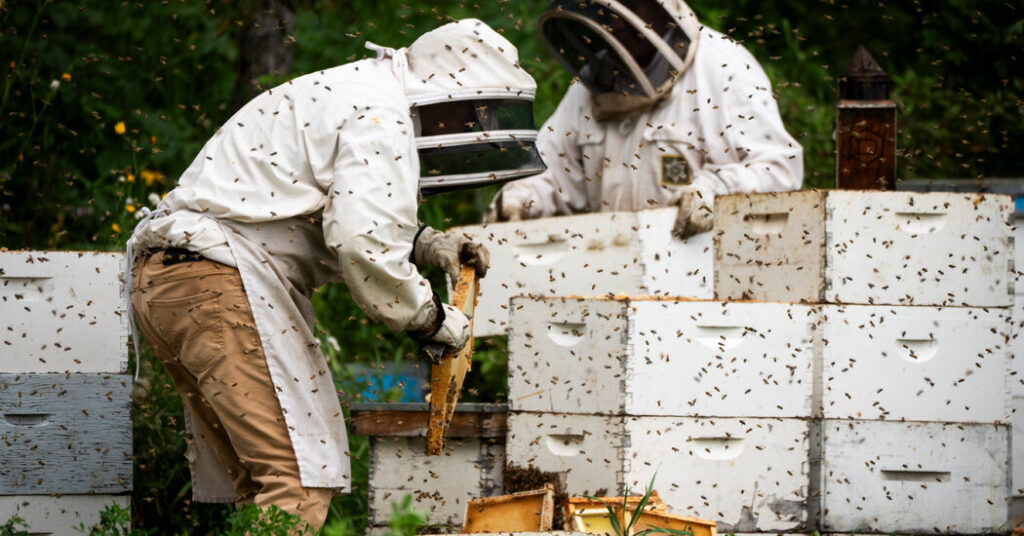
In central Alberta, where the heaviest rains in over a century kept worker bees inactive for much of the summer, Mike deJong, a beekeeper, was already facing a bleak honey harvest.
Then President Trump imposed 50 percent tariffs on honey and hundreds of other Canadian products.
The tariffs took effect after trade negotiations between the two countries collapsed on Aug. 21. Mr. Trump said the move punishes Canada for discriminating against U.S. exports.
“This year humbled me,” said Mr. deJong, the owner of Busy Bee Farm Ltd., which, at 20,000 hives, is one of the largest operations in central Alberta. The province produces 40 percent of Canadian honey.
Walking briskly around his sprawling honey house, Mr. deJong gestures to machinery, steel drums, wooden boxes and other supplies that, ordinarily purchased from American suppliers, will now cost farmers more at checkout on Tuesday — because Canada plans to retaliate with tariffs of up to 50 percent on hundreds of American exports.
While far from Canada’s most significant agricultural commodity — it represented roughly $175 million in production value last year — the honey industry and its 16,300 beekeepers are foundational to farming. Beehives are contracted out to pollinate fields of alfalfa, clover and the multibillion-dollar canola crop. The sector also illustrates how the trade war is playing out on the ground, far from Ottawa and Washington.
About 70 percent of the honey Canada has exported this year went to the United States. Yet of all the honey that the United States imports, only 2 percent comes from Canada, making it a puzzling target, beekeepers say, by the Trump administration.
The trade upheaval has left beekeepers scrambling at the end of a difficult harvest, when they would normally be selling honey and hauling barrels of it across the border. Rural communities are enduring pain acute enough that some farmers are questioning Prime Minister Mark Carney’s handling of the negotiations.
“At the last minute, they blew the whole deal up,” said Ron Greidanus, the owner of Greidanus Honeybee Farm in Stettler, Alberta. “And we are the sacrificial pawn.”
Mr. Greidanus pulled his white flatbed truck into his farm on Thursday evening after an eight-hour drive from Polson, Mont. He had crossed the border with $32,500 worth of pine for hive frames, which would soon be subject to a 25 percent Canadian tariff and would have cost him about $8,100 more.
Rain fell outside as Mr. Greidanus’s teenage son and another worker offloaded the wood, enough to keep his staff building frames for about two months over the winter. The weather inspired a metaphor: that each small farming business is a raindrop that, when collected together, has an amplified effect.
“My business, it’s just a raindrop. But it matters to Pablo, it matters to Tanya, it matters to Tony,” said Mr. Greidanus, listing his staff, most of whom are seasonal foreign workers, and the local businesses that depend on his patronage. He plans to visit the United Arab Emirates this fall to explore new markets, though he has accepted that no one can replace the United States as a prime customer given its proximity.
The economic pain from tariffs is especially personal in small Canadian towns like Warburg, a village of about 700 people southwest of Edmonton surrounded by endless canola fields and cattle ranches — the kind of place where Wild Hive, a local beeswax candle maker, has its name etched in the ice at the curling rink and on a sign at the hockey arena.
“When you live in a small town, that’s all you got,” said Candice Prins, Wild Hive’s owner, surrounded in her garage studio by fragrant tapered candles, each hand-dipped, the traditional way, 16 times in hot beeswax.
Ms. Prins quit her job last year as an agricultural inspector specializing in honeybees as her wholesale business took off, with American buyers accounting for 40 percent of sales and allowing her to hire three women from town. Since the most recent tariffs began, she has had only one sale from the United States.
“We can’t give back or do as much for our community, which was kind of the goal when I started,” she said.
Ms. Prins buys most of her beeswax from Good Morning Honey, a short drive north in Parkland County, Alberta. Its owner, Richard Ozero, has been diversifying his farm to offer retail products like honeycomb and bee pollen, while exporting about 20 percent of his honey south.
“We’re not eating their lunch, we’re not affecting their bottom line, so I don’t know how beekeeping got thrown into the cage here in this trade dispute,” Mr. Ozero said from behind the wheel of his pickup, on the way to visit his hives in a nearby hay field. “It kind of came out of nowhere.”
Margins to absorb a 50 percent price increase are not built into the system, said Mr. Ozero, who likened the tariffs to closing the border. It has made preparing for the winter a challenge farmers cannot simply postpone.
“The bees aren’t going to say, ‘OK, just call us when you’re ready,’” Mr. Ozero said.
Consumers can also bear consequences of the trade spat beyond price fluctuations, industry experts warn, because honey is one of the most adulterated food products in the world.
Fake honey, made with rice syrups, made up about 22 percent of imported samples tested in Canada last year, according to the national food inspection agency, while domestic honey tested 100 percent authentic.
Canada exports more honey than it imports, but one byproduct of the trade war is that the two countries, which normally cooperate to protect the integrity of their honey supply, are now at odds. The clash could open the door to more fake honey entering the market, said Rod Scarlett, the executive director of the Canadian Honey Council.
Canada also relies on states like California and Hawaii, which, because of their warmer climate, are leading producers of the queen bees necessary for laying thousands of eggs and keeping colonies populated.
Canada imports about 300,000 queen bees annually, 85 percent of them from the United States, according to federal data. The bees themselves are not subject to tariffs, but reliance on American suppliers is another source of unease as beekeepers plan for winter and beyond.
“Canadian and American farmers have spent generations building a continental food system,” Mr. Ozero said. “You can disrupt that system with a tariff overnight, but rebuilding those relationships could take years.”
The post A Bad Year for Bees Gets Worse as Trump’s Tariffs Hit Canada’s Honey Belt appeared first on New York Times.