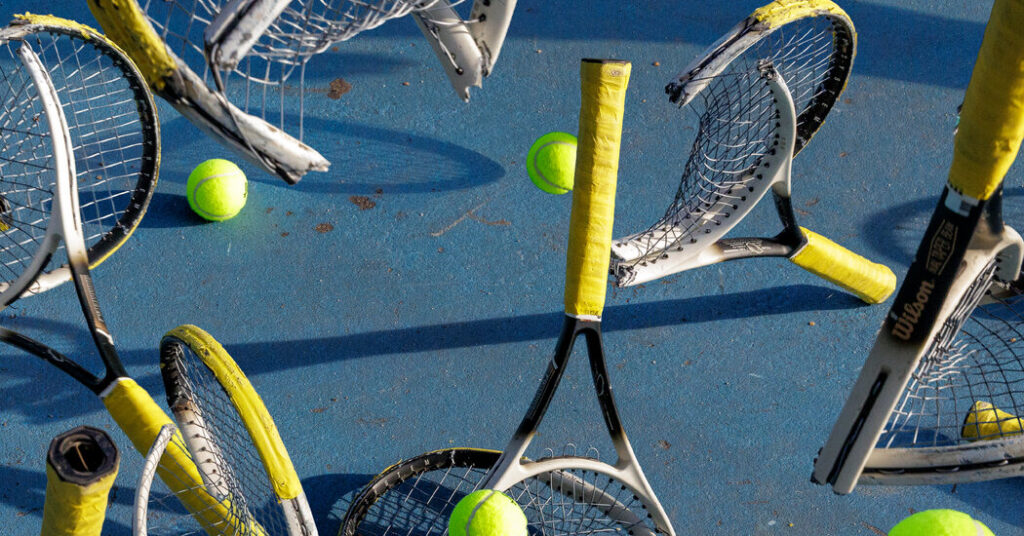
There’s a longstanding perception that tennis is snobbish and genteel, a country club activity that allows cheering only at appropriate moments. After all, it was a pastime for Victorian gentlemen and ladies who wore white because the color best masked sweat, an impolite fluid. But tennis is not a prissy sport to play or watch. It’s individuals locked in a solitary battle, enduring an often hidden psychological drama. Nothing makes that drama more visible than a smashed racket.
As a casual, mediocre tennis player, even I get angry with double faulting. I’ll loosen my grip, straighten my toss and really pronate my wrist. When the ball still hits the net, I want to break my stupid, incompetent racket into pieces. Unfortunately, I physically cannot because I’m a weakling. The pros make it look so easy.
Technically, racket smashing is not allowed in professional tennis. Per the Association of Tennis Professionals’ racket abuse rule, “players shall not violently, dangerously or with anger hit, kick or throw a racquet or other equipment within the precincts of the tournament site.” Though the rule is not always enforced, it can result in a code violation (which accumulates into point and game penalties) and a fine. Despite the rule, rackets are thrown and destroyed at many professional tennis tournaments. This year, 81 racket abuse violations were issued on just the men’s side before the U.S. Open began.
My favorite current players are Daniil Medvedev, Andrey Rublev and Alexander Bublik. Their games are frustratingly inconsistent, but they are the three foremost racket smashers on tour.
Medvedev is persistent, banging his rackets over and over, maybe eight, nine or 10 times, until they no longer resemble rackets. Rublev often uses his body, hitting his rackets against his knees, feet and head, sometimes drawing blood. One time, Bublik demolished three in a row, hammering one into the ground until it shattered, then moving on to the next. Their matches are pure pathos, like watching telenovelas.
Marat Safin is the indisputable GOAT of racket smashing. The charismatic Russian, who retired in 2009 at just 29, said he broke 1,055 rackets over his 13-year career. He’s impressive not just for his volume, but also for his range: He’s smashed a racket against a chair, breaking both the racket and the chair; bounced them like basketballs; flung them at the net; and even obliterated one in front of Boris Yeltsin. It’s an impressive physical feat. You try breaking a racket with one hand, in one throw.
Aside from Rafael Nadal, just about every great tennis player has wrecked a racket. John McEnroe broke one against a courtside pot of geraniums, while Andre Agassi has stomped on his. In 2000, Goran Ivanisevic had to withdraw from a match because he smashed three, leaving him none to play with. Novak Djokovic has demolished untold numbers of rackets, often by drumming them into the ground until the frames splinter. Even Roger Federer, the always gracious gentleman of tennis, once destroyed a racket. It’s less common on the women’s side, though Serena Williams is fond of breaking hers with a single, strong thwack. Aryna Sabalenka, currently the top-ranked woman, often pounds her racket against the court.
According to Jason Stacy, Sabalenka’s performance coach, a smash can be a “release” for a player: “If they have that boom, and then they reset and get back on track — that was them giving the moment what it needed.”
The racket abuse rule goes back to the 1970s. Before that, tennis’s biggest, most prestigious tournaments, the Grand Slams, were exclusively for amateur players, while the pros were relegated to an alternative, less visible circuit. (This divide protected the “genteel athlete from contact with his social inferiors,” as The New York Times put it in 1967.) Then, in 1968, Grand Slams were opened to professionals, and the “open era” of tennis began.
As tennis tournaments became more professional in the ’70s and ’80s, landing big sponsors and big network TV deals, the game became much more entertaining — and far less genteel. The Romanian Ilie (Nasty) Nastase smacked balls at linesmen and flipped off spectators. Playing a match in London, he and Jimmy Connors brought a bottle of champagne to drink during the game. Connors called an umpire an “abortion” and once hopped over the net to wag a finger in the face of his opponent, McEnroe, who responded by shoving him. McEnroe, a proficient racket smasher, is better known for his verbal havoc, like calling a Wimbledon umpire an “incompetent fool, an offense against the world.” Tennis traditionalists were none too pleased.
Despite, or probably because of this, tennis was becoming more popular than ever.
Prompted particularly by the antics of Nastase, the International Professional Tennis Council created a “code of conduct” in 1975 that established rules for on-court behavior and imposed consequences for breaking them. It set a fine for racket throwing. The rules were slow to work, in part because many linesmen and umpires were unpaid volunteers and lacked enough authority to check the sport’s best players. It took until the ’90s, with the likes of Jim Courier and Pete Sampras, for the biggest players to come to heel.
Two very well-mannered boys, Jannik Sinner and Carlos Alcaraz, currently dominate the sport. When they lose to each other, they hug, then congratulate each other on Instagram. It’s a pleasure to see them play tennis so ludicrously well. But I also want to feel the intensity when players lose.
Tennis officials now have unquestionable authority to punish players for misbehaving. In 2019, Nick Kyrgios racked up $113,000 in fines in a single match for calling the umpire a “tool,” leaving the court to destroy two rackets and spitting toward the umpire, among other antics. Kyrgios makes a good case for the obsolescence of the racket abuse rule. His most egregious on-court displays were about disrespecting umpires and opponents. The code violations and fines were doled out for “unsportsmanlike conduct.” The extreme, actually disruptive outbursts fall under that other category and can be punished as such.
In my mind, the only issue with throwing a racket is that it might accidentally hit a ball kid or someone in the crowd. Avoiding that requires just a bit of prudence. A good option is the Stan Wawrinka way, snapping it in half over the knee. Or, as the champion racket smasher Andy Roddick once explained in a video tutorial, “throw it face down” so “it doesn’t go anywhere.” Generally, racket smashing is far safer than a similarly punished sin, “ball abuse.” Angrily smacking a tennis ball is likelier to inadvertently hurt someone — just ask Djokovic, who was disqualified from the 2020 U.S. Open after hitting a ball at the advertising board, but instead, accidentally banging a line judge in the throat.
I’m surprised that professional players don’t break more rackets. Show us all just how enraging it is to hit a perfect backhand and still lose the point! The worst a carefully smashed racket will do is dent the court.
Jensen Davis is the features editor at W Magazine.
The Times is committed to publishing a diversity of letters to the editor. We’d like to hear what you think about this or any of our articles. Here are some tips. And here’s our email: [email protected].
Follow the New York Times Opinion section on Facebook, Instagram, TikTok, Bluesky, WhatsApp and Threads.
The post Let Tennis Players Smash Their Rackets appeared first on New York Times.