TOWER HILL: A Plantation on the Edge of Rebellion, by Alan Taylor
In 1902, a world-weary U.S. Army captain named William Nivison Blow Jr. achieved his dream of securing full ownership of his family’s long-neglected plantation in southeastern Virginia. Averse to “the new order of things,” as he wrote to a cousin, he wanted to revive the dying art of living like a Southern gentleman.
Eager for future generations to feel “pride & love” for the family’s history, he spent years combing through a massive, messy stack of papers strewed across the floor of an old granary. The captain tried his best to spin a handsome yarn from unlovely materials: Among records of bad harvests and staggering debts there were scores of ledgers and letters detailing the buying and selling of people as property and their resistance against bondage. In his unpublished account of life on the plantation, the captain, professing to care about accuracy, nonetheless passed on popular canards about the loyalty of the enslaved. “If you can’t find traditions,” he told his cousin, “make them.”
In “Tower Hill,” a rich and compelling new study of the Blow plantation, the historian Alan Taylor endeavors to separate tradition from the truth. Digging through the family archive, now housed at the College of William and Mary, Taylor finds that bondage immiserated the enslavers along with the enslaved. Despite their self-comforting prattle about the benevolence of the peculiar institution, the Blows knew they lived in a world based on violence, plunder, lies and contradiction, and feared it would come to a sudden, apocalyptic end. In 1831, it nearly did, when the most formidable revolt against slavery in American history broke out just a few miles from Tower Hill.
The story begins with Richard Blow, an old-school Southern patriarch who made his fortune during the American Revolution by using the murky coastline of the Tidewater region to run crops and goods past a British blockade. Based in Portsmouth, on the Virginia coast, Blow dabbled briefly and unsuccessfully in the African slave trade before becoming the president of a local bank. Tower Hill was his moderately profitable country retreat.
Much of the book revolves around the “long and tangled relationship” between Richard and his only son, George, as glimpsed through letters the two exchanged over four decades. Born in 1787, the year the U.S. Constitution was signed, George Blow died five years after the end of the Civil War.
These earlier Blows had even more need for willful self-delusion than their starry-eyed descendants, and Taylor, a two-time winner of the Pulitzer Prize, attends carefully to the bewildering mix of high-minded sympathy and chilling cruelty that churned inside American slave owners. “I really believe (humanity apart) it is the most profitable business of the Farmer to raise young Negroes,” George Blow wrote to an overseer in 1839, ordering him not to send pregnant or nursing women into the fields. A man who was perfectly willing to separate parents from children and use bloodhounds to track down runaways, Blow nevertheless saw himself as enlightened. In 1830, he told another overseer to engage only in “moderate whipping,” because the enslaved, “after all, are fellow beings, and have no other protectors than their owners.”
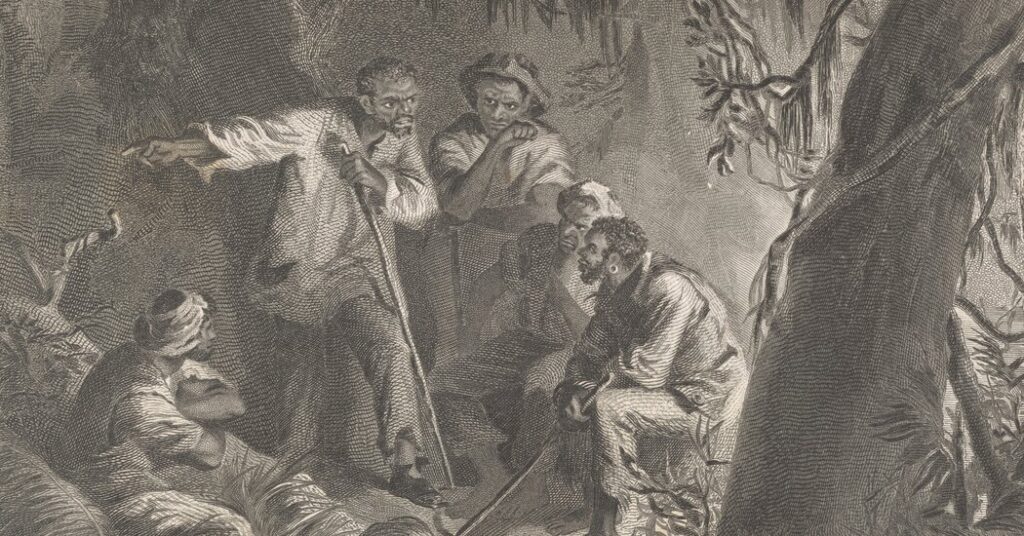
Beneath this shallow paternalism lay the constant, unspoken dread of an uprising. The long-feared reckoning came on the third Sunday of August 1831. Nat Turner, an enslaved man in neighboring Southampton County who read the Bible and celestial signs as evidence that God had appointed him to end the reign of evil, led a revolt that over two days killed 64 white Virginians (including relatives of the Blows) before the state militia put the rebellion down. More than 100 Black people were lynched in reprisal.
For a moment, slavery seemed too dangerous to sustain. Virginia’s leaders even debated easing it out of existence. But then a more comforting theory took hold: If the insurrection had been the work of only a few misguided malcontents, the system itself was secure.
That notion was untrue, Taylor argues, citing evidence that support for violent resistance in that hard-up corner of the Old Dominion was more widespread than the masters wanted to admit. A larger attack against slavery may have been brewing across the state (and possibly into North Carolina), slated for the fourth Sunday of August. Turner may simply have “jumped the gun.”
The Blows, moreover, had every reason to know the story was bunk. After the revolt, they considered leaving for “a new Country,” as one relative put it, “not cursed as ours is with slavery.” Curiously, George Blow’s letters from the weeks after the revolt are missing from the family archive.
Over the last decade Taylor has published, among other significant works, a series of sweeping narratives relating the “continental” history of the United States, from the founding of the Colonies through the Civil War. These long, busy books have been praised for their staggering breadth, their commanding synthesis of recent scholarship and their engaging storytelling. No living historian has done more to expand our appreciation for the beguiling strangeness, as well as the unsettling familiarity, of the early American Republic.
Narrower in scope, “Tower Hill” reads like a nonfiction version of William Faulkner’s “Absalom, Absalom!,” the multigenerational high-modernist epic published in 1936 that supplies two of Taylor’s chapter epigraphs.
All the familiar themes are here: race, madness, violence, illness, shame, strife, illusion, tradition, myth, inheritance. Some lines even read as if they were ripped from the novel. A cousin of George Blow’s wife, having seen his family murdered in front of him during the Turner uprising, is described by one acquaintance as “now raving distracted — he goes about saying how they killed them!! And then shakes his sides and laughs!!!”
Faulkner’s work often explored how the lies we tell about the past make it possible to live in the present, while wrecking any chance we might have of living fully human and humane lives in the future. Taylor echoes this insight in his account of the Blows. They knew slavery was morally wrong and dangerously unstable, but repressing that knowledge seemed easier than addressing it. Monstrous cruelty became a “tradition” worth loving.
The effects of this moral decrepitude reverberated through time. A quietly devastating epilogue brings the story of the scarred landscape around Tower Hill up to the present. The plantation, now in private hands, serves as a “microcosm” of all those places shaped by slavery, Taylor writes. Years of mercilessly exploiting nature, human and otherwise, drained nutrients from the area’s soil. Now only scrubby pines can grow there. Old plantations have been sold off to lumber companies and hog farms that abuse the land as ruthlessly as the planters did. The largest employer in the county, Taylor notes, is a pair of state prisons.
TOWER HILL: A Plantation on the Edge of Rebellion | By Alan Taylor | Norton | 324 pp. | $35
The post Piercing the Delusions of a ‘Humane’ Plantation appeared first on New York Times.