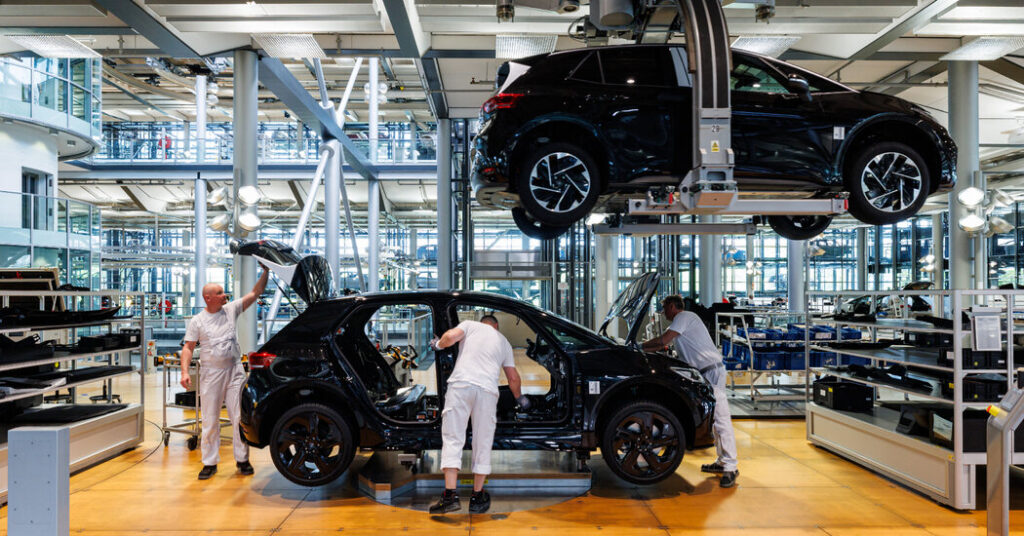
Volkswagen has won support from its unions to carry out the most sweeping overhaul in the German automaker’s 89-year history. But the biggest tests for the company and its chief executive, Oliver Blume, lie ahead.
After surprising investors this week with an agreement to cut about 50,000 additional jobs, Mr. Blume needs to put his plan into action, reducing costs that he estimates are 30 percent higher than those of rivals and slashing production capacity by more than 500,000 vehicles a year.
The labor deal “gives Volkswagen some breathing space, but essentially the problem is merely being postponed,” said Matthias Schmidt, an auto industry analyst in Germany.
Volkswagen must confront an array of challenges, from intensifying Chinese competition to U.S. tariffs, that have eroded its profit margins and threatened its survival. The deal has spurred hope that the iconic German company, and the country’s ailing industrial sector more broadly, can overcome those obstacles, while also underscoring the pain that companies and their employees are likely to endure as businesses become leaner and less complex.
Volkswagen’s shares gained nearly 6 percent on Friday, the biggest daily gain in nearly nine months. Even so, the company has lost about a quarter of its value this year.
The plan would bring total job cuts to about 100,000 by 2030, or 15 percent of the company’s global work force. It would also cut in half the number of Volkswagen models and reduce production to nine million cars a year, compared with a target of 12 million before the Covid-19 pandemic. Many of the details, including the fate of four German factories, remain unsettled.
The company has said those plants in Emden, Hanover, Zwickau and Neckarsulm don’t have a clear future beyond 2030. Still, there could be ways to avoid shutting factories, potentially by converting them for use by the defense industry as Germany ramps up spending to deter Russia’s military threat. Mr. Blume has said talks with defense companies are underway.
Such steps are unlikely to offset Volkswagen’s declines.
“People forget how big the car industry is,” said Harald Hendrikse, a managing director at Citi Research. “The chance of saving all of these jobs and all of this capacity with the defense industry is zero.”
Other options include selling its cars developed in China to the European market, or sharing capacity in Europe with Chinese partners.
After decades of growth in China, the world’s largest car market, Volkswagen’s sales in the country have plunged as Chinese companies have raced ahead in the shift to electric cars. The company also faces fierce competition from Chinese rivals at home. In the United States, the government has effectively banned cars made by Chinese companies with very high tariffs and other restrictions, but the company has still struggled in that market.
China’s “rapid rise really caught foreign automakers off guard, and it especially caught the German automakers off guard,” said Jacob Gunter, a China specialist at the Mercator Institute for China Studies.
Cheaper imports from China are fueling calls for tougher measures to counter what businesses see as unfair competition. Encouraged by government subsidies, Chinese carmakers began focusing on electric vehicles years ago and making investments that have allowed them to take advantage of brisk demand for such models. About one in five new vehicles sold in Europe is electric.
In Germany, more than half of companies support stronger European Union measures to address “distortions of competition,” even if they face higher prices, tariffs or Chinese retaliation, according to a survey published this week by the German Chamber of Commerce and Industry.
If the current policy environment remains unchanged, Chinese carmakers could triple their share of the European auto market to as much as 30 percent by 2035, said Mr. Hendrikse, the Citi analyst. A more aggressive stance toward Beijing could slow China’s advance, albeit modestly. Extending tariffs on Chinese electric vehicles to plug-in hybrids could limit China’s market share to about 25 percent, he estimated.
“It gives Volkswagen more time to deal with these factories,” he said. “If we don’t protect the European profit pool, these companies simply won’t be here.”
In a bid to improve European competitiveness and take on China, Volkswagen’s deal could provide a blueprint to other companies. Investors had doubted the company would be able to pull off a labor deal, setting off speculation that the management team might try to bypass the supervisory board and go directly to investors through an emergency shareholders meeting.
Workers at Volkswagen, as is the case for the German carmakers Mercedes-Benz and BMW, hold half the 20 seats on the supervisory board. Shareholders also have 10 seats. But at Volkswagen, two shareholder seats are held by the State of Lower Saxony, which owns 20 percent of the company’s voting stock.
“The market debate was never about whether Volkswagen had challenges,” analysts at Deutsche Bank wrote in a note Friday. “It was about whether those challenges could realistically be addressed within Volkswagen’s complex governance structure. Last night’s agreement does not end that debate, but it provides the strongest evidence yet that the answer may be yes.”
The post Will a Turnaround Plan Revive Volkswagen or Merely Delay Its Demise? appeared first on New York Times.